
How Semrush Can Transform Your Social Media Strategy
How Semrush Can Transform Your Social Media Strategy
Introduction: The Modern Social Media Challenge
In today’s hyper-connected digital landscape, social media management has evolved far beyond the occasional status update. For marketing teams, agencies, and enterprise brands, the challenge lies in navigating a fragmented ecosystem of platforms, LinkedIn, Instagram, X (formerly Twitter), Facebook, TikTok, Pinterest, and YouTube, each with its own distinct algorithms, audience expectations, and performance indicators. Without a unified strategy, brands risk shouting into a void, wasting resources on content that fails to resonate or convert.
This is where social media analytics becomes the bridge between activity and impact. Analytics is the rigorous process of gathering and analyzing data across social networks to extract actionable insights into campaign performance. By leveraging data from major networks, marketers can move past vanity metrics to improve genuine audience engagement and drive meaningful conversions.
The Semrush Social Toolkit stands as the definitive answer to this complexity. It is a comprehensive, AI-powered command center designed to automate end-to-end workflows, from initial ideation to stakeholder reporting. Whether used as a standalone solution or integrated with Semrush’s industry-leading SEO and Advertising toolkits, it enables brands to replace manual, repetitive tasks with strategic automation, ensuring every post contributes directly to the bottom line and increases overall ROI.
The Strategic Importance of Social Media Analytics
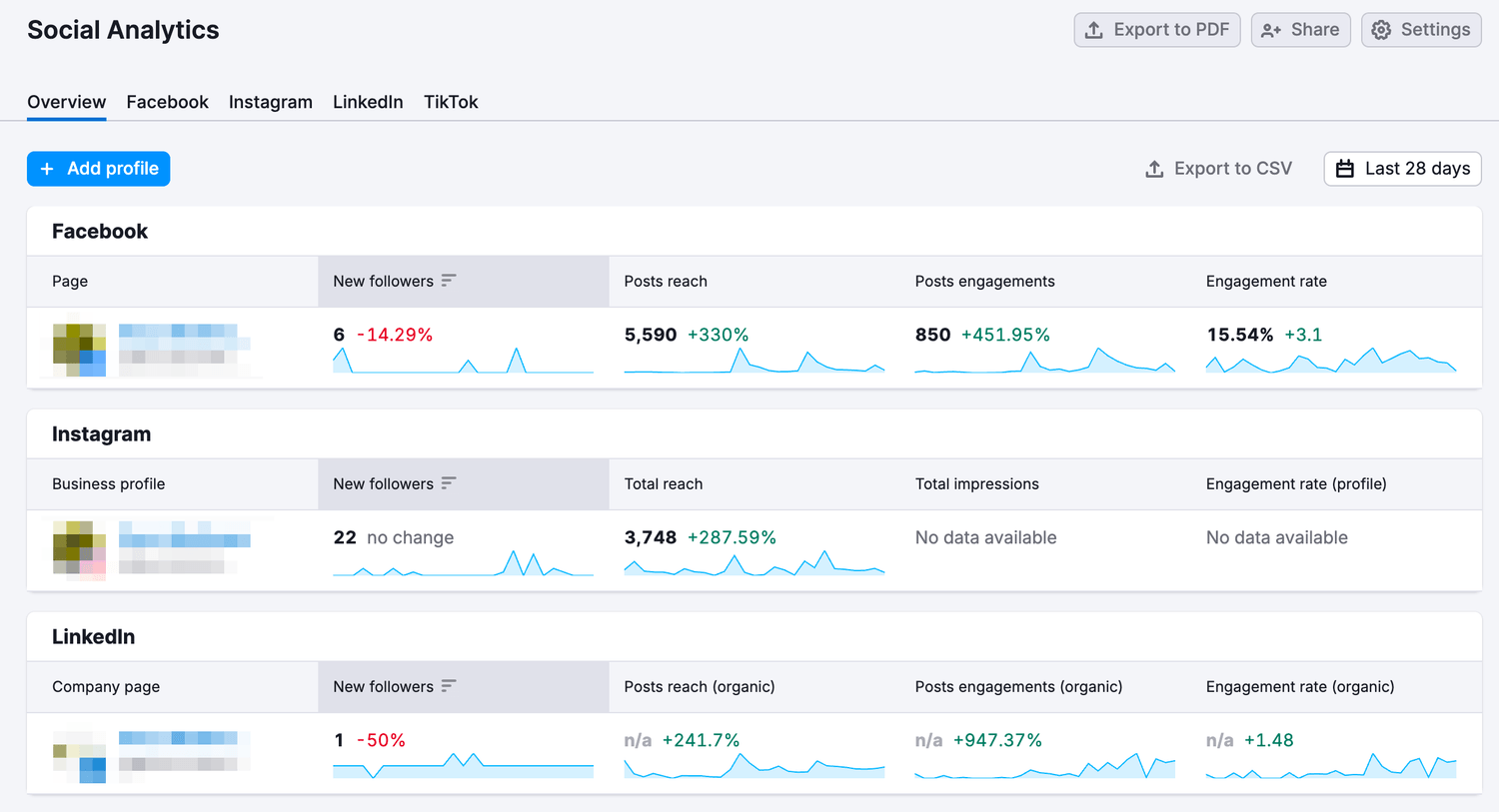
For a senior strategist, tracking analytics is not a checkbox exercise; it is the foundation of a data-backed marketing culture. Without these insights, a brand is operating on intuition, a high-risk approach in a competitive market.
Understanding the Results: The Three Pillars of Metrics
To measure the effectiveness of a social strategy, one must synthesize data into three primary categories that align with the marketing funnel:
Engagement: This pillar tracks how your audience interacts with your brand. Key metrics include likes, follows, comments, and shares. Strategically, if your goal is community building, engagement metrics reveal which specific post types are fostering loyalty and bringing new users to your page.
Awareness: These metrics define your current and potential audience footprint. By analyzing profile impressions and post reach, you can gauge the total volume of eyeballs on your brand, which is essential for top-of-funnel growth.
Conversion: This is the ultimate proof of value. Conversion metrics provide insights into which content successfully generates leads and turns audience members into paying customers.
Making Data-Driven Decisions
Advanced analytics allow you to look deep into your performance to determine exactly what is working and what is not. This real-time visibility enables marketers to spot emerging trends early and pivot strategies before resources are wasted. By establishing and monitoring performance Key Performance Indicators (KPIs), businesses can significantly reduce operational risks and ensure that content production responds to the actual needs of the market.
Optimization of Efforts
Optimization is an iterative process of refinement. To achieve a high-performing workflow, specialists must:
Define Clear Goals: Whether the objective is brand awareness, lead generation, or driving traffic to a specific landing page, the goal dictates the data focus.
Align KPIs: Metrics such as engagement rate, clickthrough rate (CTR), and impressions must be directly tied to the defined campaign goals.
Continuous Improvement: By comparing past performance against current results and benchmarking against competitors, teams can identify specific friction points and improve accordingly.
Knowing Your Audience: The Key to Personalization
The path to high conversion rates lies in personalization. Analytics reveal the "who" behind the clicks, providing a granular view of audience demographics, including age, geographic location, interests, and language.
Tailoring Content Through Demographic Insights
Understanding your audience allows you to craft messages that resonate on a personal level. For example, if your analytics indicate a primary audience of Millennials, your content strategy must adapt to their specific consumption habits. Source data suggests that this demographic favors content that is:
Authentic: They prioritize transparency over high-gloss, traditional advertising.
Story-Driven: Narrative-focused content that feels human and relatable.
Video-Heavy: Visually compelling, short-form video that captures attention in a crowded feed.
Perception and Reputation Management
Beyond basic demographics, analytics help track online behaviors and brand perception. By understanding how users perceive your brand, you can identify growth opportunities, manage your reputation proactively, and enhance the ROI of every interaction. This level of insight ensures the right message reaches the right person at the optimal moment.
👇 The Social Pulse Playbook Download Your Copy 👇
Decoding the Types of Social Media Analytics
To build a 360-degree view of your brand’s impact, you must utilize several analytical lenses. The Semrush ecosystem facilitates a multi-layered approach to data.
Tracking Your Own Performance
This involves a dual-track analysis of both organic and paid performance.
Organic Performance: Measures the inherent quality and "stickiness" of your content without sponsored boosting.
Paid Ads Performance: Evaluates the effectiveness of your financial investment in sponsored content. By monitoring metrics like impressions, reach, likes, comments, shares, views, clicks, and total sales, you can determine if your current output is meeting benchmarks or if a strategic shift is required.
Competitive Analysis
To set ambitious yet realistic goals, you must understand the competitive landscape. Competitive analysis allows you to detect rival strengths and weaknesses. Essential metrics to monitor include:
Follower growth and total count.
Active audience size and engagement rates.
Content formats and posting frequency.
Customer sentiment regarding the competitor’s brand.
Social Listening vs. Sentiment Analysis
While complementary, these two disciplines serve different strategic purposes:
Social Listening: This is the active monitoring of conversations about your brand and industry. It is a vital tool for spotting potential brand influencers, improving customer service, and identifying unmet customer needs.
Sentiment Analysis: Utilizing advanced algorithms and natural language processing (NLP), sentiment analysis gauges the emotions behind social interactions. This allows you to quantify public perception and react to customer feedback with precision.
Influencer Performance
In a modern workflow, influencers bridge the gap between brands and consumers. Tracking influencer performance, specifically their reach, engagement, and conversion impact, is critical for evaluating the ROI of collaborations and making well-informed decisions regarding future partnerships.
Industry Benchmarking
Benchmarking involves measuring your brand's performance against industry averages. By comparing metrics like reach, follower growth, and post frequency against the "best-in-class" in your niche, you can set realistic KPIs and drive better strategic outcomes.
Platform-Specific Insights: From Facebook to YouTube
Each social network offers a unique data set. Optimization requires a deep dive into platform-specific analytics.
Facebook: Utilizing Facebook Insights and Meta Business Suite, marketers can track deep audience demographics, post-level engagement, and detailed ad performance, including impressions and reach.
Instagram: Focuses heavily on visual engagement. Critical metrics include story views, profile visits, and follower growth trends to help tailor content for maximum impact.
LinkedIn: The premier B2B platform. Analytics here focus on visitor demographics (such as job functions), professional engagement rates, and lead conversions, allowing for the refinement of networking strategies.
X (formerly Twitter): Provides real-time data on tweet performance and audience engagement, facilitating rapid content iteration.
TikTok: Offers essential data on video views, trending content, and engagement rates, which are crucial for brands looking to leverage viral marketing.
YouTube: Provides deep-dive metrics, including watch time and audience retention, which are vital for optimizing long-form video content and improving search visibility.
The Semrush Social Toolkit: An Integrated Command Center
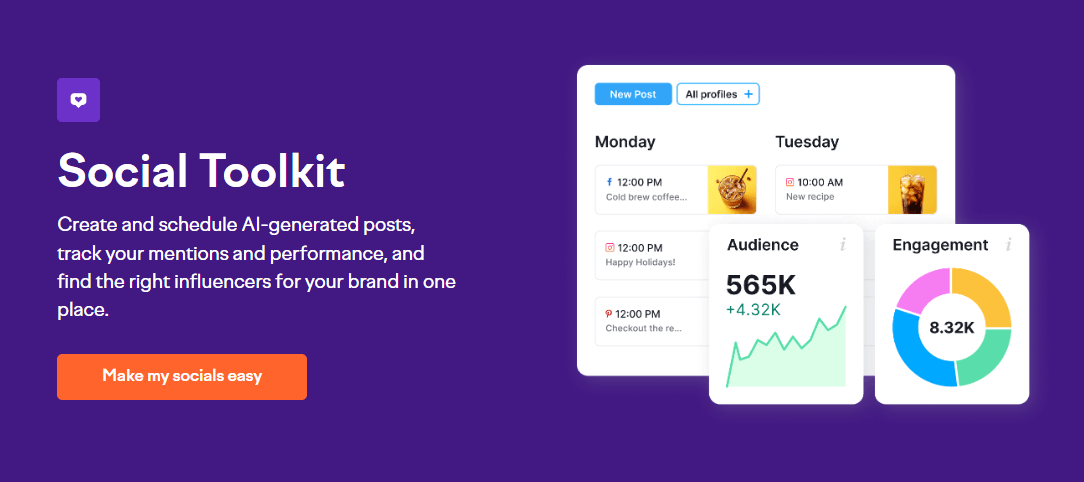
The Semrush Social Toolkit is an interconnected suite of 8 specialized tools designed to unify the disparate threads of social media management. It is built for small business owners, in-house managers, and agencies alike who need to automate their end-to-end social media workflow.
The toolkit can be used as a standalone solution or alongside Semrush’s SEO, Content, and Advertising toolkits, allowing for a fully aligned cross-channel strategy.
The Social Dashboard: Your Helicopter View
The entry point for any high-level strategy is the Social Dashboard. This provides a real-time, comprehensive view of all connected accounts.
From here, you can:
Monitor audience growth across all platforms.
Track content performance at a glance.
Receive AI-generated recommendations on where to focus your resources next. It serves as the strategic command center, allowing you to track progress before diving into tactical planning.
Streamlining Content Production with AI
In a high-stakes marketing environment, the bottleneck is often content production. The toolkit removes this friction through Social Content AI and the Social Poster.
Social Content AI
This tool transforms the creative process from manual ideation to full-post generation. By using AI, teams can generate:
Ready-to-use post ideas and captions.
On-brand visuals and design templates.
High-performing hashtag recommendations.
Automated editing and proofreading to ensure brand consistency.
Social Poster
Once the content is generated, the Social Poster provides a single interactive calendar to schedule and publish across Facebook, X, Instagram, TikTok, Pinterest, LinkedIn, YouTube, and Google Business Profile.
It includes essential productivity features:
Image Editor: For on-the-fly visual adjustments.
UTM-Builder: To ensure every link is tracked for accurate attribution.
Link Shortener: To maintain professional post aesthetics.
RSS Feed Integration: Share content from your favorite blogs with a single click, keeping your feed active with minimal effort.
Advanced Competitive Intelligence and Monitoring
Strategic dominance requires keeping a constant eye on the external environment.
Social Tracker
The Social Tracker allows you to uncover any brand’s strategy simply by entering their domain. This tool provides a 360-degree view of the competition, allowing you to:
Analyze their posting habits and content mix.
Benchmark your audience growth and KPIs against theirs.
Spot trends by monitoring the most successful posts and hashtags in your niche.
Media Monitoring
To maximize visibility, you must look beyond social feeds. Media Monitoring tracks brand mentions across blogs, forums, and news sites. This tool allows you to:
Monitor sentiment and public perception on a broader scale.
Identify new influencers.
Turn mentions into valuable backlinks to strengthen your SEO profile and brand authority.
Influencer Marketing Management
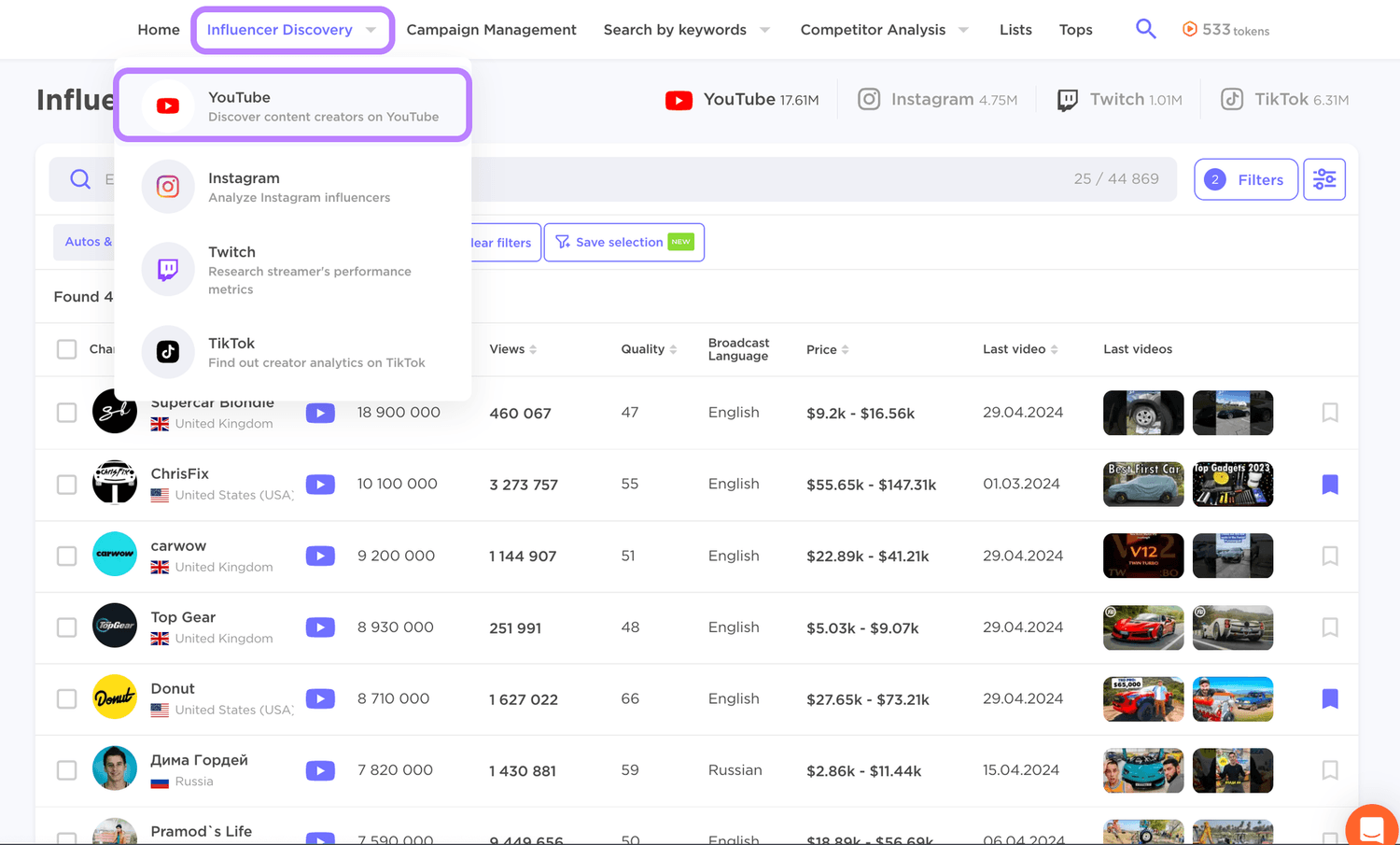
The Influencer Analytics tool handles the entire lifecycle of influencer partnerships within a single application. As influencers bridge the gap between brand and consumer, managing them effectively is paramount for ROI.
Discovery: Find the most relevant, high-performing influencers for your brand.
Evaluation: Assess engagement metrics and follower demographics to ensure a perfect audience fit.
Management: Prepare and execute campaigns, then track their specific conversion impact and ROI in one central location.
Post-Level Intelligence and Global Analysis
To truly optimize a strategy, a marketer needs both microscopic and macroscopic views of their data. This is provided by Social Content Insights and Social Analytics.
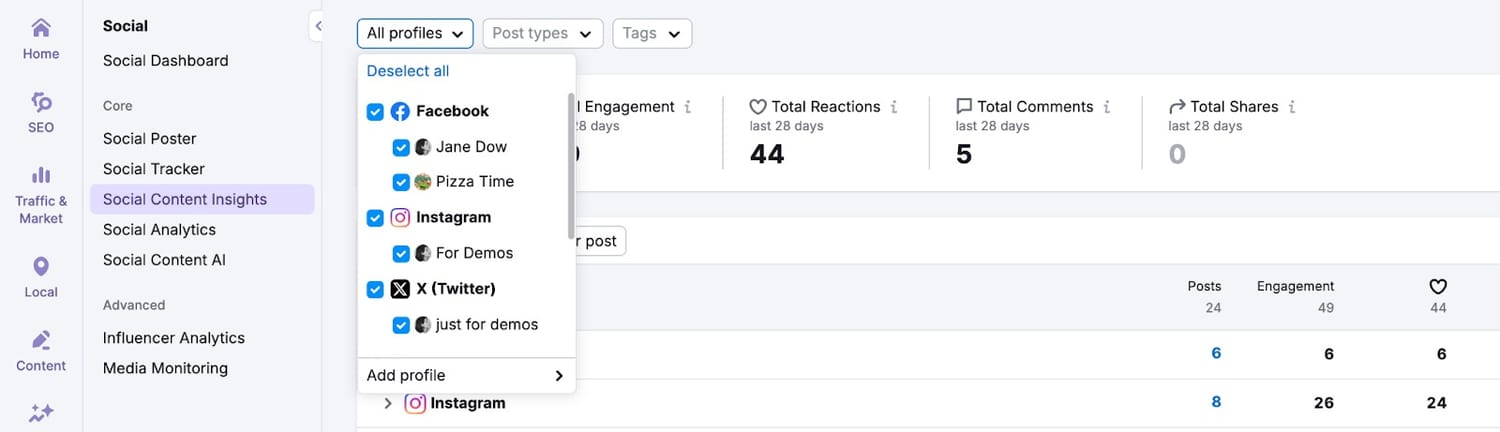
Social Content Insights
This tool provides detailed, post-level data to help you understand the nuances of your content mix.
Tagging and Organization: Use tags to organize content across platforms, allowing for easy filtering by campaign or post type.
Format Analysis: Learn which specific formats (e.g., video vs. carousel) drive the most engagement for your brand.
Strategic Refinement: Use intuitive data visualizations to identify which messages resonate most and refine your strategy accordingly.
Social Analytics
While Content Insights looks at the "what," Social Analytics looks at the "who" and the "how."
Bigger Picture Analysis: Track overall content performance and which campaigns are the primary drivers of engagement.
Audience Demographics: Gain deep insights into where your audience is based, their age range, and even their job functions.
Automated Intelligence: Receive data-driven recommendations to improve your strategy and stay updated with automatic email reports sent directly to your inbox.
Reporting and Proving Value to Stakeholders
Proving the value of social media efforts is often the most time-consuming task for a specialist. Semrush My Reports is designed to eliminate this manual work while providing high-impact visualizations for shareholders.
Multi-Platform Integration
Gathering data from individual platforms is inefficient. My Reports integrates data from 30+ PPC and marketing tools, including:
Facebook, Instagram, LinkedIn, and X.
Snapchat and Pinterest.
Google Analytics 4 (GA4) for a unified view of social-to-web traffic.
Key Benefits of My Reports
100% White-Label Customization: Align the report’s visual identity with your brand or agency.
Automation: Schedule reports to be delivered daily, weekly, or monthly.
AI-Powered Insights: Includes AI-generated summaries that explain complex data points and provide actionable recommendations for future growth.
Easy Sharing: Generate interactive dashboards that stakeholders can view via a simple link, regardless of whether they have a Semrush account.
SMM Report Checklist
A high-level report should always include:
Executive Summary: A narrative overview of performance and key wins.
KPI Tracking: Follower count, reach, impressions, engagement, and video views.
Conversions: Evidence of leads and revenue generated.
Visual Data: Graphs and charts to illustrate trends.
Strategic Recommendations: Data-backed advice for the next phase of the campaign.
Collaboration and Team Workflow
Successful social media management is a team sport. The Semrush Social Toolkit is designed to facilitate "Collaboration with Confidence."
Marketing leads can invite team members to manage profiles without the security risk of sharing passwords. Furthermore, the toolkit streamlines the approval process: posts can be shared with stakeholders for review via a simple link that requires no login. This eliminates the "back-and-forth" of email chains and ensures that content is approved and published on schedule, maintaining a consistent brand voice across all channels.
Frequently Asked Questions (FAQ)
1. What Is Semrush and How Does It Benefit Social Media Marketing?
Semrush is a smart AI solution and an all-in-one ecosystem that integrates social tools with SEO, content, and advertising toolkits. It benefits social media marketing by automating and streamlining every stage of the workflow, from generating content ideas to tracking overall performance. This allows marketers to save time on repetitive manual tasks and focus more on creativity and results.
2. Why Use Semrush for Social Media Analytics?
You should use Semrush because it provides data-backed insights through intuitive visualizations and integrates data from multiple platforms, like Facebook, Instagram, LinkedIn, and TikTok, into a single report. Key advantages include:
Multi-Platform Integration: Connects over 30 PPC and marketing tools.
AI-Powered Insights: Offers AI-generated summaries that explain data points and provide actionable recommendations.
Automated Reporting: Streamlines the process with customizable, white-label templates that can be shared easily with stakeholders.
3. When Should You Analyze Your Social Media with Semrush?
Analysis should be done regularly to track performance in real time, allowing you to spot trends early and stay ahead of the competition. Semrush enables you to set up automated reports on a daily, weekly, or monthly basis. Regular analysis is essential when you need to benchmark your brand against industry standards or adjust your strategy based on shifting audience interests and competitor behavior.
4. Where to Find Social Media Insights in Semrush?
Insights are distributed across several specific tools within the Social Toolkit:
Social Dashboard: Provides a "helicopter view" of all connected accounts and audience growth.
Social Tracker: This is where you pinpoint competitor tactics, posting habits, and top-performing content.
Social Analytics: Offers a "big picture" view of overall content performance and in-depth audience demographics, such as location and age range.
Social Content Insights: Provides detailed, post-level data to help you identify which specific messages drive the most engagement.
Semrush My Reports: Consolidates all these tracking results into one easy-to-analyze document.
5. How Does Semrush Improve Your Social Media Strategy?
Semrush improves your strategy by providing tools to benchmark your performance against top competitors and uncover their social strategies. It uses Social Content AI to generate on-brand ideas, captions, and visuals, ensuring your content calendar remains full. Additionally, it allows you to refine your strategy by identifying which post types resonate best with your audience and monitoring brand mentions to manage your reputation through Social Listening.
Conclusion: Transforming Strategy into Results
The transition from manual social media management to an automated, AI-driven ecosystem is a strategic imperative. The Semrush Social Toolkit replaces fragmented, repetitive tasks with a unified workflow that prioritizes creativity and results. By integrating planning, content production, competitive intelligence, and advanced reporting into one command center, marketing teams can finally align their social efforts with broader business goals.
Whether you are a solopreneur or a global agency, leveraging these eight interconnected tools provides the data-backed insights necessary to manage reputation, increase engagement, and ultimately drive a higher ROI. Now is the time to streamline your workflow and transform your social media presence from a challenge into a powerful growth engine.


Ako Reviews Blog is a platform dedicated to helping online businesses reach their full potential. It offers in-depth guides on product reviews, social media marketing, and comprehensive online business strategies. Whether you're an entrepreneur or a marketer, Ako Reviews Blog provides practical tips and expert insights to help you grow and succeed in the digital marketplace.
Stay informed with valuable tips delivered straight to your inbox.
Created with systeme.io 2026 | Home | Privacy Policy | Terms and Conditions | Disclaimer | Contact