
How to Use Semrush for Effective Social Media Management
How to Use Semrush for Effective Social Media Management
Introduction: The High Stakes of Social Media in 2026 and Beyond
In the fast-paced digital ecosystem of 2026, social media has evolved from a supplementary marketing channel into the undisputed global stage for brand authority. We are looking at a landscape where over five billion people, roughly 60% of the human population, are active on social platforms. For a brand, this isn't just a "presence"; it's a massive, real-time opportunity to build a reputation or watch it crumble.
Think about the sheer scale of impact. Take Wendy’s, for instance. By mastering the art of the social "vibe," they’ve amassed 3.7 million followers on X (formerly Twitter). A single post from their team doesn’t just sit on a timeline; it reaches hundreds of thousands of people instantly, sparking a wildfire of likes, shares, and direct responses. That visibility translates into foot traffic at their restaurants and a brand image that feels human, witty, and incredibly relevant. That is the power of high-level Social Media Management (SMM).
But what exactly is SMM? At its core, Social Media Management is the comprehensive process of overseeing every granular detail of your brand’s social presence. It’s the strategic roadmap that dictates how you plan, create, publish, and manage content to connect with your target audience. It encompasses community engagement, reputation monitoring, influencer collaboration, and the rigorous analysis of performance metrics.
Here’s the reality: In an era where a single ignored comment or a tone-deaf post can send negative signals, suggesting your brand is out of touch or indifferent, effective SMM is your primary shield and sword. It’s how you maintain a positive image and build relationships that actually move the needle on your bottom line.
This guide is designed to take you from the "chaos of manual posting" to the "clarity of strategic automation." We are going to dive deep into the Semrush Social Toolkit, a smart AI solution built to consolidate your entire workflow. We’ll show you how to leverage this integrated ecosystem to enter a "seamless automation loop," where data-driven insights lead to AI-assisted creation, automated scheduling, and effortless reporting. Let’s get tactical.
Why Social Media Management is Your Brand's Secret Weapon
If you’re treating social media as a chore rather than a core business driver, you’re leaving money on the table. Professional SMM ensures that every digital "touchpoint" is working toward your high-level business goals.
When you manage your accounts with precision, you unlock five critical business engines:
Building Brand Awareness: You aren't just shouting into the void. You are using the massive reach of social platforms to place your brand directly in front of the people most likely to buy from you.
Fostering Community: SMM turns casual observers into brand advocates. By actively participating in conversations, you build a "tribe" around your products or services.
Driving Website Traffic: Through strategic content and compelling calls-to-action (CTAs), you can funnel social users away from the "infinite scroll" and onto your website or landing pages.
Generating Leads: High-quality SMM uses lead magnets and specific CTAs to capture customer data, turning social engagement into a robust sales pipeline.
Cultivating Loyalty: Providing prompt, helpful customer service through social channels keeps your brand top-of-mind and builds a level of trust that competitors can’t easily steal.
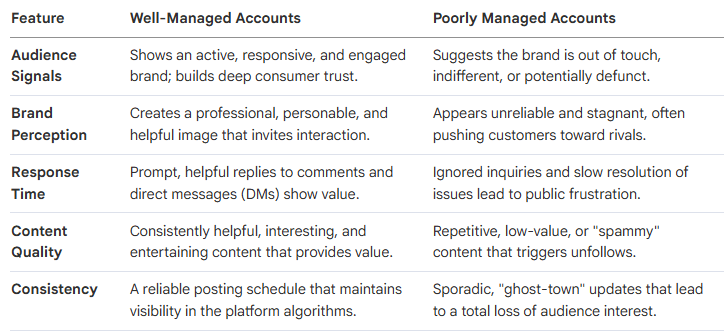
The stakes are binary: you are either building trust or losing it. The table below illustrates the stark difference between a brand that invests in management and one that ignores it.
Strategic Groundwork: The 8-Step Content Strategy Framework
You wouldn't build a house without a blueprint, and you shouldn't post to social media without a strategy. A social media content strategy is your roadmap—a comprehensive outline of how you plan to create, publish, and manage content to reach your goals. Here is the 8-step framework to build a winning strategy.
Setting SMART Goals
Every post must have a purpose. Your social goals must align with your broader business objectives (such as revenue growth) and follow the SMART framework: Specific, Measurable, Achievable, Relevant, and Time-bound.
Increase Brand Awareness: Instead of "get more followers," set a goal to "increase brand awareness by 15% in Q3." To track this, you will monitor Reach (how many unique users see your posts) and Follower Count.
Generate Leads: A SMART goal would be "Generate 50 new leads via social media downloads over the next six months." Your KPI here is the Conversion Rate on your lead magnet links.
Drive Traffic: If your goal is to "Get 20% more website traffic from social in the next year," you will focus on Organic Social Traffic in your analytics.
Deep-Dive Audience Research with One2Target
You cannot resonate with an audience you don’t understand. Using the One2Target tool, you can move beyond guesswork. Enter your domain and up to five competitors to see exactly who is paying attention. The tool breaks this down into three essential tabs:
Demographics: See the hard data, age ranges, gender splits, and geographic locations. If your audience is mostly 25–34-year-olds in urban areas, your tone should reflect that.
Socioeconomics: This is where it gets interesting. Look at household size, income levels, employment status, and education. This tells you about their purchasing power and professional life.
Behavior: Discover their interests, what devices they use (Mobile vs. Desktop), and which platforms they prefer.
Pro Tip: Take the data from One2Target and plug it into Semrush's free Buyer Persona Tool. This allows you to transform raw data into a living, breathing persona that your creative team can use to guide every caption and visual.
Competitor Benchmarking
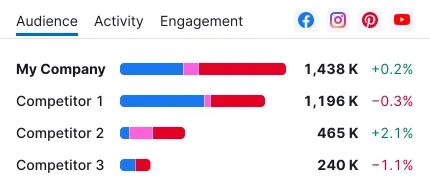
Your rivals are providing a free masterclass in what works (and what doesn't) in your niche. Open the Social Tracker and look at the "Comparison With Competitors" table. You need to benchmark three key metrics:
Audience: How does your total audience size and growth rate compare to your rivals?
Activity: How often are they posting? Use the "Activity" tab to see their posting frequency across channels and, crucially, how their engagement varies by day and time.
Engagement: Don't just look at likes. Look at the "Top Content by Channel" to see which specific posts are driving the most shares and comments. If a competitor's video is going viral, analyze why.
Selecting Your Platforms
Don't spread yourself too thin. It is better to dominate one platform than to be mediocre on five. Use your audience research to prioritize.
Facebook: A versatile giant for both B2B and B2C. Essential for sharing product lines and community building.
Instagram: The visual powerhouse. Perfect for B2C brands with high-quality photos, Reels (9:16 aspect ratio), and Stories.
X (Twitter): The place for fast-moving news and high-volume customer service.
Pinterest: A massive opportunity for visual planning. Brands like IKEA leverage this, getting over 10 million views a month because users use Pinterest for "pre-purchase" inspiration in home decor and travel.
YouTube: The world’s second-largest search engine. Use this for long-form educational content, tutorials, and "How-To" series.
LinkedIn: The gold standard for B2B. Use it to establish your team as thought leaders through professional networking and "Thought Leadership" posts.
TikTok: Best for lifestyle B2C. Brands like Samsung use platforms like Discord and TikTok to reach tech-savvy, younger segments using trending sounds and memes.
Developing the Content Plan
This is where the "what" meets the "how." Start by brainstorming topics that align with your business. Use the Topic Research tool to enter a broad industry term and find "Trending Subtopics" that are rapidly growing in popularity.
Analyze hashtags (like #HighEndFashion) to see what conversations are already organized. Then, decide on your post types:
B2C: Focus on User-Generated Content (UGC), Reels, and Reviews.
B2B: Focus on Thought Leadership, Case Studies, and Informative Product Posts.
Engagement Drivers: Carousel posts (up to 10 images) are great for "Top Tips" or "How-To" guides.
Building the Engagement Plan
Social media is not a broadcast; it’s a conversation. If you aren't participating, you're just a casual observer. Your plan should include:
Interactive Content: Run polls, ask questions, and host competitions to get people talking.
Active Response: Dedicate time every day to respond to comments and DMs.
Trend-Jacking: Use the TikTok Creative Center to find trending sounds and memes that fit your brand personality.
Content Creation & Optimization
Once the plan is set, you start the production phase. We’ll dive into the AI tools shortly. Still, the goal here is to create a library of assets (images, 9:16 videos, and copy) that match your brand’s tone, whether that is professional, humorous, or informative.
Performance Measurement
The strategy loop closes by revisiting your KPIs. Use Social Analytics to compare your results against your SMART goals. If your engagement rate is dipping, look at the data to see if you need to adjust your posting times or content formats.
Navigating the Semrush Social Toolkit: The 8 Core Tools
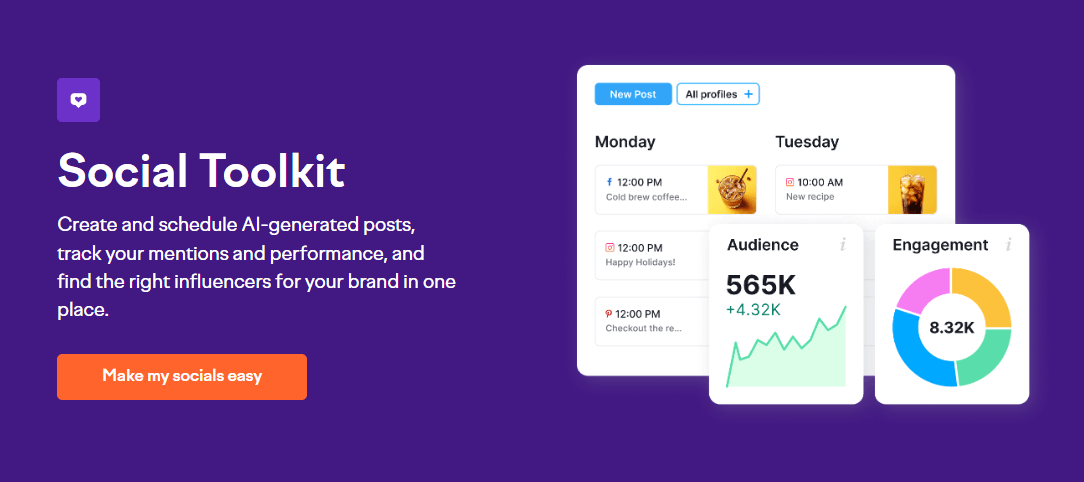
The Semrush Social Toolkit is an integrated ecosystem designed to handle the heavy lifting. Let's break down the technical interface of these eight powerhouse tools.
1. Social Dashboard This is your "helicopter view" command center. When you log in, you see a high-level overview of all connected profiles. It aggregates combined and platform-specific metrics, showing you audience growth trends and post performance at a glance. But the real magic is the AI-powered recommendations. The dashboard analyzes your data and tells you exactly what to post and how often to maximize your impact.
2. Social Tracker This is your competitive intelligence engine. You can track up to 20 social profiles across platforms like Facebook, Instagram, and Pinterest. It doesn't just show you follower counts; it reveals the "Activity" and "Engagement" trends of your rivals. You can see their comparative growth metrics and performance for each specific channel, allowing you to identify exactly where you need to level up.
3. Social Poster Social Poster is the workflow workhorse. It features an interactive, drag-and-drop calendar where you can plan and schedule content for Facebook, X, Instagram, Pinterest, LinkedIn, and even Google Business Profile. (Pro tip: GBP isn't a traditional social site, but updating it via Social Poster is a massive win for Local SEO). You can add "Tags" to your posts here, which allows for granular reporting on specific campaigns later.
4. Social Content AI If you have "writer's block," this tool is the cure. By entering your URL or a short business description, it generates over 100 tailored post ideas daily. It’s a full-post generation engine: it handles the copywriting, suggests hashtags, and provides visual templates or scripted video ideas. It’s designed to plug directly into your calendar, turning an idea into a scheduled post in seconds.
5. Social Content Insights This is for the data-obsessed manager. It allows you to zoom in on post-level performance. You can filter by campaign, specific tags, or platforms to see which formats are actually driving results. Want to know if "Video" or "Carousel" works better for your summer campaign? This tool visualizes that data so you can double down on what works.
6. Social Analytics This is your "big picture" data hub. It tracks the "macro" metrics: new page likes, followers, post reach, total engagements, page views, and profile interactions. It also offers a deep dive into Audience Insights. You can see where your followers are based, their age ranges, and even their job functions, essential for refining your B2B LinkedIn strategy.
7. Influencer Analytics Influencer marketing is a full-time job, unless you use this tool. It manages the entire lifecycle: Discovery (finding the right fit), Recruitment (outreach), and Analysis (tracking campaign results). You can evaluate an influencer's engagement metrics and "fit" before you ever reach out, ensuring your budget isn't wasted on influencers with "fake" followers.
8. Media Monitoring This tool takes you beyond the social apps. It tracks brand mentions across the broader web, including blogs, forums, and news sites. It categorizes mentions by Sentiment (Positive, Negative, or Neutral). This is critical for reputation management; it allows you to spot a PR crisis before it explodes or turn a positive mention into a valuable backlink.
Step-by-Step Implementation: From Setup to First Post
Ready to stop "winging it"? Follow this quick-start manual to get the toolkit running in minutes.
Step 1: Connection and Access
Head to the Semrush main menu and navigate to Social > Social Dashboard.
Mandatory Step: You must connect at least one social media profile to activate the toolkit.
Select your platforms (Facebook, Instagram, LinkedIn, etc.) and follow the prompts to grant access. Once connected, Semrush begins pulling real-time performance insights immediately.
Step 2: Setting up Competitor Tracking
Navigate to Social Tracker. Your connected brand will appear under the "You" section.
Click Add company and enter the URLs of your top competitors.
Select the profiles you want to track (up to 20).
Click Start tracking companies. Now, data on their audience size, posting frequency, and engagement trends will flow directly into your dashboard reports.
Step 3: Generating Content with Social Content AI
Open the Social Content AI tool.
Enter your company URL and location. This ensures the AI understands your local market and niche.
You’ll see ideas categorized by "Brand Profile," "Trending Topics," and "Semrush Insights."
Pick an idea and click Generate.
UI Controls: Once the AI provides a draft, use the one-click buttons to Rephrase, Expand, Shorten, or Change Tone. You can also add hashtags and visuals (static or video) directly within the interface.
Step 4: Scheduling via Social Poster
Once your post is polished, send it to Social Poster.
Use the interactive calendar to drag and drop the post to your desired day.
The "Best Time to Post" Feature: Look for the darker blue squares in the audience activity chart. These squares indicate when a higher percentage of your specific audience is online. Scheduling your posts for these times ensures maximum reach and engagement.
Advanced Tactics: Scaling Your Social Presence
Once you’ve mastered the daily workflow, it’s time to scale your impact using advanced features.
Mastering Social Listening
"Social Listening" is the process of monitoring brand mentions even when you aren't tagged. People often talk about you without using your @handle.
Use the Media Monitoring app to track these untagged mentions across blogs and news sites.
Sentiment Strategy: Address negative mentions first to prevent escalation. For positive mentions, react or respond to strengthen the relationship and generate "social proof."
Influencer Marketing Mastery
Scale your reach by tapping into established audiences. Use the Influencer Discovery tool to filter by:
Micro-influencers (<100k followers): These are the kings of engagement. Perfect for targeted, niche campaigns.
Macro-influencers (100k–1M followers): The sweet spot for broad brand awareness.
Celebrities (>1M followers): Use these for massive, large-scale product launches. Use the app to manage everything from one-time sponsored posts to long-term ambassadorships.
Paid Social Strategy
Organic reach is great, but "Paid Social" is how you scale. Use the AdClarity app to spy on competitor ads before you spend a dime. You can see their estimated spend, platforms (Meta, YouTube, TikTok), and which formats are getting the most impressions.
When you're ready to create your own, understand the specific formats available:
YouTube: Choose from Skippable/Non-skippable in-stream ads, Bumper ads (6 seconds), Video Discovery ads, or high-impact Masthead ads on the homepage.
Meta (Facebook/Instagram): Beyond standard images, use Carousel ads, Collection ads for products, Messenger ads, or Augmented Reality (AR) ads that let users "try on" products.
LinkedIn: Use Sponsored Messaging (direct to inbox), Video ads, or Event ads to drive webinar attendance.
TikTok: Try TopView ads (appears on app open), In-Feed ads, or Branded Hashtag Challenges to encourage user participation.
Pinterest: Utilize Shopping ads or App Install ads targeting specific interests or keywords.
Automated Reporting: Data-Driven Success
Reporting is often the most time-consuming part of SMM, but Semrush automates it. In the Social Analytics section, you can set up PDF exports that go straight to your inbox daily, weekly, or monthly.
Customization Features:
AI-Generated Summaries: The tool writes the executive summary for you, highlighting wins and areas for improvement.
Custom Branding: You can remove Semrush logos and add your own (or your client's) logo for a professional, white-labeled look.
Online Dashboards: Include links to live dashboards so stakeholders can see real-time data.
Pro Tip: For a truly holistic view, use the Custom PDF Report builder to unify your social data with your SEO and Local SEO metrics. This provides a single source of truth for your entire digital marketing performance.
Conclusion: Transforming Your Social Workflow
The Semrush Social Toolkit isn't just another piece of software; it’s a smart AI solution designed to reclaim your time. By moving away from the chaos of juggling separate apps for scheduling, analytics, and listening, you enter a seamless automation loop.
You’ve seen the roadmap: Set SMART goals, use One2Target to build buyer personas, benchmark against rivals, and use AI to fuel your creation. Whether you are a small business owner, an in-house manager, or a scaling agency, the tools to dominate your niche are now at your fingertips.
Don't let your social presence be an afterthought. Start your 7-day free trial today and begin your journey toward a more efficient, data-driven, and automated social media strategy.


Ako Reviews Blog is a platform dedicated to helping online businesses reach their full potential. It offers in-depth guides on product reviews, social media marketing, and comprehensive online business strategies. Whether you're an entrepreneur or a marketer, Ako Reviews Blog provides practical tips and expert insights to help you grow and succeed in the digital marketplace.
Stay informed with valuable tips delivered straight to your inbox.
Created with systeme.io 2026 | Home | Privacy Policy | Terms and Conditions | Disclaimer | Contact