
How to Use Semrush for Keyword Research: A Detailed Guide
How to Use Semrush for Keyword Research: A Detailed Guide
Introduction: The New Era of Keyword Research
As we navigate the complexities of 2026, the digital landscape has undergone its most profound transformation since the dawn of the search engine. We are no longer operating in a world where search is a simple "query-in, link-out" transaction. Today, search behavior is a multi-modal, conversational, and deeply integrated experience. Users are just as likely to engage with a Large Language Model (LLM) like ChatGPT or a Google AI Overview as they are to click a blue link.
Despite these seismic shifts, keyword research remains the bedrock of content strategy. Why? Because keywords are the mirrors of human intent. Every piece of content you craft, every landing page you optimize, and every strategic budget allocation you make must be anchored in an understanding of what your audience is searching for, and the "why" behind those searches. In 2026, if you aren't visible where the AI gathers its information, you simply don't exist for a massive segment of your market.
To bridge this gap between traditional SEO and the new AI-driven search ecosystem, we have unified our capabilities into Semrush One. This is the first comprehensive solution designed to maximize your brand’s footprint across traditional search engines and AI search systems. By combining the SEO Toolkit with the AI Visibility Toolkit, Semrush One provides a single source of truth for the modern marketer.
What You Will Learn in This Masterclass:
Discovery Mastery: How to leverage our 6-Method Framework to find high-value terms that span both traditional SERPs and AI platforms.
Deep-Dive Analysis: Moving beyond raw volume to understand Personal Keyword Difficulty (Personal KD) and intent-based selection.
AI Search Optimization: The mechanics of "Query Fan-out" and how to secure AI Citations in LLM responses.
Topical Authority: Using the Keyword Strategy Builder to architect topic clusters that signal trust to both Google and AI agents.
Strategic Prioritization: A value-driven framework to ensure you invest resources in keywords that move the needle on revenue, not just traffic.
Defining Keyword Research in the Age of AI
In the current era, keyword research is the systematic process of discovering and analyzing the specific linguistic inputs, both search queries and AI prompts, that your target audience uses to find solutions. It is a dual-track discipline: you are optimizing for search engine algorithms (like Google’s) and for the data ingestion patterns of LLMs.
When we look at keywords through the lens of Semrush One, we aren't just looking for strings of text. We are looking for the strategic DNA of your business.
Effective keyword research tells you:
The Unanswered Questions: What specific problems are keeping your prospects up at night that current search results fail to solve?
The Natural Language Patterns: What exact terminology do your customers use? Are they asking for a "solution," a "tool," or a "way to fix [X]"?
The Competitive Matrix: Which brands are your customers comparing you against, and what criteria are they using for those comparisons?
Buyer Journey Placement: Is the user in the "Problem Aware" stage (Informational intent) or the "Solution Ready" stage (Transactional intent)?
By mastering this data, you ensure your brand is the definitive answer across the entire search lifecycle.
Getting Started: Setting Up Semrush One
To succeed in 2026, you need a setup that accounts for both the traditional and the conversational. Semrush One is designed to provide personalized insights the moment you log in.
Step-by-Step Platform Configuration:
Account Creation: Navigate to the Semrush homepage and click Sign Up. Use your professional email to ensure your account can be linked to your enterprise domain later.
Domain Verification: Once your account is active, you will be prompted to enter your website domain. This is a critical step. By entering your domain, you unlock the "AI-powered search bar" and personalized metrics. Our systems will crawl your site to understand your current authority, allowing us to calculate Personal KD specifically for you.
Project Integration: Set up a "Project" for your primary domain. This enables the Position Tracking tool to monitor your daily rankings and visibility across both traditional and AI-driven search modes.
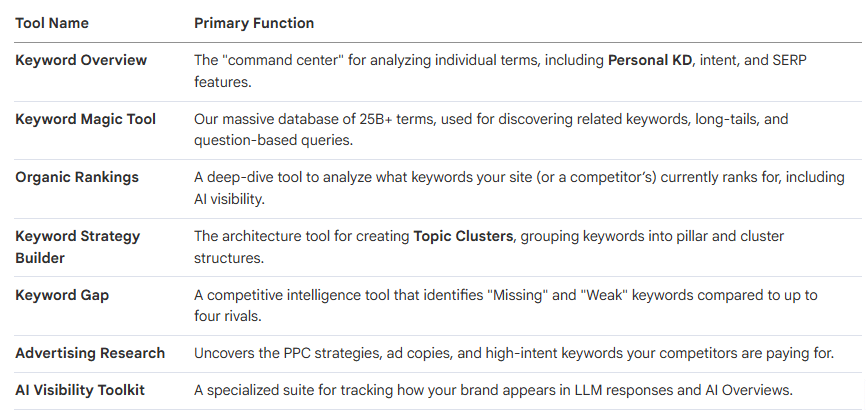
Semrush One Toolkit Overview
Phase 1: Finding Keywords (The 6-Method Framework)
The most common mistake in SEO is relying on a single method for discovery. To build a robust strategy, you must mine six distinct data sources.
Checking Existing Rankings (The "Striking Distance" Strategy)
If your site has any history, you are already ranking for keywords you haven't intentionally targeted. These are your "Low-Hanging Fruit."
Google Search Console (GSC) Integration: Within GSC, go to the Performance tab. Filter for queries with high Impressions but low Clicks. This usually means Google considers you an authority on the topic, but your content isn't satisfying the specific intent, or your meta tags aren't compelling.
Semrush Organic Rankings: This is where we go deeper than GSC. Enter your domain and navigate to the Positions tab. Use the following technical filters:
Position 11+: This identifies keywords on page two or three. We call these "Striking Distance" keywords. A simple content refresh or the addition of an AI Overview-optimized section can often push these into the Top 5.
Volume 100+: We want to ensure the optimization effort yields a meaningful return in traffic.
Keyword Difficulty (KD%) 0-49%: For most sites, this represents the "attainable" zone where you can win without a massive backlink campaign.
Technical Pro-Tip: If you find a keyword at Position #12 with high volume, don't just add more words. Analyze the current Top 3. Are they lists? Are they "how-to" guides? Use the On-Page SEO Checker to see exactly what technical elements (like H1 placement or semantic density) you are missing to cross the threshold into the Top 10.
Mining First-Party Data: Sales & Support
Tools are powerful, but they can't sit in on your sales calls. First-party data represents the "real-world" language of your customers.
Sales Team Insights: Your sales reps know the objections that kill deals. If a prospect asks, "How does your pricing compare to Competitor X for a team of 50?" that is a high-intent keyword.
Support & Onboarding: If your support team gets 20 tickets a week asking "How do I export data to Excel?", that is a clear signal.
Law Firm Case Study: A family law firm might see search tools showing "divorce lawyer" as a top term. But their support logs show clients constantly asking, "What should I bring to my first legal consultation?" Creating a guide for that specific query targets prospects at the exact moment they are ready to convert, even if the "Search Volume" in a tool looks low.
Social Platforms and Forums: The "Intent Mining" Method
People go to Reddit, Quora, and YouTube comments when Google fails them. This is where you find "unserved" intent.
Scraping for Keywords:
Find a YouTube video or Reddit thread with high engagement in your niche.
Copy the comments/discussion text.
Use this prompt in ChatGPT or Claude
Using the Keyword Magic Tool & "Query Fan-out."
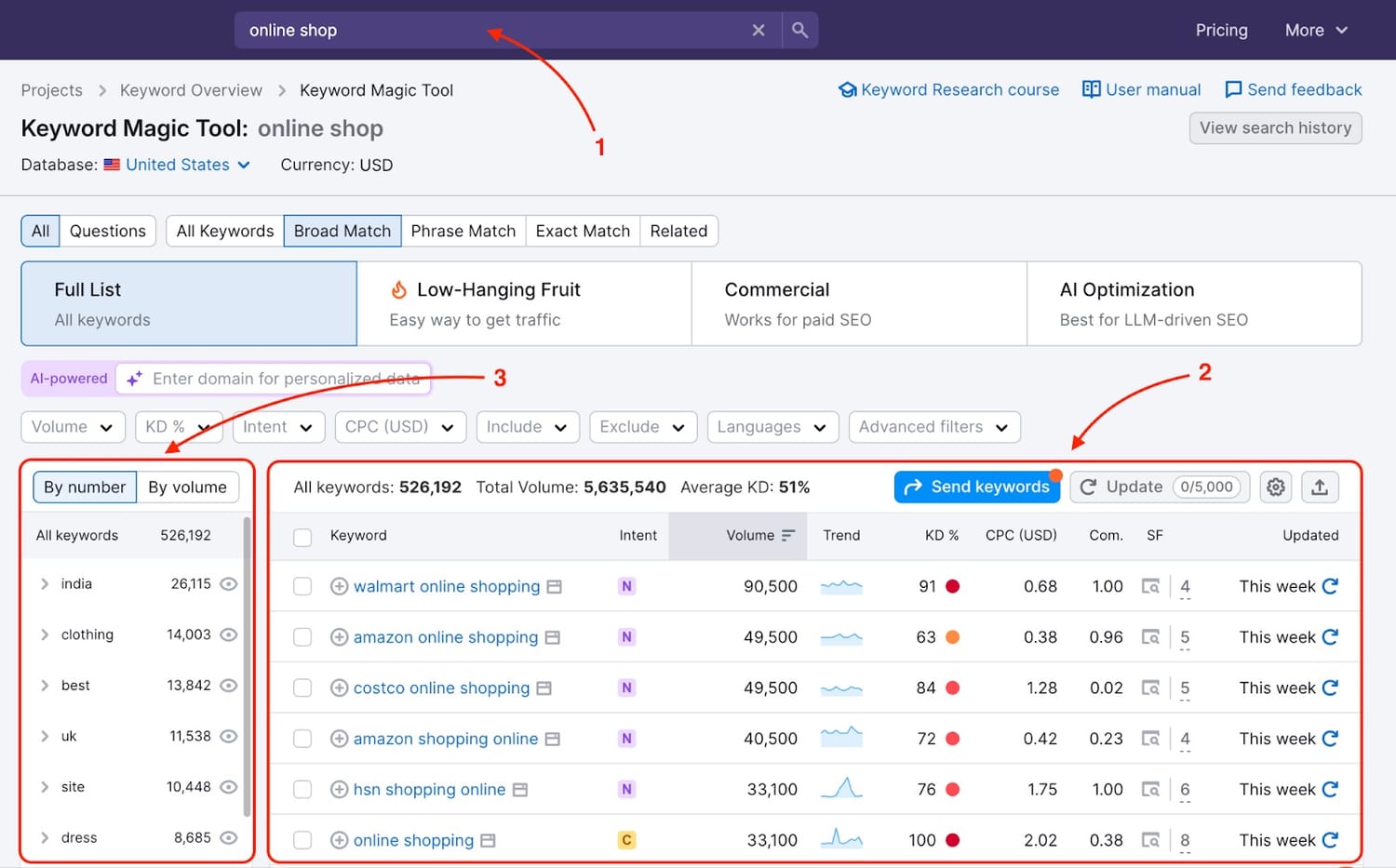
The Keyword Magic Tool is your primary engine for scale.
Match Modifiers Explained:
Broad Match: Useful for initial brainstorming.
Phrase Match: For finding specific "buying" phrases.
Related: Essential for building topical authority and identifying synonyms that LLMs use to group entities.
Technical Deep-Dive: Query Fan-out In 2026, LLMs use a process called "Query Fan-out." When a user asks a broad question, the AI runs multiple background searches for related, long-tail queries to synthesize a complete answer. By using the Questions filter in Keyword Magic Tool, you find the specific sub-queries the AI is "fanning out" to. If you provide the best answer to those sub-queries, you become a cited source in the AI's final response.
Keyword Gap Analysis: Traditional & AI
The Keyword Gap tool identifies the "white space" in your strategy.
Traditional Gap: Compare your domain to your top four rivals. Filter for Missing (they rank, you don't) and Weak (you rank lower than them).
Competitor Prompt Analysis: Within the AI Visibility Toolkit, use the Competitor Research report. Select the Prompts tab. This shows you the conversational prompts where AI tools are recommending your competitors, but your brand is absent. This is a critical gap to close for 2026 visibility.
SERP Feature Analysis
The search results page itself is a roadmap.
People Also Ask (PAA): These are conversational gold. Every PAA question is a potential H2 for your content.
AI Overviews: If an AI Overview appears for your target term, click "Show More." Analyze the structure of the response. Does it use a table? A numbered list? These are the formats you must adopt to take over that "Position Zero."
Phase 2: Analyzing and Selecting Terms
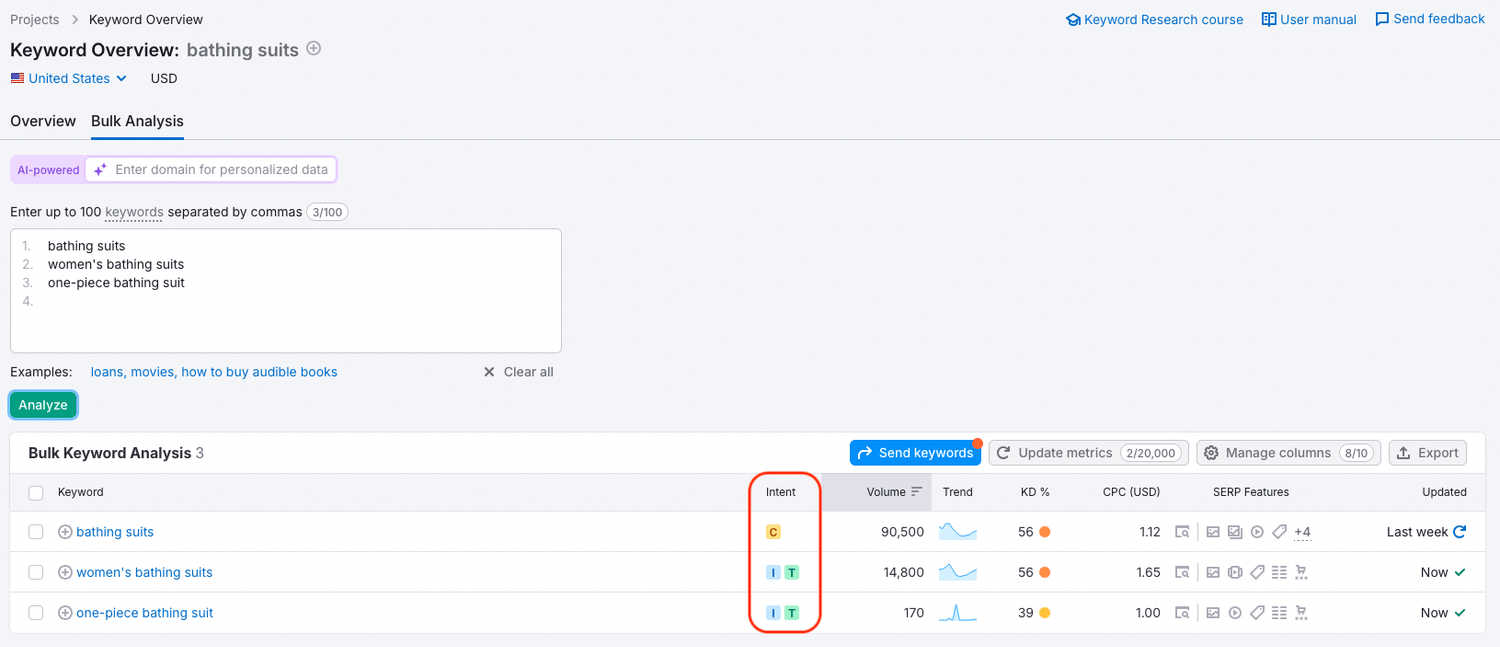
Once you have a list of several hundred (or thousands) keywords, you must filter them through the Keyword Overview tool.
The Metric Framework:
Search Volume: Monthly average demand.
Personal Keyword Difficulty (Personal KD): This is the most important metric in Semrush One. Unlike standard KD%, which is a general industry average, Personal KD evaluates the difficulty relative to your website’s current authority and content profile. If a keyword has a standard KD of 80% but your Personal KD is "Easy," it means you have high topical authority in that specific niche.
Potential Traffic: An estimate of the actual clicks you can expect, accounting for SERP features and AI Overviews.
Intent (The I-C-T-N Model):
Informational (I): "What is..." (Good for AI Citations).
Commercial (C): "Best tools for..." (High value for comparisons).
Transactional (T): "Buy [Product]" (The bottom of the funnel).
Navigational (N): Finding a specific brand page.
Technical Pro-Tip: Don't ignore Competitive Density and CPC. Even if you are focusing on SEO, high CPC and Density indicate that your competitors are seeing high ROI from these terms. They are "proven" money-makers.
Phase 3: Prioritizing Your Keywords (The Value Framework)
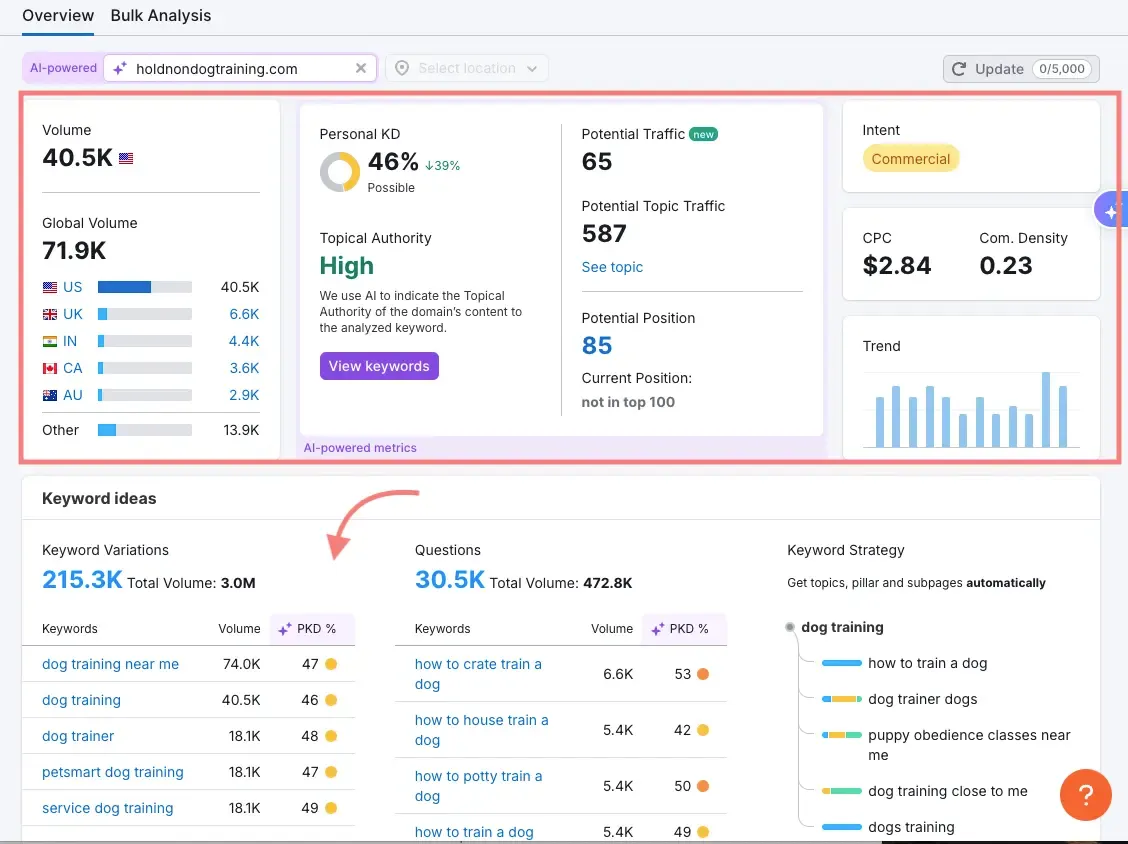
As a strategist, your job is to allocate resources. Use the following criteria for prioritization:
Conversion Potential
Always prioritize "Solution-Aware" keywords. A user searching for "how to migrate from Salesforce to HubSpot" is much closer to a purchase than someone searching for "what is a CRM."
Search Volume vs. Real-World Demand
Do not be afraid of "Zero-Volume" keywords. If your sales team says prospects are asking about a specific niche integration, target it. Search tools often lag behind real-time market shifts. These keywords are often your highest-converting terms because they are hyper-specific.
Click Potential
Assess the "SERP Real Estate."
High Click Potential: Complex processes where a user needs a detailed guide.
Low Click Potential: Simple factual queries (e.g., "What is the capital of France?") that are answered instantly by AI Overviews. Avoid spending high resources on these "no-click" terms.
Keyword Trends
Check the Trend graph in Keyword Overview. Is interest growing or fading? Use Google Trends to verify if a keyword is seasonal.
Attainability
For new domains, stick to the 0-49% KD% range. Your goal is to build "Topical Momentum." Winning five small battles is better than losing one big one.
Phase 4: Building Topical Authority with Keyword Strategy Builder
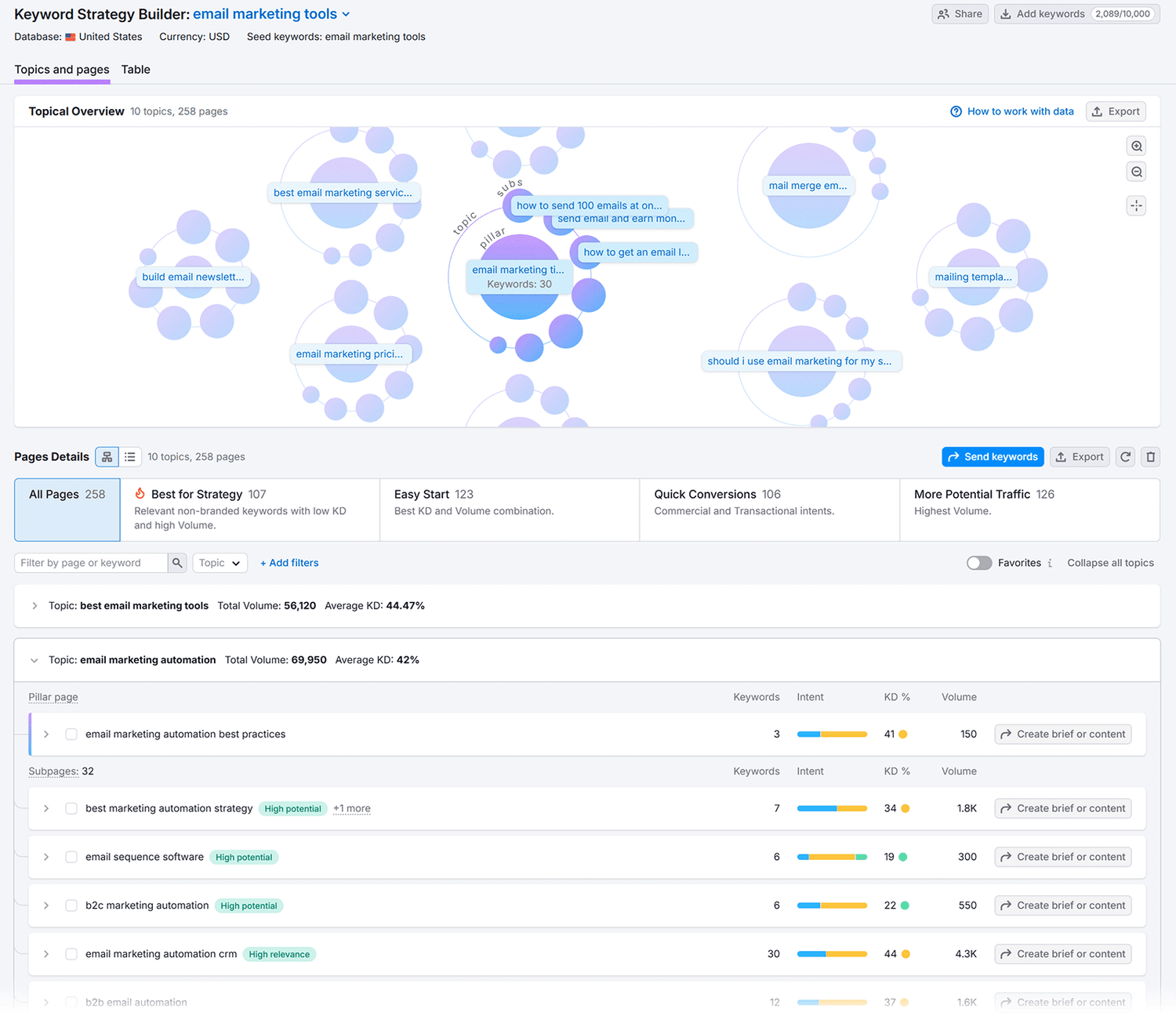
In 2026, ranking for a keyword is a myth; you rank for Topics.
The Topic Cluster Model:
Pillar Page: A comprehensive "Ultimate Guide" to a broad topic.
Cluster Pages: Specific, long-tail articles that dive deep into sub-topics and link back to the pillar.
Using Keyword Strategy Builder:
Workflow A: Clustering a List. Upload your researched list. The tool uses AI to group them by "Semantic Similarity." It will tell you exactly which keywords belong on the same page and which need their own page.
Workflow B: Seed Discovery. Enter a seed term like "Cloud Security." The tool will generate a full architectural map of pillars and clusters, prioritized by difficulty and intent.
Phase 5: PPC and Competitor Advertising Research
PPC is the fastest way to test keyword viability. Use Advertising Research to see where your competitors are "putting their money where their mouth is."
Ad Copies: Analyze the "hooks" they use. If they emphasize "Free Trial" or "24/7 Support," those are the value propositions you should mention in your organic content.
Landing Pages: Look at the structure of their high-converting pages. This provides a blueprint for your own content layout.
Implementation: How to Use Keywords in Your Content
Strategic placement ensures both Google and AI agents can parse your relevance.
Advanced Keyword Placement Checklist:
Title Tag: Primary keyword at the beginning.
Meta Description: Include the primary keyword and a clear CTA to boost CTR.
H1-H3 Headers: Use your primary keyword in the H1. Use PAA questions as H2s.
The "First 100" Rule: Mention the primary keyword and its immediate context in the first 100 words.
Semantic Density: Use variations and synonyms discovered in the Keyword Magic Tool (Related Match) to avoid keyword stuffing while signaling depth.
AI Overview Optimization: If you want to appear in AI Overviews, include a "TL;DR" or summary section at the top of your page that uses a list or table format. Use the "Show More" sources as a structural blueprint.
Semrush Optimization Suite:
SEO Writing Assistant: Use this to grade your content for "Readability" and "SEO" in real-time.
On-Page SEO Checker: Run this on existing pages to get a "To-Do" list of technical improvements.
AI Article Generator: Use this within the Content Toolkit to turn your Keyword Strategy Builder clusters into high-quality drafts instantly.
Monitoring and Refining Your Strategy
Keyword research is not a project; it is a cycle. Use Position Tracking to monitor:
Visibility Index: Your total share of voice for your keyword set.
Cannibalization: Ensure you don't have two pages fighting for the same keyword.
AI Citation Tracking: See when your brand is mentioned in AI-generated responses.
Common Pitfall to Avoid: Don't "set and forget." If a keyword’s search volume drops or a competitor releases a better guide, your ranking will slip. Review your "Top 10" keywords monthly.
Frequently Asked Questions (FAQ)
1. What is Semrush, and How Can It Help with Keyword Research?
Semrush is an all-in-one marketing solution that provides a comprehensive suite of tools for digital marketing, SEO, and AI visibility. In the modern search landscape, it has evolved into Semrush One, which unifies traditional SEO capabilities with an AI Visibility Toolkit to help brands stay visible across both search engines like Google and Large Language Models (LLMs) like ChatGPT. It helps with keyword research by allowing you to discover and analyze the specific search terms and AI prompts your audience uses to find solutions. By using its database of over 25 billion terms, Semrush helps you understand what questions your audience is asking, the language they use, and where they are in their buying journey.
2. Why Use Semrush for Keyword Research?
Using Semrush is essential because it removes the guesswork from content creation, ensuring you target terms that meet actual market demand. It allows you to:
Build Brand Awareness: Appear when people search for topics related to your offerings.
Drive Conversions: Match search intent to guide visitors toward actions like purchases or sign-ups.
Access Personalized Metrics: Features like Personal Keyword Difficulty (Personal KD) evaluate how hard it will be for your specific domain to rank, rather than providing a generic industry average.
Secure AI Visibility: In 2026, being visible to AI agents is critical; Semrush helps you identify the "Query Fan-out" paths AI uses to synthesize answers, allowing you to become a cited source in AI responses.
3. When Should You Conduct Keyword Research with Semrush?
Keyword research with Semrush should be treated as an ongoing cycle rather than a one-time project. You should conduct it:
At the Start of content strategy, it serves as the foundation for every page you optimize or piece of content you create.
Monthly: To review your "Top 10" keywords and ensure competitors haven't released better guides or that search volumes haven't shifted.
When Market Shifts Occur: Search behavior changes constantly, new competitors enter the space, and AI platforms frequently update how they present information.
When Expanding Authority: Use it whenever you need to build "topical authority" by architecting new topic clusters.
4. How Does Semrush Improve Your Keyword Research Process?
Semrush improves the process through a 6-Method Framework that moves beyond simple database searches:
Mining Existing Rankings: It identifies "low-hanging fruit" or "striking distance" keywords that you are already ranking for on pages two or three of search results.
Integrating First-Party Data: It provides a place to organize "real-world" language gathered from your sales and support teams.
AI-Powered Clustering: The Keyword Strategy Builder automatically organizes thousands of keywords into topic clusters based on semantic similarity, saving hours of manual categorization.
Gap Analysis: It quickly highlights "Missing" or "Weak" keywords where your competitors are gaining traffic that you are not.
Prioritization Frameworks: It helps you filter terms based on conversion potential, click potential (avoiding "no-click" searches), and current trends.
5. Where to Find the Best Features in Semrush for Keyword Research?
The main keyword research tools are located in the tool menu on the left-hand side of the platform. Key features include:
Keyword Overview: The "command center" for analyzing individual terms, Personal KD, and search intent.
Keyword Magic Tool: The primary engine for discovering related terms, long-tail keywords, and question-based queries.
Keyword Strategy Builder: The tool used to architect pillar pages and cluster pages to build topical authority.
Organic Rankings & Keyword Gap: Found under competitive research, these allow you to analyze rival strategies and find "white space" in your own strategy.
AI Visibility Toolkit: A specialized suite for tracking brand mentions and prompt rankings in AI-driven search modes.
Advertising Research: Located in the advertising section, this reveals high-intent keywords that competitors are paying for.
Conclusion & Resources for Further Growth
Dominating search in 2026 requires a unified approach. By leveraging Semrush One, you aren't just doing SEO; you are managing your brand's entire digital presence across the traditional and AI-driven web.
The combination of the SEO Toolkit and the AI Visibility Toolkit allows you to stay ahead of algorithm shifts and LLM behavior changes. Start small, build topical authority, and always prioritize the user’s intent over raw metrics.
Take the Lead in 2026. Don't wait for your traffic to decline as search habits shift. Start your free 7-day trial of Semrush One today and secure your visibility in the next era of search.


Ako Reviews Blog is a platform dedicated to helping online businesses reach their full potential. It offers in-depth guides on product reviews, social media marketing, and comprehensive online business strategies. Whether you're an entrepreneur or a marketer, Ako Reviews Blog provides practical tips and expert insights to help you grow and succeed in the digital marketplace.
Stay informed with valuable tips delivered straight to your inbox.
Created with systeme.io 2026 | Home | Privacy Policy | Terms and Conditions | Disclaimer | Contact