
Monid.ai Review: The Single API to Rule 2,000+ Tools
Introduction: The Agentic Tooling Crisis
It is 2026, and we are witnessing the fallout of the "Great API Fragmentation." As a Senior AI Solutions Architect, I spend half my life designing systems that are theoretically autonomous but practically paralyzed by the administrative overhead of the modern web. If you are building AI agents today, you aren't just a coder; you are an involuntary procurement officer and a credential manager.
The industry has hit a wall that no amount of parameter scaling or context window expansion can solve. We call it "API Key Hell," and it is the primary bottleneck for the agentic revolution. In the early days of LLMs, we were satisfied with an agent that could write a poem or summarize a PDF. But today’s requirements are different. We want agents that can perform deep market research, scrape real-time social sentiment, generate high-fidelity media, and execute on-chain transactions, all in a single workflow.
To build that agent under the legacy paradigm, you would need to manage subscriptions for Apollo, ElevenLabs, Apify, Browserbase, and dozens of others. You would need to navigate tiered pricing models where you pay for 10,000 seats just to use 5,000 tokens. This is "subscription fatigue" at a systemic level. It’s not just a drain on the wallet; it’s a drain on the architecture. Every new tool added to an agent increases the surface area for failure, the complexity of state management, and the risk of leaked secrets.
Enter Monid.ai.
Monid.ai isn't just another tool aggregator; it is the first true "Model Context Protocol" (MCP) native hub designed to act as the central nervous system for autonomous agents. It offers a single, unified interface that connects your agents to over 2,015 tools across 69+ different providers. The primary thesis of Monid.ai is a radical departure from the status quo: moving from static, hard-coded integrations to a dynamic, runtime discovery model where agents operate as autonomous economic actors.
In this review, we’ll dive deep into how Monid.ai is killing the subscription model, enabling on-demand tool discovery via monid.discover(), and providing a seamless execution path that requires exactly zero individual API keys. Whether you are building with LangChain, CrewAI, or custom-orchestrated agent loops, Monid.ai represents a fundamental shift in the "Agent-in-the-loop" economy.
What is Monid.ai? (The Core Concept)
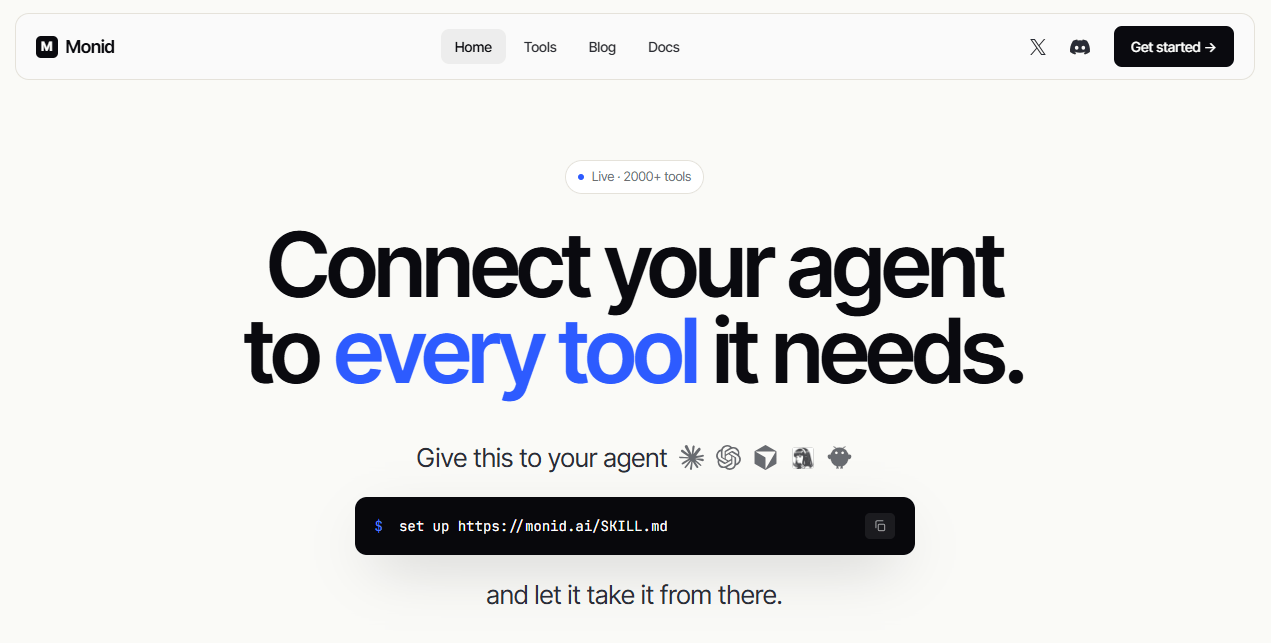
At its most fundamental level, Monid.ai is a polymorphic abstraction layer for the API economy. For the developer, it looks like a single endpoint. For the agent, it looks like an infinite library of capabilities.
When we look at the architecture of a modern agent, we usually see a "static toolset." The developer decides at design time that the agent will use Google Search and a specific weather API. If the agent realizes mid-task that it needs to check a company’s financial health on Wokelo or scrape a niche Reddit thread, it’s stuck. It can’t "buy" its way out of the problem because it doesn't have access to the credentials.
Monid.ai solves this by providing a unified gateway to 2,015 tools. It functions as a proxy that manages the authentication, routing, and metering for some of the world's most powerful APIs, from People Data Labs to Seedance 2.5.
The "Single Balance" philosophy is the heart of this concept. Instead of managing a dozen different billing cycles, you fund one Monid account. This balance is liquid. It can be spent on a $0.0013 call to OpenWeather in one second and a $0.10 lead enrichment call to Apollo the next. This liquidity transforms the agent from a pre-programmed script into a resource-aware entity that can optimize its own operations based on the budget you provide.
The simplicity of the integration is, frankly, startling. For agents that support markdown-based capability definitions, the entire setup is a single line: $ set up https://monid.ai/SKILL.md. This command doesn't just "install" a tool; it hands the agent the keys to a kingdom. It provides the system prompt with the logic required to search the Monid registry, inspect schemas, and execute calls. As a tech journalist who has seen thousands of "revolutionary" APIs, this is the first time I’ve seen the "one line of code" promise actually delivered for a toolset of this magnitude.
Breaking the Subscription Model: The Pay-Per-Call Revolution
The most disruptive claim in the Monid.ai documentation is four words long: "We killed the subscriptions." To an architect, this is a beautiful thing. To a SaaS CFO, it’s a nightmare.
The Total Cost of Ownership (TCO) Analysis
Let’s look at the traditional enterprise math. To build a comprehensive "Sales Intelligence Agent," you might need:
Apollo.io for leads ($49/month minimum)
ElevenLabs for voice outreach ($22/month minimum)
Apify for web scraping ($49/month minimum)
Exa for semantic search ($50/month minimum)
You are looking at nearly $200 a month in "overhead" before your agent has even made its first call. Most of these credits will expire at the end of the month, unused. This is "zombie SaaS" at its worst.
Monid.ai replaces this with a pure, granular pay-per-call model. If a call to a specific data enrichment tool costs $0.0013, that is exactly what is deducted from your balance. There are no tiers, no monthly recurring costs (MRC), and no "Pro Plan" barriers. This allows for a linear cost-to-value ratio. If your agent performs five tasks, you pay for five tasks. If it performs a million, you pay for a million.
The Liquidity of a Universal Balance
The architectural benefit of the single balance cannot be overstated. Consider the terminal output of a Monid-enabled agent: ~/agents/research-bot balance · $ 2.989
This isn't just a number; it’s a measure of the agent's potential energy. That $2.989 is valid for every tool in the registry. This eliminates the "procurement latency" that kills agentic autonomy. In a legacy system, if an agent needs a new tool, it has to stop, alert the human developer, wait for them to sign up, add a credit card, and update the .env file. With Monid, the agent just checks its balance and proceeds.
For the builder, this means you can prototype complex, multi-modal workflows with almost no capital risk. Monid even offers $1 in free credit to start. In a world where tools cost $0.0013 per call, that $1 is effectively a massive playground for thousands of test runs. This low barrier to entry is what will drive the next wave of "long-tail" agents, specialized bots that do one specific task once a week, where a subscription would be economically impossible.
The Discovery Engine: How Agents Find Tools
One of the greatest challenges in AI today is the "context window saturation" problem. If you have 2,000 tools, you cannot possibly cram the system prompts and JSON schemas for all of them into a single LLM call. Even with 128k context windows, the "lost in the middle" phenomenon makes the agent unreliable when faced with too many choices.
Monid.ai solves this through monid.discover(). This function turns the agent into a "Tool Scout."
Runtime Strategy and Economic Agency
Instead of the developer hard-coding a tool, the agent describes its need. For example, if the agent is tasked with comparing OpenAI vs. Anthropic, it doesn't just go to a search engine. It executes: monid_discover("competitor compare")
The Monid discovery engine then returns a ranked list of candidates. This is where the "Architect" persona gets excited. The ranking isn't just semantic; it’s economic and performance-based. The agent might see:
strale /x402/competitor-compare · $0.011/call
exa /search · $0.01/call
pdl /v5/company/enrich · $0.10/match
The agent now has to make a choice. This is "Agentic Orchestration" in its purest form. Does it spend 1.1 cents for a highly specialized "competitor compare" endpoint from Strale, or does it try to do the work itself using a 1-cent semantic search from Exa? This decision-making process happens at runtime, without human intervention. It allows agents to be "resource-aware," choosing cheaper tools for simple tasks and premium tools when precision is paramount.
The monid_inspect() Protocol: Look Before You Leap
After discovery, the agent doesn't just blindly fire a request. It uses monid_inspect(). This is a critical safety and efficiency step. The inspection returns the exact JSON-RPC schema and the current pricing. This ensures the agent understands the input requirements (e.g., does it need a ticker symbol or a company name?) and confirms that the cost won't exceed its budget. This prevents "hallucinated" tool calls and keeps the agent's state management consistent across thousands of disparate APIs.
Executing at Runtime: The monid_run Workflow
Once discovery and inspection are complete, the agent moves to the execution phase. This is handled by the monid_run command (note the syntax preference for underscores in execution logic, as seen in the Monid technical snippets).
The Technical Orchestration Flow
The monid_run command is a masterpiece of backend abstraction. When the agent calls monid_run('api.strale.io', '/x402/competitor-compare'), a complex series of events occurs behind the scenes:
Auth Abstraction: Monid identifies the provider (Strale) and pulls the necessary API key from its own managed, high-throughput credential pool.
Request Routing: The request is routed through Monid’s secure infrastructure, which handles retries and circuit-breaking if the provider is down.
Metering: Monid records the successful call and debits the user's balance by the precise amount ($0.011 in this case).
Response Sanitization: The data is returned to the agent in a clean, consistent format, ready for processing.
From the developer's perspective, this is "Stateless Tool Execution." You don't need to maintain local state for forty different API clients. You don't need to worry about pip installing a new library for every tool. The agent interacts with the world through a single, stable interface.
Zero-Friction Scaling
Because no sign-up is needed for individual providers, scaling an agent's capabilities is instantaneous. If you decide your agent now needs to handle 3D modeling, you don't change your code; you just broaden the scope of what the agent is allowed to "discover." The Monid balance handles the rest. This creates a "plug-and-play" architecture that was previously impossible in the brittle world of REST API integrations.
The Massive Tool Ecosystem: 2,000+ Capabilities
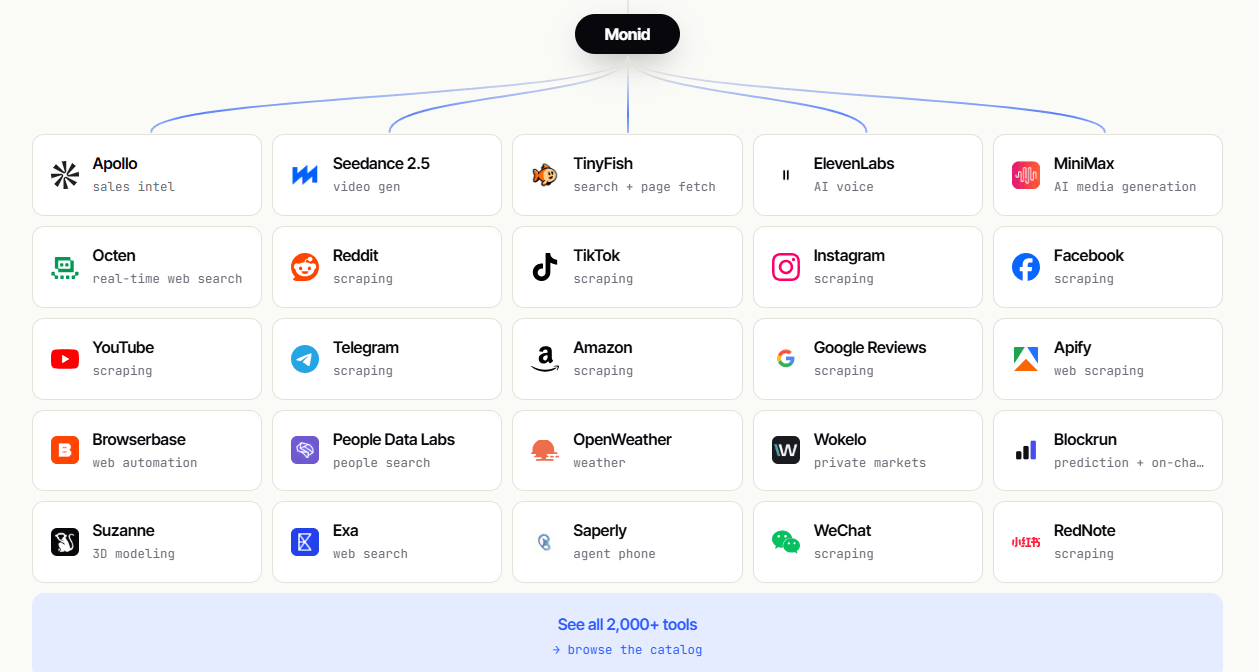
Monid.ai's real power lies in the diversity of its registry. It isn't just a collection of "wrappers"; it’s a curated list of the most high-leverage tools available for AI agents. Let’s take a narrative tour of how an agent actually lives and works within this ecosystem.
Data & Lead Generation: The "Venture Scout" Scenario
In the category of Data & Lead Gen, Monid features titans like Apollo, Sales Intel, and People Data Labs (PDL).
Day-in-the-Life: Imagine a "Venture Scout Agent" running on a Monid balance. It starts its morning by calling Octen for real-time news on Series A startups. It identifies a promising new company. Instead of stopping, it calls Wokelo to pull private market intelligence on the company’s competitors. It then moves to PDL to find the LinkedIn profiles of the founding team. Finally, it uses Apollo to retrieve the CEO's direct work email and mobile number. The agent has moved from "vague news item" to "qualified lead with contact info" in seconds, spending roughly $0.15 of its balance. No human was involved, and no CSVs were exported.
Media Generation: The "Viral Content Studio" Scenario
The media stack is world-class, including ElevenLabs (voice), MiniMax (AI media), Seedance 2.5 (video), and Suzanne (3D modeling).
Day-in-the-Life: A "Social Media Agent" is tasked with creating a video ad for a new product. It uses an LLM to write a script, then calls ElevenLabs to generate a narration in a professional "Silicon Valley" voice. Simultaneously, it calls Seedance 2.5 to generate 15 seconds of high-fidelity B-roll based on the script's themes. If the product requires a 3D walkthrough, it utilizes Suzanne to render a 3D model. The agent assembles these assets and prepares them for posting. The cost of this entire production? Less than a dollar, billed to the same Monid balance that paid for the lead gen research.
Search & Intelligence: The "M&A Due Diligence" Scenario
For intelligence, Monid provides Exa (semantic search), Octen (real-time), TinyFish (search + page fetch), and Saperly (agent phone).
Day-in-the-Life: An "M&A Due Diligence Agent" is investigating a potential acquisition. It uses Exa to find all blog posts and technical documentation written by the target company's CTO. It uses TinyFish to crawl their pricing page and detect recent changes. If it needs to verify a physical address or operational status, it can even utilize Saperly to place an automated phone call for verification. This is the "Physical-Digital Liaison" role that was previously the stuff of sci-fi.
Web & Social Scraping: The "Sentiment Arbitrage" Scenario
Scraping is usually a nightmare of proxies and rate limits. Monid offers specialized tools for TikTok, Instagram, Facebook, YouTube, Reddit, Amazon, Google Reviews, WeChat, and RedNote.
Day-in-the-Life: A "Hedge Fund Sentiment Agent" needs to know if a consumer brand is facing a backlash. It simultaneously scrapes the latest TikTok comments, Reddit threads, and Amazon reviews for a specific product SKU. It doesn't need to manage proxy rotations or handle TikTok's bot detection logic; Monid's specialized scraping providers handle the heavy lifting. The agent simply receives the raw text, analyzes the sentiment shift, and issues a "sell" alert.
Infrastructure & Automation: The "Legacy Navigator" Scenario
Finally, for tasks that require "hands-on" work on the web, there are Browserbase and Apify.
Day-in-the-Life: A "Government Liaison Agent" needs to check the status of a building permit on a legacy 1990s-era website that has no API. It calls Browserbase to spin up a headless browser, navigates the complex UI, and scrapes the permit status. This "browser-as-a-tool" capability ensures that the agent isn't limited by the availability of modern REST interfaces.
Three Ways to Connect: Integration Deep Dive
As a Senior Architect, I care about the "How" as much as the "What." Monid.ai is designed to be protocol-agnostic, supporting three distinct integration paths.
Skill: The "Agent-Native" One-Liner
The setup at https://monid.ai/SKILL.md is designed for frameworks that treat tools as "Skills." By pointing an agent to this URL, you are providing a Markdown-formatted instruction set. This is incredibly efficient because it leverages the LLM's inherent ability to parse documentation. The agent reads the SKILL.md, understands the monid_discover and monid_run syntax and immediately begins using the registry. It is the closest thing we have to "installing" a brain for an agent.
MCP (Model Context Protocol): The Enterprise Standard
For more robust architectures, Monid provides a remote MCP server. MCP is the emerging JSON-RPC standard for agent-tool communication. Adding a remote MCP server is a "set it and forget it" operation. Architectural Insight: Unlike local MCP servers that run on your machine, a remote MCP server offloads the compute and connection overhead to Monid's cloud. This is vital for agents running in resource-constrained environments or browser-based interfaces. The MCP connection maintains a persistent, structured context, allowing the agent to see all 2,000+ tools as native functions within its own environment.
CLI: The Developer’s Power Tool
For those of us who live in the terminal, the Monid CLI is indispensable. It allows you to debug your agent's potential moves. You can run monid balance to check your funds or manually test a discovery query like monid discover "lead enrichment" to see the exact candidates your agent will be looking at. This transparency is key for debugging "economic logic" errors where an agent might be choosing an overly expensive tool for a trivial task.
For the Builders: Becoming a Tool Provider
Monid.ai is not just a consumer platform; it is a marketplace. This is what I call the "App Store Moment" for APIs.
In the old economy, if you built a great API, say, a specialized tool for analyzing 3D medical images, you had to spend a fortune on marketing to developers. You had to build a landing page, an authentication system, a billing portal, and a documentation site.
On Monid, you can skip all of that. You apply to list your tool, and Monid handles the rest. They route agent traffic to your endpoint, meter every call, and handle the collection of funds from the users' single balances. You get a revenue share for every successful call your tool performs.
This creates a "Supply-Side" ecosystem where the best tools win based on performance and price, not who has the biggest marketing budget. For the AI agent, this is a dream; it has access to a constantly evolving marketplace of niche, high-performance tools that it can discover and use at runtime. For the API provider, it’s a way to tap into the massive and growing "Agentic Traffic" segment without the overhead of building a standalone SaaS business.
Pros and Cons
Pros of Monid.ai
Elimination of "API Key Hell": Replaces the friction of subscribing to and managing credential keys across dozens of individual platforms with a single managed gateway and entry point.
Pay-Per-Call Model Over Subscription Fatigue: Eliminates costly monthly recurring subscription tiers and unused "zombie SaaS" credits by charging strictly per successful API call.
Universal Liquid Balance: Uses a single, shared balance valid across 2,015+ tools and 69+ providers, allowing agents to access new tools instantly without waiting for human procurement or card additions.
Dynamic Runtime Discovery (monid.discover()): Solves LLM context window saturation by letting agents query tools dynamically at runtime and receive ranked, cost-conscious candidates.
Pre-Execution Inspection (monid_inspect()): Allows agents to check exact JSON-RPC input schemas and real-time costs before executing a tool, reducing hallucinated tool calls.
Framework-Agnostic & Rapid Setup: Integrates via a single line ($ set up https://monid.ai/SKILL.md), remote Model Context Protocol (MCP) servers, or CLI tools across frameworks like LangChain, CrewAI, AutoGPT, and custom loops.
Enterprise Rate-Limiting & Protection: Buffers traffic across an enterprise provider pool and protects user balances from charges if a provider API suffers an execution failure.
Developer Marketplace: Enables API creators to publish niche endpoints and monetize agentic traffic without building custom authentication or billing platforms.
Cons & Technical Considerations
Proxy Dependency & Abstraction: Routing, authentication, and metering depend on Monid’s central infrastructure and managed credential pool.
Multi-Step Execution Overhead: The workflow requires sequential steps, discovering (monid_discover), inspecting (monid_inspect), and running (monid_run), before receiving finalized tool output.
Economic Logic Complexity: Agents must be prompted or designed to handle cost-benefit choices at runtime (e.g., selecting a $0.01 general search vs. a $0.011 specialized comparison tool), requiring developer oversight to prevent poor tool choices.
Disruption to Traditional SaaS Revenue: The pay-per-call structure bypasses traditional recurring subscription models, which may create friction with providers that rely on fixed monthly subscriptions.
Frequently Asked Questions & Common Concerns
Based on my deep dive into the Monid documentation and the 2026 tech landscape, here are the critical technical answers for developers.
Do I need API keys for each provider?
No. This is the core value proposition. Monid acts as the "Key Master." You only need your Monid credentials. Their infrastructure handles the provider-level authentication, allowing you to use 2,015+ tools with a single point of entry.
How is pricing structured?
It is strictly pay-per-call. There are no monthly fees. Each tool has a specific price (e.g., $0.0013 for a weather call or $0.10 for a deep data match). These costs are debited from your universal balance. This makes your agentic costs 100% variable and 0% fixed.
A provider failed. Do I get charged?
The Monid system is built for agentic reliability. If a tool call fails on the provider’s side (e.g., a 500 error from Apollo), your balance is typically protected. Monid's metering is based on successful execution and routing, providing a layer of "transactional integrity" that you don't get when calling APIs directly.
Which agent frameworks are supported?
Monid is framework-agnostic. Because it supports the Model Context Protocol (MCP), a standard CLI, and a markdown-based Skill definition, it can be integrated into AutoGPT, LangChain, CrewAI, or even a simple Python loop using the OpenAI SDK.
What about rate limits?
Monid acts as a Rate Limit Aggregator. Instead of being stuck with the rate limits of a "Free Tier" account on twenty different sites, you benefit from Monid’s enterprise-level throughput across its provider pool. They act as a buffer, smoothing out the bursts of traffic typical of autonomous agents.
Conclusion: Is Monid.ai the Future of Agentic Workflows?
The transition from "scripts" to "agents" requires a fundamental rethink of our infrastructure. We cannot expect autonomous entities to thrive in a world designed for human procurement and monthly billing cycles.
Monid.ai has successfully identified the friction points that have been holding the industry back: the lack of tool discovery, the complexity of multi-provider authentication, and the inefficiency of the subscription model. By solving these through a single, discovery-first API, Monid is enabling a new class of Autonomous Economic Agents.
If you are tired of managing a graveyard of API keys and paying for subscriptions you only use 10% of the time, the solution is already here. You can start with $1 in free credit and watch your agent navigate a world of 2,000+ tools with the same ease that a human navigates an App Store.
In the 2026 landscape, we don't build integrations anymore. We build agents, and we let Monid.ai give them the tools they need to succeed. Monid isn't just a platform; it’s the clearinghouse for the future of AI.


Ako Reviews Blog is a platform dedicated to helping online businesses reach their full potential. It offers in-depth guides on product reviews, social media marketing, and comprehensive online business strategies. Whether you're an entrepreneur or a marketer, Ako Reviews Blog provides practical tips and expert insights to help you grow and succeed in the digital marketplace.
Stay informed with valuable tips delivered straight to your inbox.
Created with systeme.io 2026 | Home | Privacy Policy | Terms and Conditions | Disclaimer | Contact