
Top 5 Features of the Semrush AI Visibility Toolkit You Should Know
Top 5 Features of the Semrush AI Visibility Toolkit You Should Know
The digital search landscape is currently undergoing its most seismic shift since the introduction of the first ranking algorithms. We have officially exited the era of the simple "blue link" and entered the age of the synthesized answer. Today’s consumers are bypassing the traditional search engine results page (SERP) in favor of interactive, conversational experiences within platforms like ChatGPT, Google’s AI Mode, and Perplexity.
For brands, this isn't just a technical update; it’s an existential challenge. In the old world, you optimized for keywords to land on page one. In the new world of Generative Engine Optimization (GEO), if a Large Language Model (LLM) doesn’t include your brand in its generated response, you simply don’t exist for that user. This is the "Zero-Click Reality" taken to its ultimate conclusion.
AI Visibility is the new critical layer of digital marketing. As defined by the Semrush ecosystem, it is the measurement of how brands appear in AI-generated answers beyond traditional search rankings. The risk of being "invisible" to these models is no longer a theoretical threat; it is a direct drain on your conversion pipeline. To combat this, Semrush launched the AI Visibility Toolkit in 2025, providing marketers with the first comprehensive dashboard to benchmark, track, and optimize their presence in the LLM training sets and real-time retrieval systems that define modern discovery.
1. AI Visibility Score & Regional Benchmarking: The Strategic Health Check
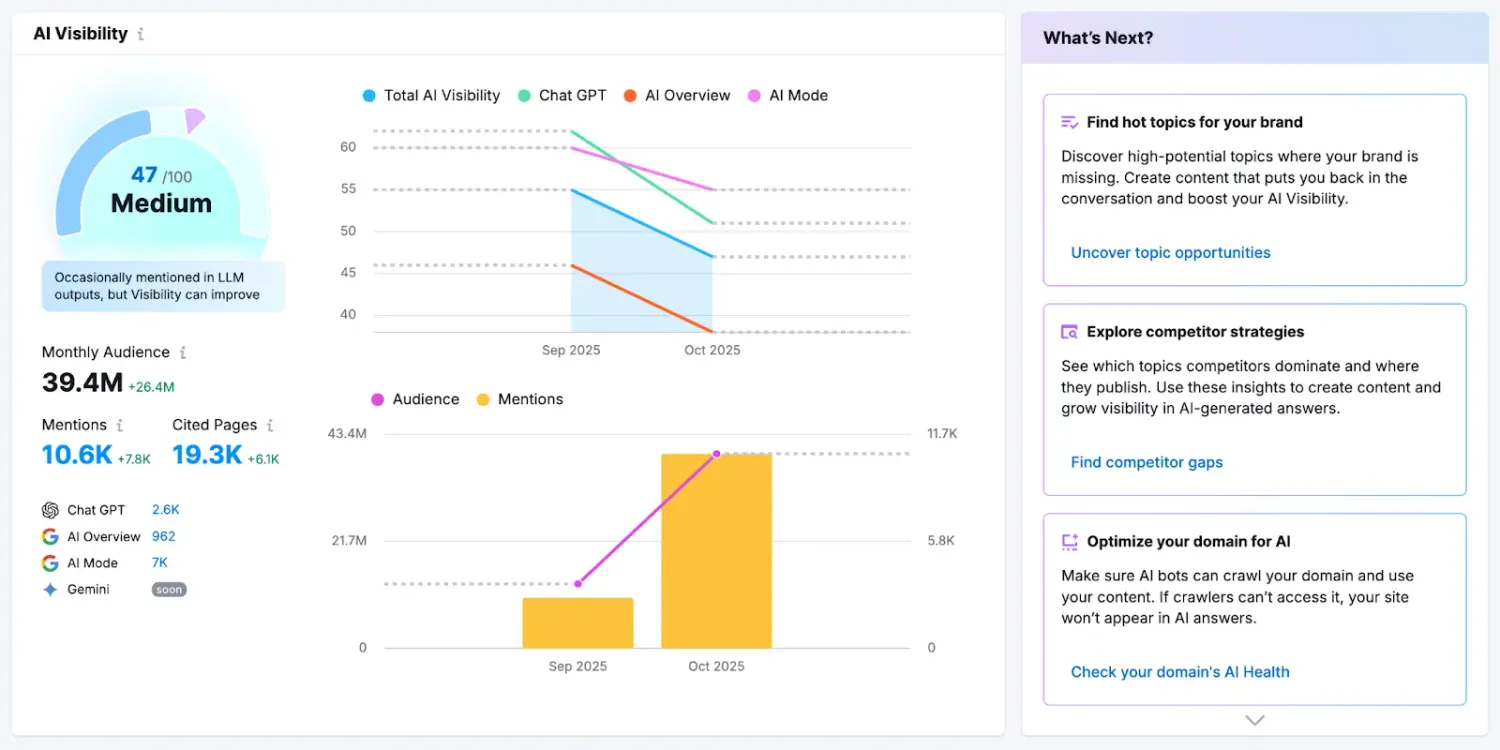
Before you can fix your visibility, you must benchmark your current authority. The Visibility Overview report serves as your command center for understanding brand health within the AI ecosystem.
The Mechanics of the AI Visibility Score
The centerpiece of this report is the AI Visibility Score. This isn't just a vanity metric; it is a weighted calculation reflecting how often your brand is mentioned in AI-generated answers relative to the Category Median.
Why it matters: In traditional SEO, a ranking of #3 is constant regardless of how many times the #1 spot is mentioned. In AI Search, visibility is fluid. The toolkit automatically identifies your top industry competitors and calculates the median number of mentions across thousands of representative queries. If your AI Visibility Score is lower than the median, you are being de-prioritized by the model's recommendation engine.
Step-by-Step Walkthrough:
1. Select Your Scope: Open the Visibility Overview and enter your domain.
2. Toggle the Geography: Use the regional dropdown. While you can view data on a Worldwide scale, the strategist’s move is to drill down into the 15 specific regions currently supported (including the US, UK, Canada, France, Japan, and more). AI models are fine-tuned differently across borders; what ChatGPT says about you in London may differ significantly from what it says in Tokyo.
3. Analyze the "Big Three" Metrics:
AI Visibility Score: Your high-level authority benchmark.
Share of Voice (SOV): The percentage of total category mentions you own.
Mentions & Citations: The raw count of how many times the AI refers to your brand name and—crucially—how often it provides a link back to your site as a source.
Pro Tip: The Category Median Strategy. Don't just look at your own score. If your AI Visibility Score is 45 but the Category Median is 70, the AI perceives a "consensus" around your competitors that you haven't reached. Use this data to justify the budget for high-authority content that reinforces your brand’s core pillars.
2. Advanced Competitor Research & Gap Analysis: Uncovering the "Why" Behind Their Mentions
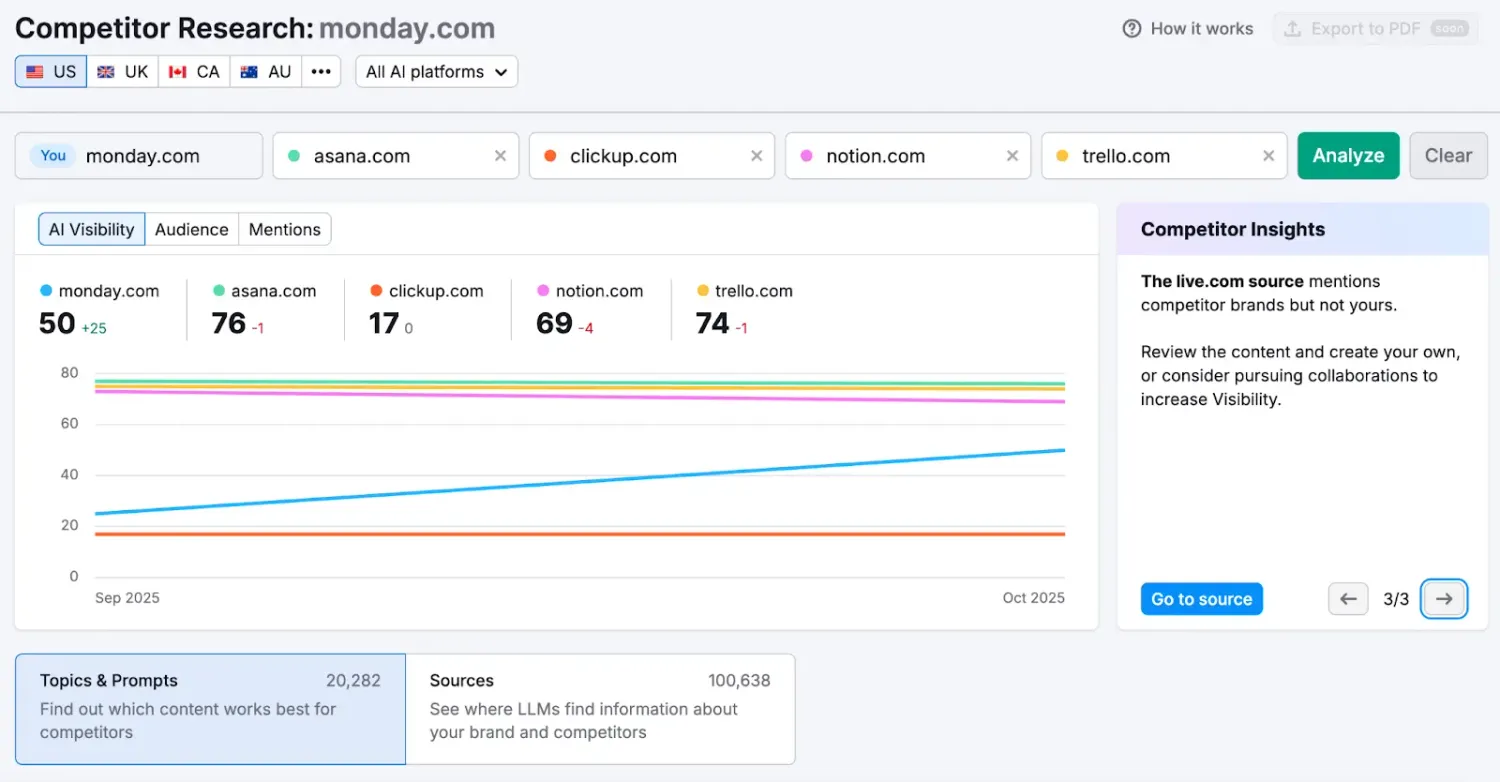
In the age of AI, traditional "Keyword Gap" analysis is insufficient. You need to understand Prompt-level gaps. The Competitor Research report identifies the specific, high-intent conversations where your competitors are getting the spotlight while your brand remains in the shadows.
Identifying Citation Sources
LLMs are not creative writers; they are sophisticated synthesizers. They rely on a diet of high-authority external domains, industry publications, niche blogs, and technical forums. This feature identifies the "Citation Sources" feeding the LLMs' knowledge about your competitors.
Step-by-Step Walkthrough:
1. Enter Competitor Domains: Input up to three competitors to see a side-by-side comparison of visibility strength.
2. Filter by "Prompt Gaps": Look for prompts where the competitor has a high mention rate, but your brand has zero. These are your "low-hanging fruit" opportunities for content creation.
3. Export the Citation List: Navigate to the "Citation Sources" tab. This list reveals the specific URLs the AI is referencing to validate the competitor’s claims.
Pro Tip: The PR Pivot: Treat the "Citation Source" list as your new PR hit-list. If a specific publication like TechCrunch or a niche blog like MarTech Today is consistently cited by ChatGPT for your competitor's features, that domain has high "AI Authority." Focus your guest posting and outreach efforts there to "poison the well" in your favor.
3. Prompt Research & Tracking: The New Keyword Research
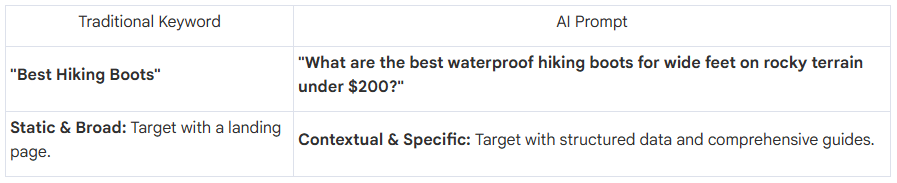
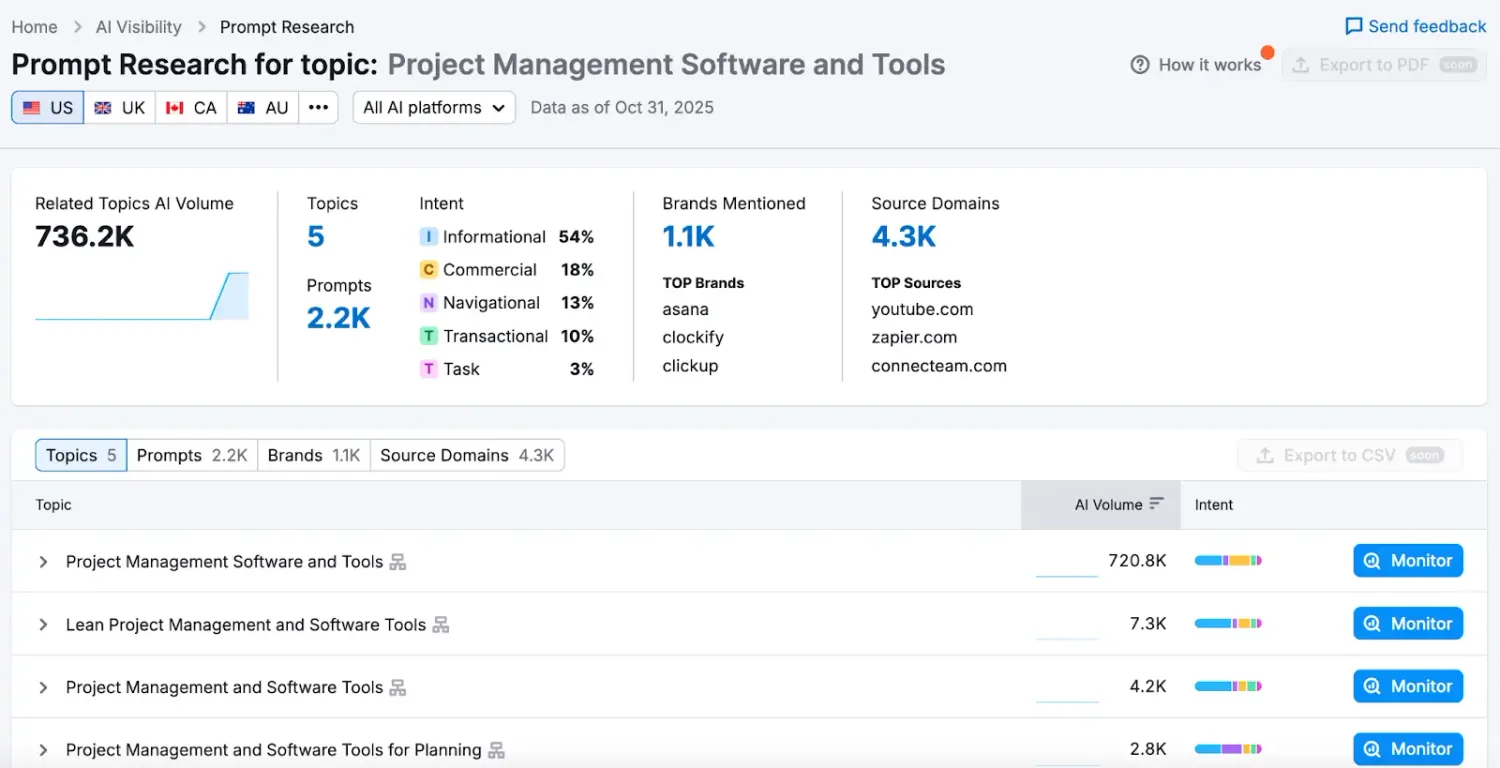
We are witnessing the transition from keywords to prompts. While keywords are often fragmented (e.g., "CRM software"), prompts are conversational, context-heavy, and intent-rich (e.g., "What is the best CRM for a mid-sized marketing agency that needs HubSpot integration?").
Prompt Research is essentially keyword research for the AI era. It allows you to enter "seed prompts" to find related high-value topics, topic-level volume, difficulty scores, and user intent patterns.
The "Keyword vs. Prompt" Shift
Daily Prompt Tracking
Once you’ve identified your high-value prompts, you must monitor them. The Prompt Tracking tool supports 220+ countries and territories, tracking your presence across major platforms like ChatGPT and Google AI Mode.
Why it matters: Unlike Google rankings, which might stay stable for weeks, AI responses can fluctuate based on new data ingestions or model updates. Semrush provides Daily Updates, allowing you to see the immediate impact of your GEO efforts or PR wins.
4. Brand Performance & Sentiment Analysis: Mastering the Narrative
Visibility is only one side of the coin. If an AI mentions your brand but describes your product as "difficult to use" or "overpriced," high visibility actually becomes a liability. The Brand Performance suite uses LLMs to analyze not just if you are mentioned, but how you are perceived.
Analyzing Narratives and Sentiment
This tool analyzes vast collections of queries to identify:
Sentiment: Positive, neutral, or negative.
Narratives & Attributes: What are the key themes the AI associates with you? (e.g., "innovative," "reliable," or "steep learning curve").
Buyer-Intent Signals: How the AI’s tone changes when a user is in the "consideration" phase versus the "ready to buy" phase.
AI-Generated Strategic Recommendations
The most powerful aspect of this report is the "Strategic Recommendations" section. The tool doesn't just give you a sentiment score; it acts as a consultant.
Example Recommendation: "AI sentiment is neutral regarding your 'pricing' attribute. Shifting your content tone from 'affordable' to 'premium value' could align better with current user intent patterns observed in ChatGPT."
Pro Tip: Localized Sentiment Use the vast geographical coverage (68,000+ location options) to see if your brand narrative is slipping in specific cities or states. A localized sentiment drop often precedes a regional sales dip.
5. AI Search Site Audit & Technical Readiness: The Technical Insurance Policy
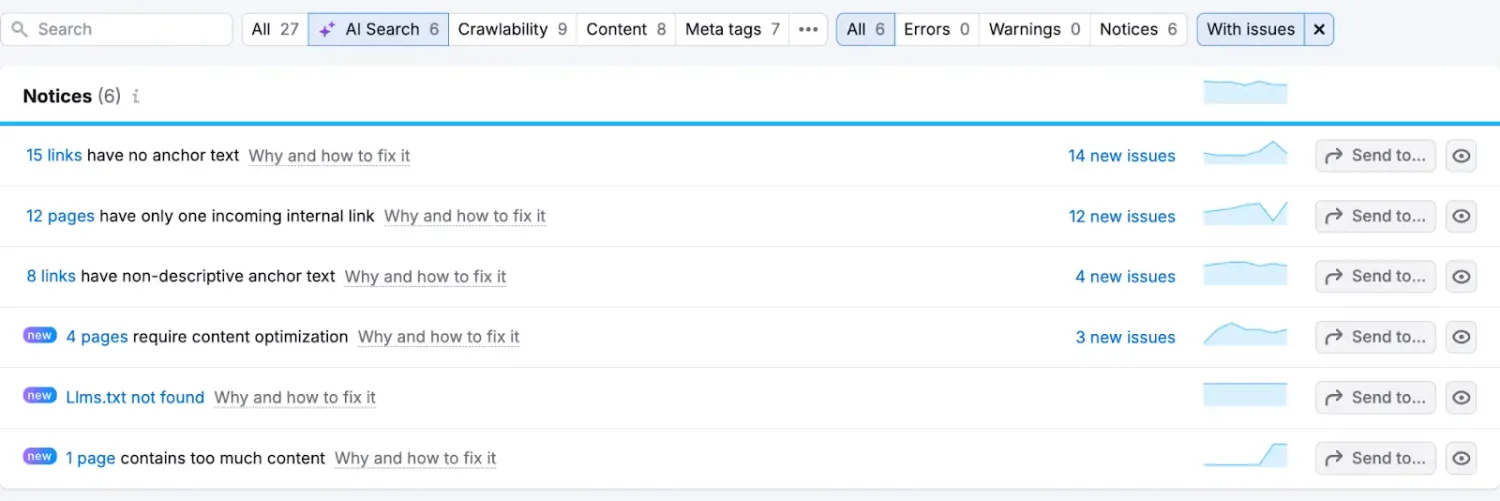
Even world-class content will fail if it’s technically "invisible" to AI crawlers. Inside the standard Semrush Site Audit tool, the AI Search Health widget serves as your technical insurance policy.
Solving the "Blocker" Problem
The tool flags specific technical hurdles that prevent LLMs from effectively "reading" your site:
Missing llms.txt file: This is an emerging industry standard (similar to robots.txt) that provides LLMs with a clean, structured view of your site’s most valuable content. Without it, bots may ingest "noise" rather than your "signal."
Links without Anchor Text: AI bots rely heavily on descriptive anchor text to understand the relationship between pages. "Click here" tells an AI nothing; "Read our guide on AI search visibility" tells it everything.
Content Optimization for Bots: Flags pages where the HTML structure is too cluttered for efficient AI parsing.
Why it matters: Technical debt is the "hidden killer" of GEO. If the bot can't crawl you, the model can't cite you.
Implementation & Scalability: Pricing and Plan Limits
The AI Visibility Toolkit is designed to scale with your organization, from individual consultants to global enterprises.
Pricing Structure
The standalone AI Visibility Toolkit is $99/month. It is important to note that this standalone toolkit does not include a free trial. However, for teams looking for a holistic strategy, the toolkit is bundled into the Semrush One plans (Starter, Pro+, and Advanced), which do offer a 7-day free trial for the entire platform.
Comparison Table: Limits and Scale
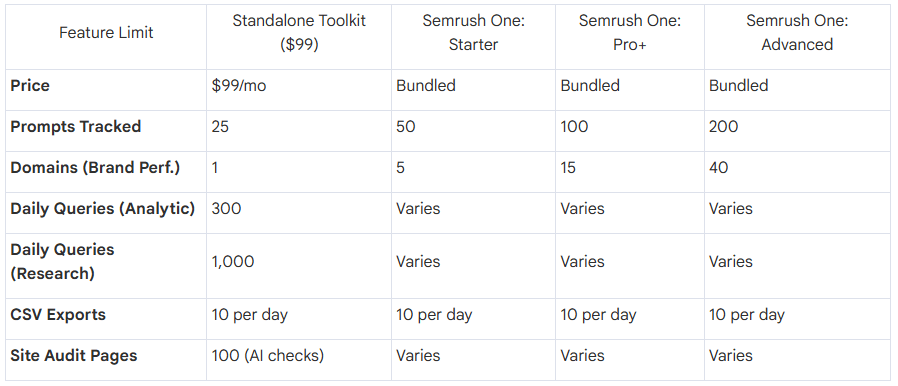
Note: Additional domains for Brand Performance can be purchased for $99/mo each, and you can add 50 more prompts to your tracking limit for $60/mo.
Frequently Asked Questions
What Is the Semrush AI Visibility Toolkit?
The Semrush AI Visibility Toolkit is a specialized suite of tools designed to help brands measure and manage their presence in AI-generated search results beyond traditional search engines. It allows marketers to monitor how their sites are positioned across major AI systems like ChatGPT, Perplexity, and Google AI Mode.
Why You Should Use the Semrush AI Visibility Toolkit?
You should use this toolkit to benchmark your brand’s AI presence and ensure you aren't losing potential customers who use AI platforms for research. It helps you understand brand sentiment, how AI describes your brand compared to competitors, and identifies missing mentions or citations that could weaken your perceived authority. Additionally, it allows you to spot visibility gaps where competitors are being cited, but you are not, providing a clear roadmap for improving your footprint in AI results.
How Does the Toolkit Enhance Your SEO Strategy?
The toolkit enhances your strategy by bridging the gap between traditional SEO and AI-driven search through several key features:
AI Search Site Audit: It identifies technical blockers, such as a missing llms.txt file or anchor text issues, that might prevent AI bots from crawling your content.
Prompt Research: Similar to keyword research, this tool helps you discover high-value AI prompts and topics your audience is actually using, allowing you to target high-intent conversations.
AI SEO Content Optimization: Inside the Content Toolkit, you can use the “AI SEO” feature to evaluate drafts and receive suggestions to make your content more interpretable for AI platforms.
Competitive Intelligence: You can see which external publications and sources consistently cite your competitors in AI answers, giving you a targeted list for outreach and PR.
When Is the Best Time to Implement the Toolkit?
The best time to implement the toolkit is now, as search visibility becomes increasingly unpredictable due to the rise of AI-powered search features. It is particularly critical to start when you notice competitors gaining ground in AI-generated answers or when you want to transition your marketing from guess-based planning to a data-driven, AI-first workflow.
Where to Access the Semrush AI Visibility Toolkit?
You can access the toolkit directly through the Semrush platform. It is available as a standalone subscription for $99 per month or as part of Semrush One plans (Starter, Pro+, and Advanced), which bundle SEO and AI visibility tools together. A free AI Visibility Checker is also available among Semrush's free tools for those looking to get a quick initial assessment.
Actionable Conclusion: Your AI Visibility Roadmap
To secure your first-mover advantage in the generative era, you must treat AI Visibility as a continuous cycle, not a one-time project.
Follow this 5-step workflow:
1. Audit: Run an AI Search Site Audit. Ensure your llms.txt is live and your anchor text is descriptive.
2. Research: Use Prompt Research to identify the conversational questions your audience is actually asking.
3. Benchmark: Check your AI Visibility Score in the Overview report to identify your current standing against the Category Median.
4. Track: Set up Prompt Tracking for your top 25-200 prompts to monitor daily volatility.
5. Optimize: Use Brand Performance insights to refine your narrative. If the AI thinks you’re "budget," but you’re "premium," update your content signals immediately.
Ready to start? While the standalone toolkit is a paid add-on, you can explore the full power of Semrush, including these AI features, with a 7-day free trial of Semrush One.


Ako Reviews Blog is a platform dedicated to helping online businesses reach their full potential. It offers in-depth guides on product reviews, social media marketing, and comprehensive online business strategies. Whether you're an entrepreneur or a marketer, Ako Reviews Blog provides practical tips and expert insights to help you grow and succeed in the digital marketplace.
Stay informed with valuable tips delivered straight to your inbox.
Created with systeme.io 2026 | Home | Privacy Policy | Terms and Conditions | Disclaimer | Contact