
How Solo Marketers Are Replacing Agencies with AI Workflows
How Solo Marketers Are Replacing Agencies with AI Workflows
The traditional marketing agency model is a relic of a high-friction, high-cost era that is rapidly collapsing under its own weight. For over a decade, I’ve sat in the boardrooms where $200,000-per-month retainers were the norm, budgets that primarily funded junior account managers to move data between spreadsheets and creative directors to spend weeks on a single campaign concept. That model is no longer just inefficient; it is a liability.
In the current landscape, complexity is no longer a proxy for scale. It is a sign of operational drag. We have entered the era of the AI-first marketing platform, where the "friction" that once required a team of fifty can now be managed by a single strategist with the right architecture. This is the rise of the Agency-of-One.
The definitive shift occurred recently when Semrush became an Adobe company.
This acquisition wasn't just a corporate merger; it was a strategic signal. It represents the unification of Adobe’s enterprise-grade creative and experience power with Semrush’s 17 years of deep search intelligence. For the solopreneur, this means you are no longer bringing a knife to a gunfight. You are wielding a central nervous system that allows you to out-execute multi-million dollar agencies by leveraging hyper-personalization at scale and total automation of the "grunt work."
The Solo Marketer 2.0 does not manage people; they manage workflows. They don't hire departmental specialists; they consolidate their tech stack to eliminate data silos. By using a platform like Semrush One, the modern solopreneur replaces the "agency floor" with a single interface, turning strategy into the only remaining bottleneck.
The Engine Room: Unifying Authority with Semrush One
The Agency-of-One model only survives if it rests on a foundation of absolute data integrity. If your data is scattered across five different tools, you aren't an architect; you're a data entry clerk. To function at an enterprise level, you need a "Single Source of Truth" that collapses traditional marketing silos.
Semrush One is that central engine. It is the leading platform that unifies traditional SEO authority with the new frontier of AI visibility. When I talk about "authority," I am talking about the sheer scale of intelligence required to influence both Google’s algorithms and Large Language Models (LLMs) like ChatGPT and Claude.
As a solopreneur, you are now commanding a data lake of staggering proportions:
28 Billion Keywords: A comprehensive universe of search intent, allowing you to find every micro-niche and long-tail opportunity.
43 Trillion Backlinks: The world’s largest database for building the credibility and "trust signals" that LLMs use to decide who to cite.
213 Million+ LLM Prompts: A specific dataset focused on the conversational queries users are actually feeding into AI search tools.
808 Million Domain Profiles: Providing a "secret superpower" of market insights into every competitor in your niche.
By centralizing these assets, Semrush One collapses the following agency silos into a single, high-speed interface:
The Technical SEO Silo: Replaced by automated, recurring audits that flag everything from broken links to the absence of AI-specific crawl files.
The Content Marketing Silo: Replaced by real-time optimization engines that reverse-engineer what Google and AI platforms reward today, not six months ago.
The Public Relations Silo: Replaced by AI PR Toolkits that identify which journalists and outlets the LLMs actually trust and cite.
The Paid Media Silo: Replaced by the Ads Launch Assistant, which handles asset creation, budget allocation, and real-time optimization.
Workflow #1: Mastering the New Search Frontier (AI Visibility)
The game has changed. Your target audience is no longer just "Googling it." They are asking ChatGPT for product recommendations, asking Perplexity to summarize the best B2B software, and using Google’s AI Mode to bypass traditional blue links. To win as a solopreneur, you must track your brand's presence inside the generative answer.
This is where the AI Visibility Toolkit becomes your most valuable asset. It introduces the AI Visibility Score, a 0-100 metric that tells you exactly how often your brand appears in AI-generated answers. In my experience, a low score is a death sentence for top-of-funnel discovery. If the AI doesn't know you exist, you don't exist.
Deep Dive: The AI Visibility Architecture
To master this, you need to understand the technical "why" behind the score. LLMs don't just "know" things; they crawl, index, and cite.
Technical AI Audits: Use the Site Audit tool to run a specialized LLM visibility audit. It looks for technical barriers like "links with no anchor text" (which confuse AI crawlers) and, most importantly, the presence of an llms.txt file.
What is llms.txt? Much like robots.txt tells search engines where to go, the llms.txt file provides LLMs with a clean, structured view of your key content. It helps AI systems interpret your site’s architecture without the "noise" of heavy code or irrelevant UI elements.
Prompt Research & Seed Methodology: You cannot optimize for what you don't measure. Use the Prompt Research tool by entering a "seed prompt" (e.g., "What is the best CRM for solopreneurs?"). The tool will generate a comprehensive list of related high-value prompts and user questions.
Competitor Prompt-Level Gaps: This is where you steal market share. The Competitor Research tool lets you see specific prompts where your competitors (like Google, Samsung, or Apple, who currently hold massive Share of Voice in ChatGPT) appear, but not where you do. By identifying these gaps, you can create content specifically designed to "intercept" those citations.
Your Daily Routine for Monitoring AI Visibility
08:00 AM – The Pulse Check: Open the Visibility Overview report. Note your 0-100 AI Visibility Score. Is it rising? If not, check the Overall Sentiment. If AI platforms are describing your brand with neutral or negative sentiment, your conversion rates will crater regardless of traffic.
08:15 AM – Prompt Tracking: Check the Prompt Tracking tool for your "Money Prompts." These are the high-intent questions that lead directly to sales. See how your visibility shifts day-over-day across ChatGPT, Perplexity, and Google AI features.
08:30 AM – Gap Identification: Run a quick Competitor Research scan. Look for "citation sources" that your competitors benefit from. If a specific industry publication is being cited as the source for your competitor’s AI mention, that publication becomes your #1 PR target for the week.
08:45 AM – Technical Health: Scan your Site Audit for AI-specific errors. Ensure your llms.txt is active and that your key pages are "AI Search Ready" via the AI SEO check.
Workflow #2: Content Operations at Enterprise Scale
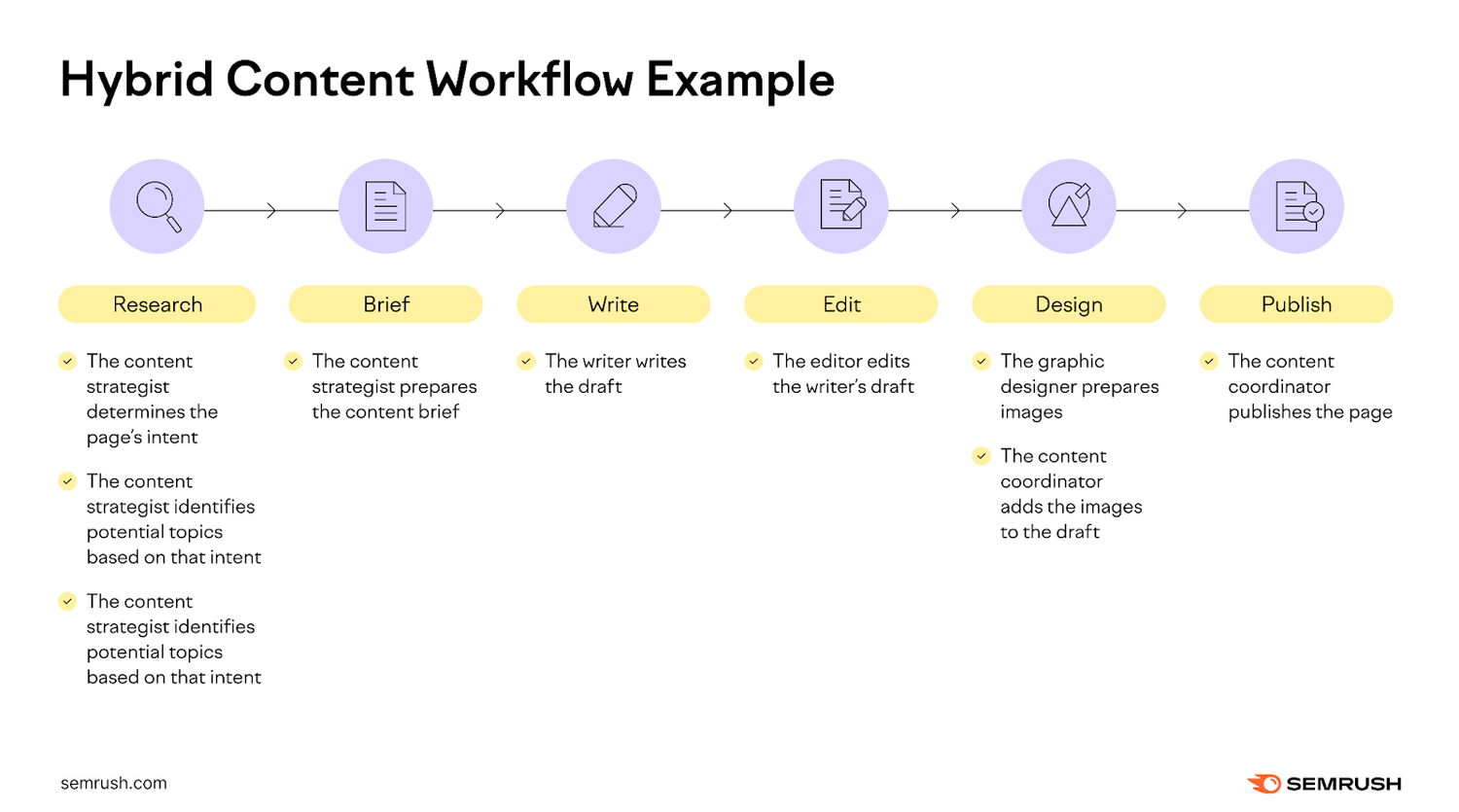
The Agency-of-One does not waste time staring at a blinking cursor. We focus on Content Architecture. In this workflow, AI handles the heavy lifting of production—generating drafts and ensuring SEO alignment, while the human strategist focuses on "weird ideas" and creative risks.
The Draft-to-Optimize Pipeline
Step 1: Strategic Clustering
Stop guessing which keywords to target. Use the Keyword Strategy Builder to group thousands of terms into pillars and subtopics automatically. This builds "topical authority," signaling to search engines that you aren't just writing a post; you are an expert on the entire subject.
Pay close attention to Personal Keyword Difficulty (PKD%). Unlike a generic difficulty score, PKD% tells you how hard it is for your specific domain to rank. If your PKD is 80%, move on; if it's 30%, that’s your entry point.
Step 2: AI-Powered Drafting
Feed your pillar keywords into the AI Article Generator. This isn't just a "text bot"; it's an engine that understands search intent.
Inside the content editor, click the “AI SEO” button in the right-hand panel. The tool evaluates the draft for AI search readiness and provides suggestions on terminology and structure to make your content more likely to be cited by LLMs.
Step 3: Real-Time Reverse Engineering
The Content Optimization feature analyzes the current top-ranking pages for your keyword. It provides real-time guidance on headings, subtopics, and "semantic gaps" that your competitors missed. This cuts the hours usually spent manually analyzing the SERPs.
The Strategy Check: According to a recent MIT study, an overreliance on AI can actually reduce creativity over time. AI is built on patterns, which means it is inherently "average." To win, use AI for the structure and data, but then inject the "human moat", the scrappy, emotional, or polarizing ideas that make B2B content memorable. Block time for "no-prompts-allowed" creative sessions to ensure your brand doesn't sound like a robot.
Workflow #3: The High-Performance Ad Desk
Paid advertising used to require a media buying team and a creative agency. For the Agency-of-One, this is now a streamlined "Ad Desk." With rising CPCs and creative burnout, your only edge is speed of testing.
Leveraging AdClarity and Exploding Topics
Before you spend a dollar, you need to scout the territory. Use the Top Apps integration to access AdClarity and Exploding Topics.
Exploding Topics allows you to see which trends are gaining traction before they become competitive and expensive.
AdClarity lets you dissect your competitors' ad budgets and creative strategies.
Once you have your "winning angle," deploy the Ads Launch Assistant. This tool generates images, templates, and video-ready assets in minutes. You can customize text, colors, and layout directly in the tool, allowing you to launch twelve variations in the time it would take an agency to schedule a "creative kickoff."
Pro-Tip: The Conversational Ad Analyst
One of the most "power-user" moves is the MCP integration with Claude. You can pull your Advertising Toolkit data directly into a conversational workflow with Claude.
Ask Claude: "Compare my top three competitors' ad budgets and CPC trends over the last six months. Where are they under-investing?"
This provides instant, context-aware competitive intelligence that would normally take a data analyst three days to compile into a deck.
Workflow #4: The Automated PR & Local Presence Firm
"Earned media" (PR) and local search are often the most expensive agency retainers. The Solo Marketer 2.0 eliminates these by using automated agents to handle the "grunt work" of outreach and profile management.
The AI PR Toolkit: Getting Cited
The goal of PR in the AI era is not just a "link"; it is a citation. If the publications that LLMs trust talk about you, the LLMs will recommend you.
AI-Cited Media: Use this tool to see which outlets LLMs frequently reference in your niche. Each outlet is scored from 0 to 100 based on AI Media Visibility. Focus your energy only on the high-scoring outlets.
Journalist Discovery: Instead of manual lists, this tool finds reporters who are currently covering your specific category.
AI Outreach Writer: Use this to craft personalized, data-backed pitches. It uses AI Irrelevancy Detection to ensure you aren't spamming, keeping your monitoring focused on coverage that actually moves the needle.
Local Dominance: The GBP AI Agent
If you have a local presence, you don't need a local SEO firm. The GBP AI Agent automates your Google Business Profile:
Automated Audits: It runs a setup audit to find what’s hurting your local visibility (e.g., inconsistent NAP data or stale posts).
Scheduled Activity: It generates and publishes tailored GBP posts and photos on a schedule.
Review Management: It replies to new reviews using the specific brand tone you define, ensuring your profile stays active, a key signal for both local and AI rankings.
Workflow #5: Strategic Reporting & Traffic Benchmarking
To act as a high-level consultant, you must provide "C-suite level" insights. You need to show not just clicks, but Market Share in the new digital landscape.
The Traffic & Market Toolkit now allows you to measure traffic from over 20 different AI assistants, including Gemini, Claude, and Perplexity. This is the new "AI Visibility Index." In a world where ChatGPT’s Share of Voice is dominated by giants like Google (7.9%) and Samsung (7.4%), the solopreneur needs to know exactly where their traffic is being reallocated.
Deep Reporting with AI Summaries
The reporting burden is solved by My Reports AI Summaries. Instead of you spending hours interpreting complex data, the AI converts raw performance metrics into a clear narrative.
It identifies Trend Signals: "Your traffic from Perplexity increased 15% this month due to your new 'Comparison Guide' pillar."
It monitors Google AI Mode Visibility: This allows you to see exactly how Google’s new interface is changing click patterns in your niche, giving you the foresight to redirect budget before a traffic drop hits.
Trends API: For power users, you can bring this traffic data into your own custom GPT or Claude environment to create bespoke, automated reports for clients that look like they were produced by a 50-person research team.
The Human Moat: Why Solo Marketers Still Matter
As we consolidate our stacks and automate our workflows, we must remember the "Human Moat." AI is a tool of efficiency, not of judgment. There are three specific gaps highlighted by experts like Nikki Parsons that AI cannot fill. To thrive as an Agency-of-One, you must double down on these.
1. Building Relationships: AI can personalize an email, but it cannot navigate the "human friction" of a deal. AI doesn't understand when a champion gets promoted mid-cycle or how to handle a "no" from a risk-averse legal department. Those moments require a human to pick up the phone, record a custom video, or send a checklist that builds trust.
2. Adapting to Power Dynamics: AI cannot interpret silence. It doesn't see the tension on a Zoom call when a CFO joins unexpectedly. An experienced solopreneur senses a power shift and pivots the strategy in real-time. Use AI notetakers to capture the words, but use your human intuition to capture the tone.
3. Delighting with Creativity: AI is excellent at "polished and informative." It is terrible at being "weird, scrappy, or emotional." Creativity is an act of risk-taking. AI is built on the most probable outcome (patterns). To stand out in a sea of AI-generated content, you must take the risks the machine won't.
To survive the AI transition, your value must shift from "the person who does the work" to "the person who manages the architecture and the relationships."
Frequently Asked Questions
1. Why Are Solo Marketers Turning to AI Instead of Traditional Agencies?
Solo marketers are moving away from traditional agencies because the old model is increasingly seen as a relic of a high-friction, high-cost era. Traditional agencies often involve expensive retainers that primarily fund operational drag, such as junior managers moving data between spreadsheets or long timelines for single campaigns. By contrast, the "Agency-of-One" model allows a single strategist to use an AI-first architecture to manage the friction that previously required a team of fifty. This shift enables solopreneurs to out-execute multi-million dollar agencies by automating "grunt work," eliminating data silos, and leveraging hyper-personalization at scale.
2. What AI Tools Are Most Effective for Solo Marketers?
The most effective tools allow a solo marketer to function as a complete agency through a unified "central nervous system." Key tools include:
Semrush One: A unified platform that merges traditional SEO authority with AI visibility.
AI Visibility Toolkit: Crucial for tracking how often a brand appears in AI-generated answers (the AI Visibility Score) across platforms like ChatGPT and Perplexity.
Ads Launch Assistant: Reduces ad production time from hours to minutes by generating images, templates, and video-ready assets.
AI PR Toolkit: Identifies journalists and outlets that LLMs frequently cite, allowing solo marketers to build "AI trust" through earned press.
GBP AI Agent: Automates the management of Google Business Profiles, including posts, photo updates, and review replies.
AI Article Generator and Content Optimization: These tools automate technical SEO clustering and provide real-time guidance to ensure content is both search-ready and AI-search-ready.
3. When Should Solo Marketers Start Implementing AI Workflows?
The transition should begin immediately, as the landscape of search and discovery has already shifted. With the rise of AI assistants like ChatGPT, Gemini, and Perplexity, being "invisible" to AI platforms is described as a "death sentence" for top-of-funnel discovery. Marketers are encouraged to start their migration to AI workflows now to move away from "the grind" and toward "the architecture," ensuring they are not left behind by the collapsing traditional agency model.
4. Where Can Solo Marketers Find the Best AI Resources?
Solo marketers can find comprehensive data and educational resources through the following:
Semrush One Platform: Access to massive datasets, including 28 billion keywords, 43 trillion backlinks, and over 213 million LLM prompts.
Semrush Academy & Blog: Offers free certification courses on how AI is changing search, and practical guides on winning AI visibility.
AI Visibility Index: A resource for exploring the strategies used by current AI search leaders.
Spotlight Events: Industry gatherings (such as those in Amsterdam or London) where experts discuss integrating AI into SEO and content workflows.
5. How Is AI Changing the Landscape for Solo Marketers?
AI is fundamentally shifting the role of the marketer from "the person who does the work" to "the person who manages the architecture".
Automation of Routine: AI handles data-heavy tasks like campaign management, lead scoring, and technical audits, allowing marketers to focus on strategy and relationships.
New Discovery Channels: The landscape now requires optimizing for generative answers rather than just traditional "blue links," making the AI Visibility Score a critical metric for success.
The "Human Moat": As AI-generated content becomes standard, the landscape places a higher premium on human-specific skills, such as building complex B2B relationships, navigating power dynamics, and taking creative risks that AI cannot replicate.
Enterprise Power for Individuals: Acquisitions, such as Adobe’s purchase of Semrush, have democratized enterprise-grade intelligence, giving solopreneurs the same data power as global brands,,.
Conclusion: Starting Your 14-Day Migration
The transition from a manual marketer to a strategy-first Agency-of-One does not happen by accident. It happens by design. The goal is to move your daily existence away from "the grind" and toward "the architecture." In an agent-led digital landscape, the winners are those who control the tools that influence the agents.
The Adobe acquisition of Semrush has democratized enterprise-grade intelligence. The only thing missing is your implementation.
The Agency-of-One Roadmap
Consolidate Your Stack: Stop the tool-sprawl. Unify your data under Semrush One to eliminate operational drag and protect your margins.
Audit Your Presence: Run an AI Visibility audit today. Find your AI Visibility Score and check for your llms.txt file. If you aren't being cited, you are invisible to the future of search.
Automate the Routine: Deploy the GBP AI Agent for local presence and the Ads Launch Assistant for creative testing. Let the machine handle the "average" tasks.
Humanize the Strategy: Reallocate the 20+ hours a week you’ve saved into "weird idea" brainstorms, relationship building, and high-level consulting.
The future of B2B marketing isn't about the size of your team; it’s about the speed of your intelligence and the strength of your "Human Moat." Start your 14-day free trial of Semrush One today and begin building your own high-performance, AI-first marketing engine. The era of the bloated agency is over. Your era has begun.


Ako Reviews Blog is a platform dedicated to helping online businesses reach their full potential. It offers in-depth guides on product reviews, social media marketing, and comprehensive online business strategies. Whether you're an entrepreneur or a marketer, Ako Reviews Blog provides practical tips and expert insights to help you grow and succeed in the digital marketplace.
Stay informed with valuable tips delivered straight to your inbox.
Created with systeme.io 2026 | Home | Privacy Policy | Terms and Conditions | Disclaimer | Contact