
Surviving Google’s Ranking Chaos: A Playbook for Independent Publishers
Surviving Google’s Ranking Chaos: A Playbook for Independent Publishers
The "HouseFresh Moment": A State of the Digital Union
The independent web is not just under pressure; it is being systematically dismantled. For two decades, the social contract of the internet was a functional meritocracy: if you produced the most rigorous, expert-driven content, Google’s librarian-in-chief would reward you with the traffic necessary to sustain your craft. That contract has been unilaterally torched.
We are currently witnessing the "HouseFresh Moment," a cautionary tale of "David vs. Digital Goliaths" that serves as the blueprint for the coming extinction of the specialist voice. HouseFresh, an independent air purifier review site led by Gisele Navarro, didn't just write about products; they lived them. They bought every unit with their own money, conducted long-term evaluations in real-world environments, produced original video evidence, and maintained a mission to uncover "scam" products. Yet, in March 2024, during a particularly opaque core update, HouseFresh saw its search traffic collapse by 91%. A site that welcomed 4,000 visitors daily was algorithmically erased, left to fight for the attention of fewer than 200.
The tragedy isn't just the loss of traffic; it’s what replaced it. Google didn't find a "better" review site. It replaced HouseFresh's primary data and years of testing logs with 64 separate Google Shopping product listings and generic "best of" lists from media conglomerates. These "Goliaths" often recommend air purifiers costing over $1,000 to users searching for "budget" options, a clear signal that the algorithm no longer prioritizes "helpfulness," but rather the defensibility of a big-brand logo.
As the HouseFresh team noted in their scathing exposé:
"The web seems to be getting claustrophobically smaller... If we don't stand up for our right to a free and open web, we'll be stuck with platforms that only let us reach other people when we pay for it."
This is the state of our union. The internet is being paved over by "monetized SEO husks", legacy brands bought by private equity, gutted of their editorial staff, and repurposed as affiliate engines. If you are a mid-tier publisher relying on the old rules, you have roughly 18 months before the "Zero-Click Economy" renders your current business model obsolete.
Inside the Black Box: 480 Trillion Tokens and the End of Referral Traffic
Google has re-engineered itself from a search engine into a synthesis engine. At the heart of this shift is a staggering scale of automation. According to the latest technical specifications, Google’s AI Mode is now processing 480 trillion tokens per month, a mind-bending 4,948% year-over-year increase. This isn't an incremental update; it is a total re-architecture of information retrieval.
To survive, publishers must distinguish between the various surfaces Google uses to swallow their traffic:
AI Overviews (AIO): These are the automatic summaries appearing on 90% of high-stakes queries in healthcare and education. They are designed to resolve the user's intent without a click.
AI Mode: An opt-in, conversational interface powered by Gemini 2.5. It supports multi-step reasoning and maintains context across a session. This is where the "Source Cards" live, cited 13 to 39 times per answer.
Agentic Search (Project Mariner): Utilizing Gemini 2.0 capabilities, this is the "final boss" for aggregators. Project Mariner allows the AI to perform "Agentic" tasks, filling out forms, booking tables via OpenTable or Resy, and purchasing tickets through Ticketmaster, all without the user ever touching a publisher's site.
The shift is a move from "Position" (being #1 on a list) to "Inclusion" (being the data source the LLM trusts to build its answer).
Traditional Search vs. AI Synthesis: The Economic Collapse
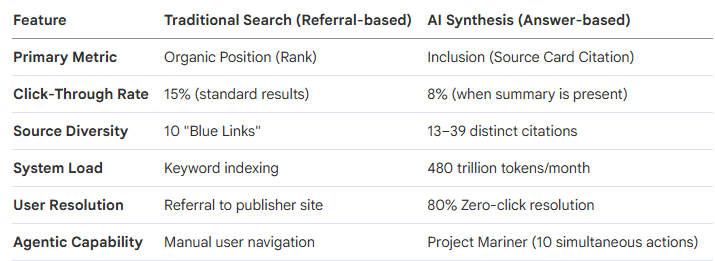
For the independent publisher, tools like Semrush are no longer just for keyword research; they are investigative instruments to monitor "Inclusion Rates." If your content appears in traditional results but is missing from AI Mode source cards, you are facing an "Authority Gap" that no amount of "quality content" can fix.
The Goliath Playbook: How Big Media "Swarms" the SERPs
The decline of the independent web isn't an accident; it is the result of predatory SEO tactics employed by digital media conglomerates like Dotdash Meredith, Forbes, and IAC. These Goliaths use their massive domain authority to colonize niches where they have zero actual expertise.
Keyword Swarming: The Flywheel of Dominance
Anonymous tips from former Dotdash Meredith employees reveal a strategy called "Keyword Swarming." When the conglomerate identifies a specialist site with a foothold in a valuable niche, they "swarm" it. They don't just write one article; they publish 10 across their network, Food & Wine, Southern Living, Travel & Leisure, using their interlinked authority to drown the independent competitor. As IAC leadership views it, this is simply a "flywheel for generating advertising and commerce revenue" for shareholders.
The Forbes "Puppy" Strategy
Forbes.com, once a bastion of business journalism, has pivoted into a massive affiliate engine. By pumping out thousands of articles about puppies, kittens, and cats under the "Forbes Advisor" sub-brand, they built artificial authority in the pet insurance space. They utilized statistics round-ups designed to obfuscate sources, forcing the web to link back to Forbes rather than the primary researchers. This tactic alone generates an estimated 1.1 million visitors per month for their pet insurance section, traffic stolen from specialist veterinary and pet-care sites.
Brand Flipping & the "Steps of the Flip"
Legacy brands are being bought, gutted, and turned into SEO husks through a repeatable process:
Buy: A private equity firm or digital media company (like Ad Practitioners LLC/Money Group) buys a trusted, hemorrhaging brand like Money or Deadspin.
Fire: The entire editorial staff, the humans with the institutional knowledge, is laid off.
Revamp: The site is repurposed to drive "intent-based" traffic to gambling or affiliate products.
A prime example is Money.com. Once a respected finance magazine, it now uses its high-authority domain to review "garage door openers" and "paint sprayers" without ever testing them, merely adding "for your money" to the title to maintain a thin veneer of relevance. Furthermore, firms like AdVon Commerce (ASR Group) have been caught providing "AI slop" to Sports Illustrated and USA Today, using fake author names to pump out commerce content that Google’s algorithm rewards simply because it lives on a "Goliath" domain.
The Authority Gap: Why Quality is No Longer Enough
Research from Trinity College Dublin (O’Raghallaigh) has identified a phenomenon called the "Authority Gap." In an AI-first search environment, Google prioritizes "Risk Minimization." Because Google is now "on the hook" for the answers it synthesizes, its systems favor sources that are "easy to defend."
The "Site X" Case Study
The Trinity white paper highlights "Site X," a niche project with accurate, well-written explainers. The publisher holds a PhD, but the PhD is in a discipline unrelated to the site’s subject. Despite high-quality prose, Site X stalled under an "inclusion ceiling." Google’s AI Mode favored university departments and institutions over Site X because the "Expertise Mismatch" triggered a defensibility deficit. The PhD was irrelevant to the topic, and the system viewed the site as "ambiguous" in intent (education vs. promotion).
The Interpretative Threshold
Google treats "Aggregation" (simple facts) and "Interpretation" (analysis and recommendations) differently. When a query moves into interpretation, the bar for inclusion rises dramatically. An independent blog might rank for "air purifier CADR ratings," but for "is this air purifier worth it?", Google defaults to established, stable institutions.
The Defensibility Checklist
To bridge this gap, publishers must audit their site against these defensive signals:
Topic-Relevant Credentials: Are bios linked via SameAs schema to third-party authoritative profiles? Does the author have domain-specific expertise (not just a generic degree)?
Institutional Affiliation: Is the site connected to recognized industry bodies or academic institutions?
Citation Hygiene: Does the content link to primary academic sources rather than other blogs?
Transparent Methodology: Are there "methods notes" (e.g., the HouseFresh air purifier testing logs) that prove the content isn't just "AI slop"?
Entity Consistency: Is the author’s name and professional profile consistent across the web to allow for "Entity Consolidation"?
Tactical Pivot: Shifting from "Ranking" to "Inclusion"
The goal is no longer to be the first link; it is to be the citation the LLM trusts to build its answer.
Citation-Ready Content: Start every section with a brief, declarative, well-structured answer. Use headers, tables, and lists that LLMs can easily ingest.
Author Identity as Product-Critical: In the AI era, author credentials are part of the technical SEO stack. Google’s rater guidelines (E-E-A-T) now place extreme weight on who created the content.
Semantic Structuring: Use Semrush to monitor "Topic Authority Scores" and "Brand Mention Velocity." If your brand name is being searched alongside your category (e.g., "HouseFresh air purifier reviews"), you are signaling to Google that you are an "Entity" that must be included.
Primary Source Dominance: If you cannot be the primary answer, be the source the Goliath sites are forced to cite. Use original datasets, exclusive interviews, and field notes to create "AI-Resistant" content.
The Publisher’s Survival Framework: 11 Critical Actions
The clock is ticking. With a projected $2 billion annual industry revenue loss and 25-40% of mid-tier publishers facing an exit within 18 months, immediate action is the only defense.
Action: Set Independence Targets. Reduce Google Search dependency to 50% or less. Outcome: Resilience against algorithm volatility and core update traffic collapses.
Action: Build "Newsletter-First" Models. Follow the Morning Brew or Stratechery strategies. Outcome: 5-7x higher revenue per reader compared to search-dependent programmatic ads.
Action: Implement SameAs Schema for Authors. Link bios to verifiable third-party profiles. Outcome: Bridges the "Authority Gap" by signaling verifiable identity to the LLM.
Action: Track Brand Visibility in AI. Use Semrush to monitor appearances in AI Mode source cards. Outcome: Accurate measurement of "Inclusion" as a primary KPI instead of raw traffic.
Action: Optimize for "Latent Query Coverage." Ensure content covers the "constellation" of related synthetic queries generated by AI Mode. Outcome: Increases the probability of being cited in conversational follow-up queries.
Action: Diversify Revenue Immediately. Move to subscriptions, premium community access, or micropayments (0.99–2.99 per article). Outcome: Offsets the 50-70% decline in affiliate and programmatic revenue.
Action: Negotiate Licensing Deals. Engage with OpenAI or Perplexity for licensing (potentially worth 10,000–50,000 monthly). Outcome: Direct compensation for AI reuse of your proprietary data.
Action: Deploy "Revenue per Session" Metrics. Adopt the Arena Group model, focus on increasing pages per visitor (e.g., from 1.1 to 2.0). Outcome: Adds seven figures to the bottom line by maximizing the value of the traffic you do keep.
Action: Build "AI-Resistant" Formats. Focus on investigative reports, first-person "experience" narratives, and original research. Outcome: Protects content from being easily summarized or absorbed into AI Overviews.
Action: Secure "First-Party Data" Systems. Use robust email lists to fuel personalized marketing. Outcome: Publishers with deep email lists show 60% better resilience to AI traffic disruption.
Action: Coordinate Legal Response. Support collective licensing negotiations to ensure fair compensation for "Site Reputation Abuse." Outcome: Long-term protection against Goliaths using your brand signal to sell their products.
Mastering Multi-Platform Distribution: "Be Everywhere Else"
Survival requires building a "direct navigation" habit. You must go where the users are and create a "ripple effect" that forces Google to acknowledge your brand.
The YouTube Strategy: Video content generates 3-4x higher CPMs and is largely immune to current AI summarization. As HouseFresh discovered, a video ranking on YouTube can reappear in Google's video carousels, bypassing the text-based AIO "gatekeeper."
Reddit Domination: Reddit has an agreement with Google that gives it massive SERP visibility. Independent publishers should start their own subreddits to capture this interaction and drive users back to their own "owned" ecosystem.
Social Proofing: Be relentless on TikTok, Instagram, and LinkedIn. When users start adding your brand name to their search queries, the "HouseFresh Effect", you regain the leverage Google tried to take away.
Industry Impact: The Zero-Click Economy and the "Final Boss"
We are entering a "Zero-Click Economy" where 80% of consumers resolve their needs without ever leaving Google's interface. This is not a "tsunami"; it is a rapid change in the value proposition of a website.
For many, Project Mariner is the "Final Boss." When Agentic Search can handle the restaurant booking, the flight coordination, and the product purchase, aggregators and comparison portals that offer no unique data will be the first to die.
The successful survivors, like The Arena Group (Parade, The Street), are already rewriting the playbook. They are no longer chasing raw volume; they are curating the on-site experience, using AI-powered content recommendations to drive pages-per-visitor from 1.1 to 2.0. By making every visit more valuable, they remain profitable even as referral traffic remains under extreme pressure.
Conclusion: The Fight for the Open Web
The future of independent publishing is a battlefield. Google’s transition from "world’s best digital librarian" to "judge of a popularity contest" is a direct threat to specialist expertise. But as HouseFresh’s vow to "not go down without a fight" demonstrates, independent creators are not helpless.
The "HouseFresh Moment" is a catalyst. It is a signal to stop renting your audience from Google and start owning it. The math is brutal, the Goliaths are predatory, and the algorithm is biased, but the future belongs to those who build direct, verifiable, and authoritative relationships with their readers. We must fight for an Open Web where a PhD's expertise and a tester's week-long evaluation are worth more than a conglomerate's swarming strategy.
Own your audience. Own your data. Survive the ranking chaos.


Ako Reviews Blog is a platform dedicated to helping online businesses reach their full potential. It offers in-depth guides on product reviews, social media marketing, and comprehensive online business strategies. Whether you're an entrepreneur or a marketer, Ako Reviews Blog provides practical tips and expert insights to help you grow and succeed in the digital marketplace.
Stay informed with valuable tips delivered straight to your inbox.
Created with systeme.io 2026 | Home | Privacy Policy | Terms and Conditions | Disclaimer | Contact