
Understanding Google's UCP: A Guide to AI Mode and SERP Product Listings
Introduction: The Dawn of Agentic Commerce
We are currently witnessing the most tectonic shift in the digital landscape since the introduction of the smartphone. As a Senior AI Search Strategist, I’ve spent the last decade navigating the nuances of crawl budgets and keyword intent. Still, the emergence of "agentic commerce" represents a total rewrite of the rules. We are moving away from a web of destinations, where users navigate to specific URLs to perform tasks, to a web of agents, where artificial intelligence acts as a sophisticated proxy for the consumer.
In this new paradigm, the "search result" is no longer the final destination. Instead, it is the beginning of a seamless, automated transaction. Data from recent Semrush research, which analyzed billions of web visits across more than 50,000 diverse sites, confirms that AI is fundamentally reshaping traffic channels. Traditional organic traffic is no longer a guaranteed stream for those who simply rank well; it is being diverted into conversational interfaces that prioritize direct answers and immediate action. If your brand isn’t capable of being "acted upon" by an agent, it risks becoming invisible.
Enter the Universal Commerce Protocol (UCP). Launched as the technical bridge between these high-level AI agents (like Gemini and ChatGPT) and the complex backends of modern ecommerce stores, UCP is the protocol that makes agentic commerce possible. For retailers, this isn't just another SEO trend; it is the infrastructure for the next decade of retail. Shoppers no longer want to browse through ten tabs to find a pair of running shoes; they want to tell their AI, "Find me the best waterproof trail runners under $150 and buy them using my preferred shipping address." UCP is what allows that agent to understand your inventory, verify your prices, and complete that transaction without the user ever touching your homepage.
What is Universal Commerce Protocol (UCP)?
The Universal Commerce Protocol (UCP) is an open-source, vendor-agnostic standard. In technical terms, it provides a common language, a Rosetta Stone, that allows AI agents and merchant platforms to communicate without the need for bespoke, one-off integrations for every possible combination of bot and store.
A Collaborative History
UCP didn't emerge from a vacuum. It was co-developed in January 2026 through a massive industry collaboration spearheaded by Google and a "who’s who" of global retail and tech. Initial partners included Shopify, Etsy, Wayfair, Target, and Walmart. The goal was to prevent the "walled garden" effect that often plagues new technologies. By making UCP open-source and vendor-agnostic, the creators ensured that any retailer, regardless of their platform, could participate.
The financial sector followed suit almost immediately. To ensure the protocol had the "trust layer" necessary for real-world transactions, more than 20 major financial and payment partners endorsed the standard, including Visa, Mastercard, Stripe, and Adyen. This endorsement was critical; it signaled to the market that UCP wasn't just a discovery tool, but a secure transactional framework.
The Technical Architecture
From an engineering perspective, UCP functions as an intermediary layer between two distinct worlds:
Consumer Surfaces: These are the "heads" of the experience, the Gemini app, Google Search’s AI Mode, or even third-party LLMs. This is where user intent is captured and refined.
The UCP Layer: This layer facilitates the handshake. It handles the "capabilities" the merchant supports, such as cart management or identity linking, and translates the agent's requests into standardized API calls.
The Store Backend: The retailer's existing infrastructure. Whether you are running on a headless BigCommerce setup or a legacy custom build, UCP interacts with your order management, inventory, and fulfillment systems.
One of the most important strategic aspects of UCP for any Head of E-commerce to understand is the "Merchant of Record" status. Despite the transaction occurring within an AI interface, the retailer remains the Merchant of Record. You own the customer data, you handle the fulfillment, and you maintain the direct relationship with the shopper. UCP is simply the pipe through which the transaction flows.
The May 2026 Breakthrough: UCP Hits the Main SERP
While the early iterations of UCP were confined to the more "experimental" AI Mode and Gemini app, May 2026 brought the technology into the mainstream. Google began rolling out UCP-powered checkout directly on the primary Search Results Page (SERP). This move signaled that Google considers agentic commerce ready for the masses.
The "Buy" Button Reality
In May 2026, industry observers and Semrush users began noticing a "Buy" button appearing on Wayfair product listings within the standard, non-AI search results. This wasn't a "Buy" button that redirected to a product page; it was a UCP-powered trigger.
To visualize the impact, let's look at a hypothetical shopper scenario. Imagine Sarah, a busy professional looking for a mid-century modern sofa. In the old world, Sarah would search "mid-century sofa," click three different links, compare shipping costs, create a guest account on one site, and finally enter her credit card.
In the May 2026 UCP world:
Sarah searches for the sofa on her mobile device.
A Wayfair listing appears with a prominent "Buy" button.
Sarah clicks "Buy."
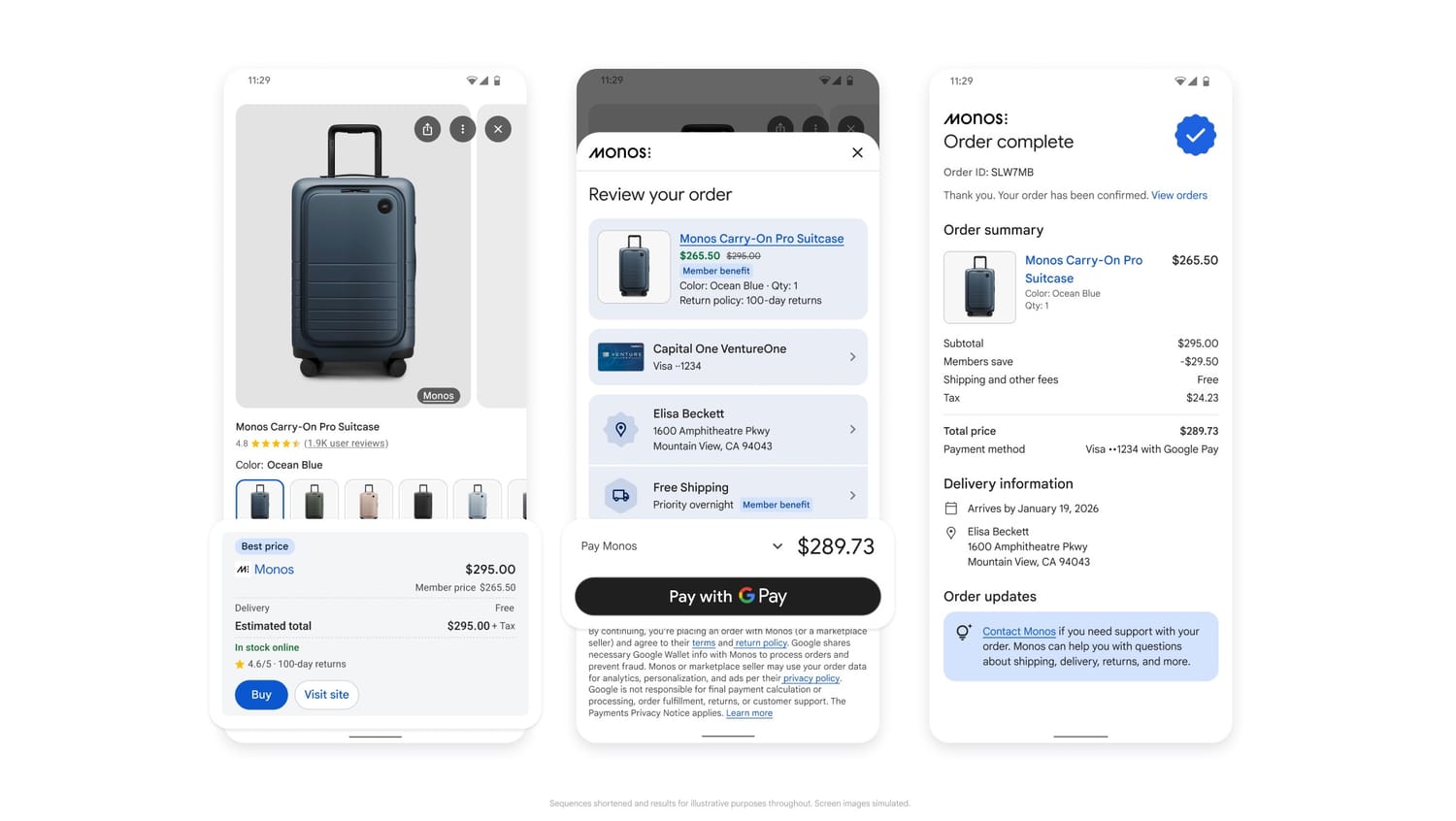
A secure overlay appears, connecting Sarah’s Google Pay account directly to Wayfair’s checkout system via UCP.
Sarah confirms her delivery address and payment method (already stored in her Google Wallet).
The transaction is completed in seconds. Sarah never leaves the SERP.
The significance of this expansion cannot be overstated. It eliminates the "checkout friction" that has plagued e-commerce for decades. For retailers who are first-movers in this space, the "Buy" button is a massive competitive advantage. If your competitor requires a five-step checkout on an external site and you offer a one-click UCP transaction on the SERP, you win the conversion nearly every time.
The Five Core Capabilities of UCP
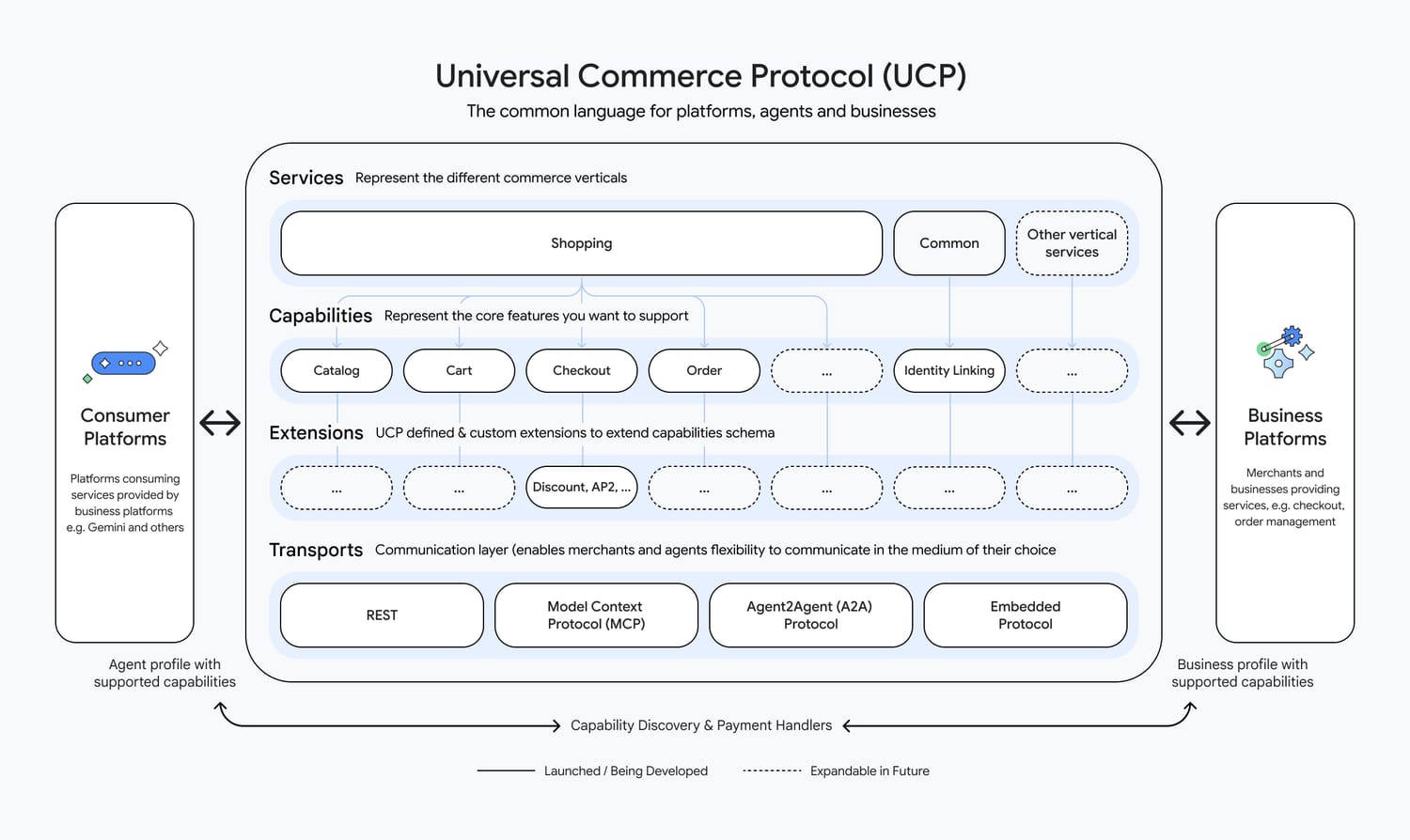
Following the major update in March 2026, the UCP framework expanded to include five core capabilities. As a Technical SEO Lead, you need to understand that these aren't just "features", they are endpoints that must be correctly exposed through your store’s manifest.
Checkout
The foundational capability. While the initial January 2026 launch supported basic, single-item guest checkouts, the March update enabled "richer transaction flows." This means agents can now handle complex variables such as selecting shipping speeds (standard vs. overnight), applying dynamic promotional codes, and calculating taxes based on real-time location data. It moves the agent from a simple "order placer" to a sophisticated shopping assistant.
Cart
Modern commerce is rarely about a single item. The Cart capability allows AI agents to add multiple products to a single session simultaneously. If a user asks an agent to "get me the ingredients for a classic lasagna from Target," the agent can use the Cart capability to bundle ten different SKUs into one transaction. This mirrors the natural behavior of a shopper and is essential for driving Average Order Value (AOV) in agentic search.
Product Discovery (Catalog)
This is where technical SEO and merchandising intersect. The Catalog capability allows agents to pull real-time product details directly from your store. This includes complex variants (size, color, material), live inventory levels (to prevent the agent from selling out-of-stock items), and current pricing. Without this capability, the agent is flying blind, relying on cached data that might be minutes or hours old. In a world of flash sales and fluctuating stock, real-time catalog access is the difference between a sale and a "sorry, this item is unavailable" error message.
Identity Linking
Retailers often worry that agentic commerce will cannibalize their loyalty programs. Identity Linking is the solution. It allows shoppers on UCP-integrated platforms to securely link their retailer accounts (e.g., a Wayfair Rewards or Target Circle account). Once linked, the agent can fetch member-only pricing, apply existing loyalty points to the total, and ensure the customer receives their "free shipping for members" benefit. This preserves the "Agentic Trust" between the brand and its most valuable customers.
Order Management
The relationship doesn't end at the purchase. The Order Management capability allows agents to handle post-purchase inquiries. A user can ask Gemini, "Where is my Wayfair order?" and the agent, via UCP, will retrieve the tracking number, current shipping status, and estimated delivery date directly from the retailer's backend. This reduces the burden on customer support teams and provides a premium experience for the shopper.
Preparing Your Store for Agentic Search with Semrush
As transactions migrate into AI interfaces, the traditional metric of "ranking #1" is being replaced by "share of voice in AI answers." You cannot manage what you do not measure. This is where the Semrush ecosystem becomes indispensable for the modern strategist.
Auditing Brand Presence in AI
You must begin by auditing how LLMs currently perceive your brand. Are you being cited as a reliable authority, or are you being ignored? Use the Semrush AI Visibility Toolkit to get a baseline. This tool provides an AI Visibility Score (benchmarked 0-100) that tells you how frequently your brand appears in answers across ChatGPT, Gemini, and Google’s AI Mode. If your score is low, your UCP implementation won't matter because the agents won't "know" to look for you.
Identifying Topic Opportunities
Within the Semrush AI Visibility Index, you can drill down into "topic opportunities." These are specific prompts, not just keywords, but full conversational queries, where your competitors are being cited but you are not. For example, if a search for "best eco-friendly sofas" frequently mentions a competitor but ignores your brand, you have a content gap that is directly impacting your agentic revenue potential. By using Semrush, you can identify the exact "cited pages" that agents prefer and optimize your own content to match those signals.
Maintaining the Bedrock
Never forget that AI agents are trained on the web. The "Traditional" SEO foundation, backlinks, technical health, and content quality, remains the fuel for AI citations. The Semrush SEO Toolkit should be used daily to ensure that as you layer on AI-specific optimizations, your core site health doesn't suffer from "technical debt" or "schema drift." For larger organizations, Semrush Enterprise Site Intelligence includes Bot Analytics, which provides a granular look at how AI crawlers (like the newly documented "Google-Agent") are interacting with your site. If your server is blocking these crawlers, you are effectively opting out of the agentic future.
Technical Requirements for UCP Eligibility
To enable the "Buy" button and participate in this new ecosystem, your technical team must meet a specific set of requirements. This isn't a "flip a switch" process; it requires coordination between your SEO leads, your developers, and your Merchant Center managers.
Google Merchant Center (GMC) Account: Your store must have an active GMC account with approved product listings eligible for free listings. This is the source of truth Google uses for the SERP "Buy" button.
The native_commerce Attribute: This is the most critical field. You must set the native_commerce attribute to "true" for all items you want to be eligible for UCP checkout.
Strategy Tip: Do not add this to your primary feed immediately. Use a supplemental data source in Merchant Center. This prevents "Feed Shock," where a simple formatting error in a new attribute could accidentally cause Google to reject your entire primary product catalog, killing your Shopping Ads overnight.
ID Mapping (merchant_item_id): Your Merchant Center product IDs must map exactly to the IDs used by your checkout API. If they don't match (e.g., your feed uses a SKU but your API uses a database ID), you must use the merchant_item_id attribute to bridge the gap.
Compliance and Disclosures (consumer_notice): For products that require legal warnings (like Prop 65 in California), you must include the consumer_notice attribute. AI agents are programmed to be "safety-first" and will disregard products that lack necessary legal disclosures.
Policy Configuration: Your GMC account must have clearly defined return policies, shipping settings, and customer support contact info. An agent will not complete a purchase if it cannot tell the user, "You can return this within 30 days."
The /.well-known/ucp JSON Manifest: This is your "storefront for bots." You must publish a JSON manifest at this specific URL on your domain. This file lists which of the five UCP capabilities your store supports.
REST Endpoints: Your engineering team must implement and expose three core REST endpoints:
Session Creation: To initiate the checkout process.
Session Updates: To handle changes like shipping method selection or quantity adjustments.
Session Completion: To finalize the transaction and hand off the order to your fulfillment system.
Data Consistency and Structured Data: The New SEO Bedrock
In the era of UCP, "data consistency" has moved from a best practice to a hard requirement. Why? Because AI agents are risk-averse. If a bot sees a price of $199 in your Merchant Center feed but the Schema.org markup on your product page says $219, the agent will experience "Agentic Dissonance." To protect the user experience, the agent will simply disregard your site entirely.
Auditing for Schema Drift with Semrush
To prevent this, you should utilize the Semrush Site Audit tool with a focus on the "Markup" report. Specifically, look at the "Merchant listings" row. This report will identify any invalid items or missing fields in your JSON-LD that could disqualify you from UCP. For example, if you are missing the priceValidUntil or availability fields, your "Buy" button eligibility may be revoked.
The Rise of Conversational Attributes
Google is also introducing "Conversational Commerce Attributes." These are new schema fields and Merchant Center attributes designed to help agents answer granular questions. These include:
Product Q&A: Pre-emptively answering common questions (e.g., "Is this table solid wood?").
Compatible Accessories: Helping an agent suggest the right batteries for a toy or the right lens for a camera.
Substitutes: Giving the agent permission to suggest an alternative if the primary item is out of stock.
Retailers who begin populating these attributes now will have a significant "trust advantage" with AI agents, as they provide the depth of data required for a confident recommendation.
The Attribution Gap and Cross-Functional SEO
As a Technical SEO Lead, one of the most difficult conversations you will have with your CMO involves the "Attribution Gap." UCP-powered transactions are incredibly efficient for the user, but they are a nightmare for traditional analytics. Because the entire transaction happens within an AI interface or the SERP, there are no pageviews, no sessions, and no "Thank You" page hits in GA4.
Solving for the Gap
To fix this, you must build an internal infrastructure that logs order sources at the API level. Work with your engineering team to ensure that any order coming through the UCP REST endpoints is flagged with a UCP_SOURCE tag. This data should then be pushed into your data warehouse (like BigQuery) and joined with your Semrush visibility data. This is the only way to prove the ROI of your UCP efforts.
The New SEO Workflow
The role of the SEO is now cross-functional. You are the "Conductor" of the UCP implementation. You must coordinate:
Legal: To ensure your return and shipping policies are UCP-compliant.
Engineering: To manage the JSON manifests and the API handshakes.
Merchandising: To guarantee that the real-time catalog access is accurate, preventing the "Stock-Out" errors that damage agentic trust.
Analytics: To bridge the attribution gap mentioned above.
This is a massive shift, but it elevates SEO from a "marketing tactic" to a "core business infrastructure" function.
Conclusion: Embracing the Agentic Future
The transition to agentic commerce is not a "future" problem; it is a "today" problem. With the expansion of UCP to the main Google SERP and the emergence of the "Buy" button on listings like Wayfair, the window for first-mover advantage is closing. Brands that wait for the technology to "mature" will find themselves locked out of the most valuable real estate on the web.
Your roadmap for the next 90 days is clear:
Audit your technical stack for UCP compatibility.
Deploy your /.well-known/ucp manifest and the three core REST endpoints.
Use the Semrush AI Visibility Toolkit to measure your current share of voice and identify gaps.
Consolidate your reporting under Semrush One to maintain a unified view of traditional SEO and AI-driven growth.
The future of retail belongs to the brands that are easiest for agents to find, trust, and transact with. By leveraging the power of Semrush and the infrastructure of the Universal Commerce Protocol, you can ensure your store is not just visible, but shoppable in the agentic era. Audit your tech stack, prepare your data, and claim your place on the new SERP today.


Ako Reviews Blog is a platform dedicated to helping online businesses reach their full potential. It offers in-depth guides on product reviews, social media marketing, and comprehensive online business strategies. Whether you're an entrepreneur or a marketer, Ako Reviews Blog provides practical tips and expert insights to help you grow and succeed in the digital marketplace.
Stay informed with valuable tips delivered straight to your inbox.
Created with systeme.io 2026 | Home | Privacy Policy | Terms and Conditions | Disclaimer | Contact