
Step-by-Step Guide to Understanding Google Lighthouse's Agentic Browsing Report
Introduction: The Emergence of the "Two Internets"
The structural cleavage of the World Wide Web is no longer a theoretical projection of futurists; it is a documented architectural reality. We are witnessing the emergence of the "Two Internets", a dual-layered ecosystem where the traditional, human-facing web is being overlaid by a machine-facing infrastructure designed for AI agent invocation. For decades, the web was built for the human eye, optimized for visual layouts, DOM-based navigation, and the psychological nuances of the click-through. Today, however, the web is rapidly evolving into a headless infrastructure, where websites serve as callable tools for autonomous agents.
The catalyst for this shift is the recent integration of the Agentic Browsing report within Google Lighthouse. While the foundational standards for this shift, specifically the Web Model Context Protocol (WebMCP), are currently in early preview within Chrome 146 Canary and sequestered behind feature flags, the inclusion of an agent-specific reporting layer in Lighthouse signals that the "machine internet" is becoming a primary audit requirement. This is not merely an incremental update; it is the formalization of "Agentic Visibility" as a core technical SEO performance indicator.
The strategic stakes of this transition were perhaps best summarized by Box CEO Aaron Levie on February 16, 2026, when he declared that any organization failing to adopt an "API-first" architecture is essentially "DOA to agents." For the Senior Technical SEO and AI Architect, this quote serves as a grim warning. If your digital assets are not legible to the "Google-Agent" or cannot be invoked via WebMCP standards, your brand will effectively vanish from the agentic layer of the internet. We are moving from a world where we optimize for ranking to a world where we optimize for invocation. This guide serves as the technical blueprint for navigating this transition, moving from the human-facing surface to the machine-facing core.
Defining Agentic Browsing and WebMCP
To navigate the new Lighthouse reporting capabilities, one must first master the technical architecture of the Google WebMCP (Model Context Protocol). WebMCP represents the formalization of Agentic Website Standards, a shift from passive data scraping to active tool invocation. In traditional browsing, an AI model (like Gemini or GPT-4o) might scrape a page to summarize its content. In agentic browsing, the model uses WebMCP to understand the site’s functional capabilities, such as "book a reservation," "check real-time inventory," or "execute a return", and invokes those capabilities directly through the browser.
The current technical roadmap for WebMCP is a multi-year journey. As of the current cycle, the protocol is feature-flagged in Chrome 146 Canary. This means that while the broader internet is not yet agent-callable, the infrastructure is being baked into the world’s most popular browser. The core mechanism of this protocol is the navigator.modelContext.registerTool() API. This API allows a developer to "register" specific functions of their website with the browser's resident AI agent. A registration might look like a JSON-based declaration of a tool's name, its semantic description (which the LLM uses to decide when to trigger it), and the required parameters (e.g., date, item_id, user_email).
The industry currently suffers from a massive "Awareness-Action Gap." When early explainers of the Model Context Protocol were released, they garnered over 7,200 reactions on LinkedIn, a staggering number that proves practitioners recognize the strategic gravity of agentic browsing. However, the gap between this awareness and technical readiness remains vast. Most organizations are still struggling with basic schema implementation, while the new standard requires a shift toward "API-first" documentation. The Agentic Browsing report in Lighthouse is designed to bridge this gap, highlighting where a site fails to provide the machine-readable hooks necessary for an agent to take action on behalf of a user. We are no longer just optimizing for "crawlers"; we are optimizing for "executors."
Meet the "Google-Agent": The Core of Agentic Interaction
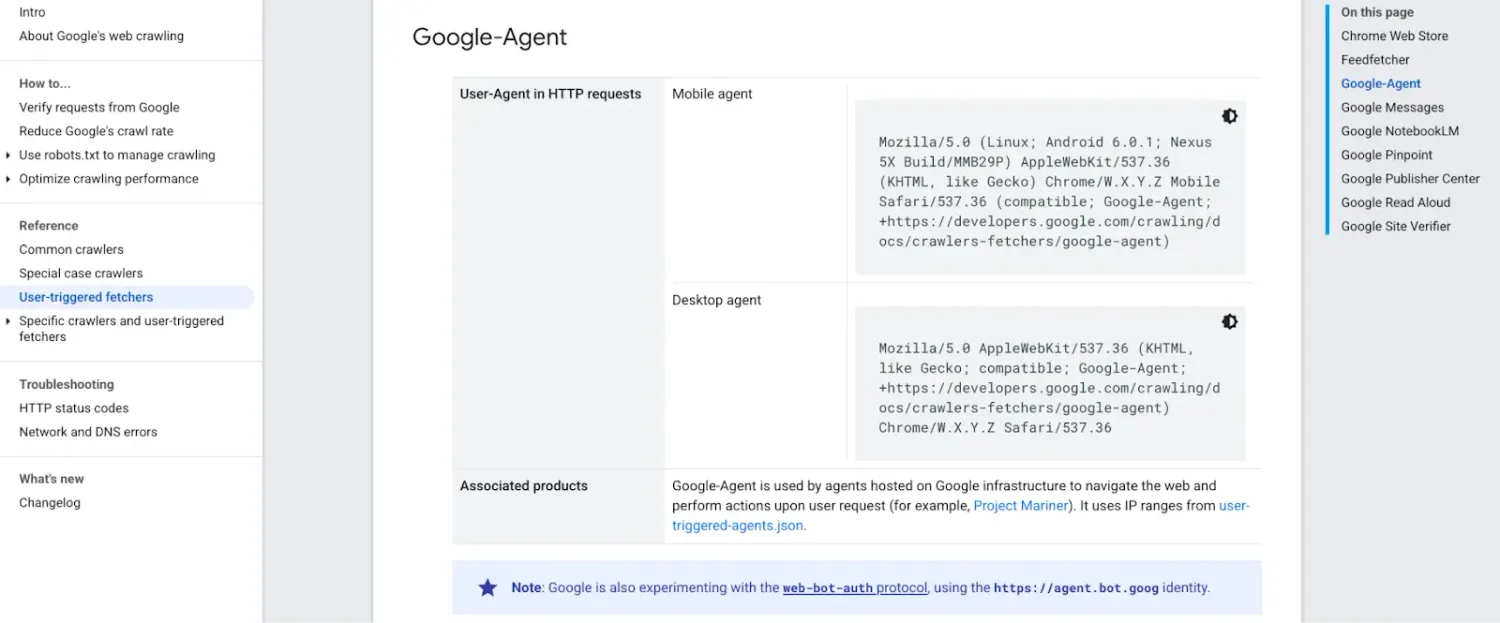
The most significant change for technical teams is the introduction of the "Google-Agent" user agent. This is a fundamental departure from the "Asynchronous Crawlers" we have optimized for over the last twenty years. Traditional Googlebot is a background process; it fetches data, stores it in an index, and processes it later. "Google-Agent," however, is a "Synchronous User-Triggered Agent."
When Google-Agent appears in your server logs, it represents a live human intent. It means a user is currently interacting with an agent, likely through "Project Mariner," Google’s research prototype for Chrome-based AI automation, and has requested that the agent perform a task on your site in real-time. Because these requests are user-triggered, they carry a "latency-sensitive" requirement. A human is waiting for the agent to return with a "task complete" confirmation. If your infrastructure treats Google-Agent with the same low priority as a standard background crawl, the agentic interaction will time out, and the transaction will be lost.
This creates an immediate security and accessibility imperative for IT teams. Many modern Web Application Firewalls (WAFs) and Content Delivery Networks (CDNs) are configured to block or throttle "headless" traffic that looks like an automated agent.
However, blocking Google Agent is equivalent to blocking a high-intent customer at the door. To prevent this, technical architects must ensure their security layers allow the specific IP ranges associated with these agents. Google maintains these in the user-triggered-agents.json file. Unlike standard bot IP lists, these ranges must be whitelisted for high-performance, low-latency access. Failure to distinguish between background "scraping" and synchronous "agentic action" is one of the most common pitfalls identified in early Agentic Browsing audits.
Navigating the GA4 AI Assistant Channel
The "Machine Internet" is no longer a dark pool of untraceable activity. Google has formalized the reporting of agent-mediated traffic by adding a dedicated "AI Assistant" channel to the GA4 Default Channel Group. This update is a landmark moment for attribution, as it allows us to quantify exactly how much traffic and revenue is being siphoned from traditional organic search into agentic interfaces.
Marketers and architects must now look for three specific technical identifiers in their GA4 property:
Medium: ai-assistant (This is automatically assigned when the referrer string matches a recognized AI interface).
Channel Group: AI Assistant.
Campaign: (ai-assistant).
The strategic value of this data lies in the "Discovery-to-Action" analysis. By comparing "Organic Search" traffic against "AI Assistant" traffic, we can see where users are moving from traditional discovery (browsing the SERP) to agent-mediated action (asking Gemini to "find and buy" the product). If your AI Assistant traffic is growing while your Organic Search traffic is declining, it is a signal that your "Machine-Facing" SEO is succeeding, even if your "Human-Facing" visual CTR is dropping. This is the first quantifiable proof of the "Two Internets" thesis, showing the migration of users from the visual web to the agentic web.
E-commerce Insights: The Merchant Center AI Performance Report
For e-commerce architects, the battle for visibility has moved from the standard SERP into the "AI Mode" and Gemini shopping journeys. Google’s new "AI performance insights" report within Merchant Center is the primary dashboard for this new battlefield. Unlike traditional reports that focus on clicks and impressions, this report emphasizes "Relative" rather than "Absolute" metrics.
The most critical metric to monitor is "Share of Voice." In an AI-driven experience, there is often only one "recommended" product or a very small set of citations. Therefore, ranking "number three" is often functionally equivalent to ranking "number zero." Share of Voice benchmarks your brand’s visibility against similar competitors in journeys originating in AI Overviews, AI Mode, or the Gemini app.
The report also provides a deep dive into "Shopping Funnel Performance," which Google now categorizes into three distinct stages:
Discovery: When an agent surfaces your product in response to a broad query.
Evaluation: When the agent compares your product attributes (price, material, style) against a competitor.
Purchase: When the agent confirms the final intent to buy.
Technical SEOs must use the "Product Term" and "Product Attribute" insights to optimize their feeds. If the report shows that agents are frequently filtering for "organic cotton" or "sustainable sourcing" in Search conversations, but your Merchant Center feed lacks those specific attributes, you will be filtered out during the "Evaluation" phase of the agentic journey. This report signals a shift from "Keyword Optimization" to "Attribute-Led Optimization."
Universal Commerce Protocol (UCP) and the "Buy" Button
The most aggressive manifestation of the "Two Internets" is the expansion of the Universal Commerce Protocol (UCP) from specialized AI modes to the main Search Engine Results Page (SERP). UCP is the protocol that enables a "Buy" button to appear directly on a product listing, allowing a logged-in Google user to complete a transaction without ever landing on your website.
This is the ultimate "decoupling of revenue and clicks." As seen in early implementations by Wayfair and the expected rollout to Etsy, Walmart, and Shopify, the website's role is shifting from a "destination" to an "inventory provider." In this paradigm, Google’s SERP serves as the front-end interface, while your site serves as the back-end infrastructure that handles the logistics of fulfillment.
For brands, implementing UCP is no longer a "nice-to-have" experiment. It is a strategic imperative. If a user can buy a competitor’s product with a single click via the agentic "Buy" button on the SERP, but must click through three pages of your visual site to find your "Add to Cart" button, you will lose on friction alone. Adhering to Merchant Center guidelines and adopting UCP standards is how brands ensure they remain "transactionable" in a world where users value speed over the "brand experience" of a traditional storefront.
Step-by-Step Implementation: Preparing Your Site for Agents
Transitioning to an agent-ready architecture requires a systematic technical audit. The following four steps are the foundation of any "Agentic Search Optimization" (ASO) strategy.
Step 1: Log File Analysis and User-Agent Identification
The first step is to establish a baseline of agentic activity. You must filter your server logs specifically for the "Google-Agent" string. This will reveal how many "synchronous user-triggered" requests your site is already handling. Do not conflate this with Googlebot. Look for the "Project Mariner" identifiers and analyze which pages agents are attempting to access. Are they hitting your "Contact" page? Your "Product Specifications"? This data provides the business case for further WebMCP investment.
Step 2: Security & Accessibility Audit for AI Crawlers
Review your WAF and CDN rules with extreme scrutiny. Use the Semrush Site Audit tools to detect if you are inadvertently blocking "ChatGPT-User," "OAI-SearchBot," "Perplexity-User," or "Claude-SearchBot." These agents are the "eyes" of the machine internet. If your security settings prevent them from "grounding" their answers in your data, those LLMs will hallucinate information about your brand or simply ignore you. Ensure that the IP ranges in user-triggered-agents.json are given a priority path.
Step 3: Structured Data Validation and Merchant Compliance
Agentic browsing relies on "legibility." If an agent cannot verify your return policy, it will not recommend your product. You must implement a robust schema, including specific elements like hasMerchantReturnPolicy, inStock, and priceValidUntil. Use the Lighthouse Agentic Browsing report to check for "Schema Completeness." Every missing attribute is a reason for an agent to disqualify your site during the evaluation phase.
Step 4: API-First Readiness and Tool Registration
While WebMCP is early, you must begin planning for the navigator.modelContext.registerTool() requirement. This involves mapping your site's core functions into machine-callable actions. For example, a travel site should prepare a tool registration that looks like this:
Tool Name: check_room_availability
Description: "Checks if a hotel room is available for specific dates and price ranges."
Parameters: check_in_date, check_out_date, room_type. By defining these tools now, you ensure that when WebMCP reaches widespread browser adoption, your site is "callable" rather than just "scrappable."
Measuring Success with Semrush AI Visibility Tools
Google’s ecosystem reporting is powerful, but it is not exhaustive. A true Senior Architect must manage visibility across the entire LLM landscape, including OpenAI, Anthropic, and Perplexity. This is where the Semrush AI Visibility toolkit becomes the essential "Global" dashboard.
The "Citations Report" in Semrush is perhaps the most important tool for "Grounding Audits." Grounding is the process by which an AI model verifies its answer using a trusted source. By using the Citations Report, you can identify exactly which of your URLs are being used as the "authoritative source" for AI answers. If your competitors are being cited more frequently for high-value queries, you can reverse-engineer their content structure to understand what the "machine" considers more authoritative.
Furthermore, the Semrush AI Visibility Reports allow you to track "Brand Mentions" and "Sentiment" within LLM responses. Unlike traditional rankings, where you simply want to be "number one," in the agentic web, you want to be the "recommended" solution. Semrush allows you to benchmark your "Share of AI Recommendations" against your top five competitors. For Enterprise organizations, the Agent Analytics feature is critical for detecting technical hurdles, showing you where agents are getting "stuck" in your navigation or which robots.txt rules are preventing discovery.
Frequently Asked Questions (FAQ)
1. What is the Agentic Reporting mentioned in the sources?
While not in Lighthouse, the sources describe two primary new reports:
AI Performance Insights (Merchant Center): A report for ecommerce brands to see visibility (share of voice) and funnel performance across AI-driven experiences like Google AI Mode and Gemini.
AI Assistant Channel (GA4): A dedicated traffic channel in Google Analytics 4 that identifies referral traffic from popular AI assistants using a new "ai-assistant" medium.
2. Why Should You Use these Agentic Reports?
Marketers should use these reports to measure and optimize AI visibility, which the sources call the "new battleground". Tracking these metrics helps distinguish between background bot crawls and high-intent, user-triggered AI activity (such as through the new Google-Agent fetcher).
3. When were these updates added?
The timeline for these agentic updates is as follows:
Google-Agent fetcher: Added to documentation on March 20, 2026.
GA4 AI Assistant channel: Announced on May 14, 2026.
Merchant Center AI performance report: Announced on May 28, 2026.
4. How do these updates improve your website analysis?
These tools improve analysis by:
Attributing Traffic: GA4 now automatically categorizes AI-driven visits, allowing you to compare them against traditional organic search.
Benchmarking Visibility: The Merchant Center report provides a "Share of voice" metric, showing how often your brand appears in AI responses relative to competitors.
Tracking Intent: Identifying Google-Agent activity in server logs allows you to see when an AI agent is taking specific actions (like booking a call or navigating content) on behalf of a user.
5. Where Can You Find these reports?
GA4: In the Default Channel Group reports under the "AI Assistant" channel.
Merchant Center: Within the Analytics section, specifically the "AI performance" insights tab.
Web Server Logs: You can find agentic activity by filtering for the Google-Agent user-agent.
Conclusion: The Roadmap to AI-Visibility
The introduction of the Agentic Browsing report in Google Lighthouse is the definitive signal that the "Two Internets" have arrived. We are witnessing a fundamental pivot from "Organic Search" to "Agentic Search Optimization" (ASO). In this new era, the "Human Internet" remains a place for brand storytelling and visual inspiration, but the "Machine Internet" is where the transactions will happen.
Technical health is no longer defined solely by how fast a page loads for a human; it is defined by how legible and "callable" that page is for an agent. While the full implementation of WebMCP and browser-integrated agents will take years to reach total market saturation, the battle for "AI Visibility" is being fought today. Every citation in ChatGPT, every "Buy" button on the SERP, and every "Google-Agent" request in your log files is a data point in this new landscape.
Your roadmap is clear: benchmark your current AI Share of Voice using Semrush, audit your log files for Google-Agent activity, ensure your structured data is compliant with Merchant Center standards, and prepare your infrastructure for the transition from a destination to a callable tool. Those who master the machine-facing layer today will be the infrastructure that the world’s AI agents rely on tomorrow. Be AI-visible, or be invisible. In the agentic web, there is no in-between.


Ako Reviews Blog is a platform dedicated to helping online businesses reach their full potential. It offers in-depth guides on product reviews, social media marketing, and comprehensive online business strategies. Whether you're an entrepreneur or a marketer, Ako Reviews Blog provides practical tips and expert insights to help you grow and succeed in the digital marketplace.
Stay informed with valuable tips delivered straight to your inbox.
Created with systeme.io 2026 | Home | Privacy Policy | Terms and Conditions | Disclaimer | Contact