
How to Find Low-Competition Keywords Using Semrush
How to Find Low-Competition Keywords Using Semrush
Stop treating SEO like a multi-year marathon you’re destined to lose. The reality is that for most new websites or those struggling with low domain authority, the traditional "head terms" are a trap. If you’re trying to outrank industry titans for massive, broad keywords, you’re throwing your budget into a void.
Think of low-competition keywords as your shortcut to the first page. These are the "hidden gems", queries with significant search interest that the giants have overlooked. By targeting this "low-hanging fruit," you can drive meaningful organic traffic and build authority without a massive backlink profile. This isn't just a tactic; it’s the most effective growth strategy for anyone who needs results now, not three years from today.
The Fundamentals: What Are Low-Competition Keywords?
In the context of a high-growth strategy, low-competition keywords are phrases you can feasibly rank for within a reasonable timeframe. They represent a vacuum in the market where search demand exists, but high-quality, optimized content is lacking.
The concept of "low-hanging fruit" is central to this. Instead of fighting for the top spot on a keyword that requires thousands of backlinks, you’re picking up the easy wins that move the needle immediately.
"With the Keyword Magic Tool, I like to start by filtering out difficulty scores that are too high. That way, I know my client won't focus on unreachable keywords … This is a simple way to grab low-hanging fruit and make sure the content plan that we follow will actually be useful to customers." — Alizée Baudez, SEO Consultant & Digital Marketing Specialist.
To quantify this, Semrush provides the Keyword Difficulty (KD%) metric. This is a 0-100% scale that estimates how hard it would be to rank in the top 10 organic results. As a Senior Strategist, here is how I break down that scale for my clients:
0-14% (Very Easy): These are the easiest to rank for. They often require little to no backlink building, but you must be careful; sometimes these terms are "weird" or have low commercial value.
15-29% (Easy): This is the "sweet spot." There is enough competition to prove the keyword is valuable, but it’s still well within reach for a new site with solid content.
30-49% (Possible): You’ll need well-structured content and perhaps a few quality backlinks to break into the top 10.
50%+ (Difficult to Hard): These require significant authority, a heavy backlink profile, and high-end content investment.
Method 1: Mastering the Keyword Magic Tool & The "Questions" Strategy
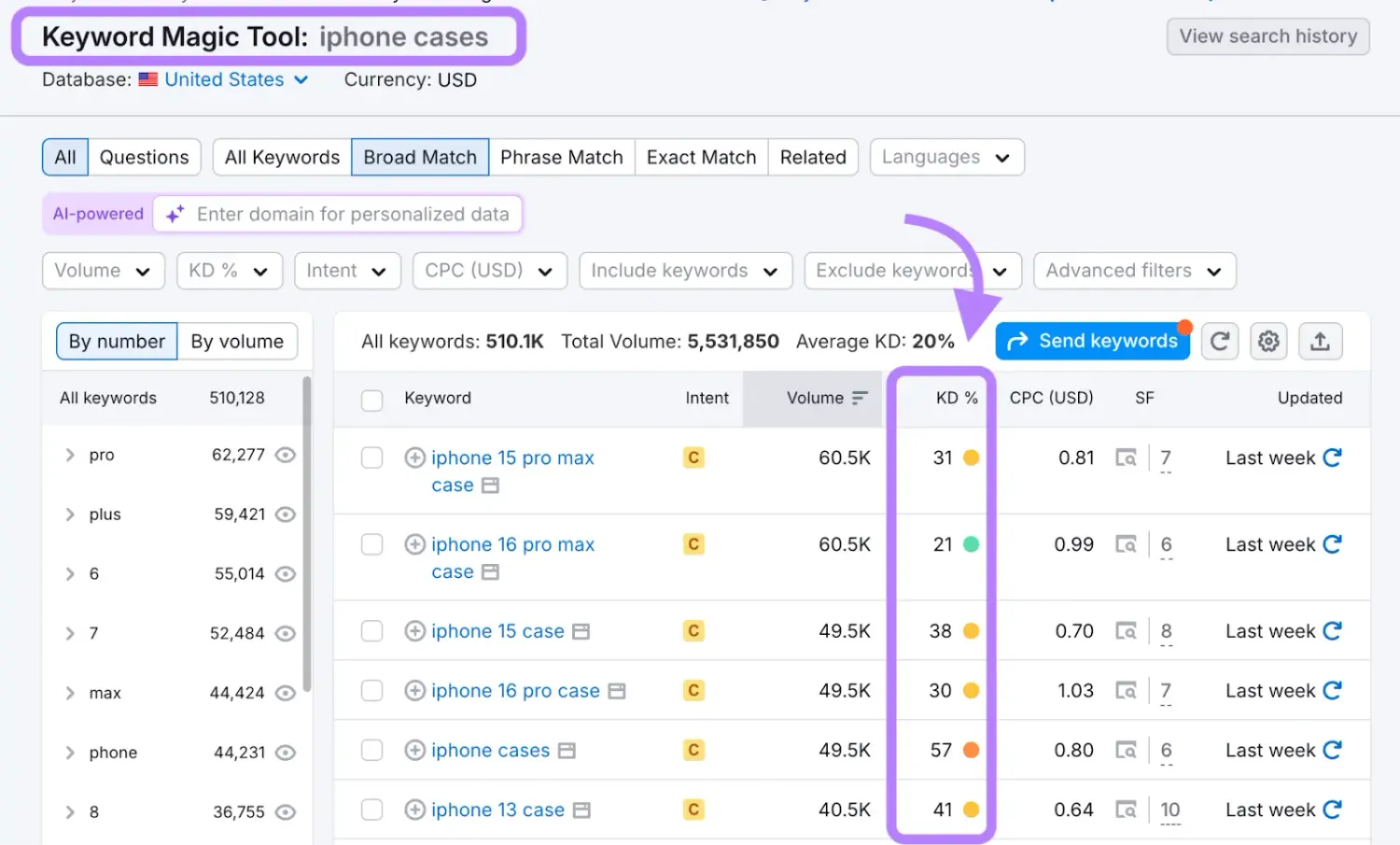
The Keyword Magic Tool is your primary engine for discovery. You start with a "seed keyword", a broad topic like "content marketing", and the tool generates a massive list of related terms. For a broad term like that, you might see over 30,000 results. To find the gems, you need to filter aggressively.
The Power of the "Questions" Filter
One of my first moves is always hitting the "Questions" filter. Why? Because head terms (like "content marketing") attract broad competition from every major publication. However, specific questions represent the "long tail." These searchers are often further along in their journey and looking for specific solutions, which big brands frequently ignore in favor of high-volume traffic.
Question-based keywords often have higher intent. Consider these examples:
How content marketing drives sales (High commercial intent; a potential client asking for proof of ROI).
What does a content marketer do? (Informational intent; useful for top-of-funnel brand awareness).
Why content marketing matters (Great for educational "pillar" content).
The "Easy" Range Nuance
Don’t fall into the trap of only looking at 0% difficulty. Often, keywords with 0-5% difficulty are phrases like "content marketing is like a first date", awkward, low-value, or virtually useless for conversion.
I recommend filtering for the "Easy" range (15-29%). This is where you find high-value, niche professional terms that actually drive business. Examples from this range include:
B2B content marketing agencies
B2B content marketing audit
Content marketing manufacturers
These keywords have enough competition to signal they are "money" keywords, but the 15% difficulty means you can still rank for them with a well-written, authoritative page.
Method 2: Reverse-Engineering Competitor Success
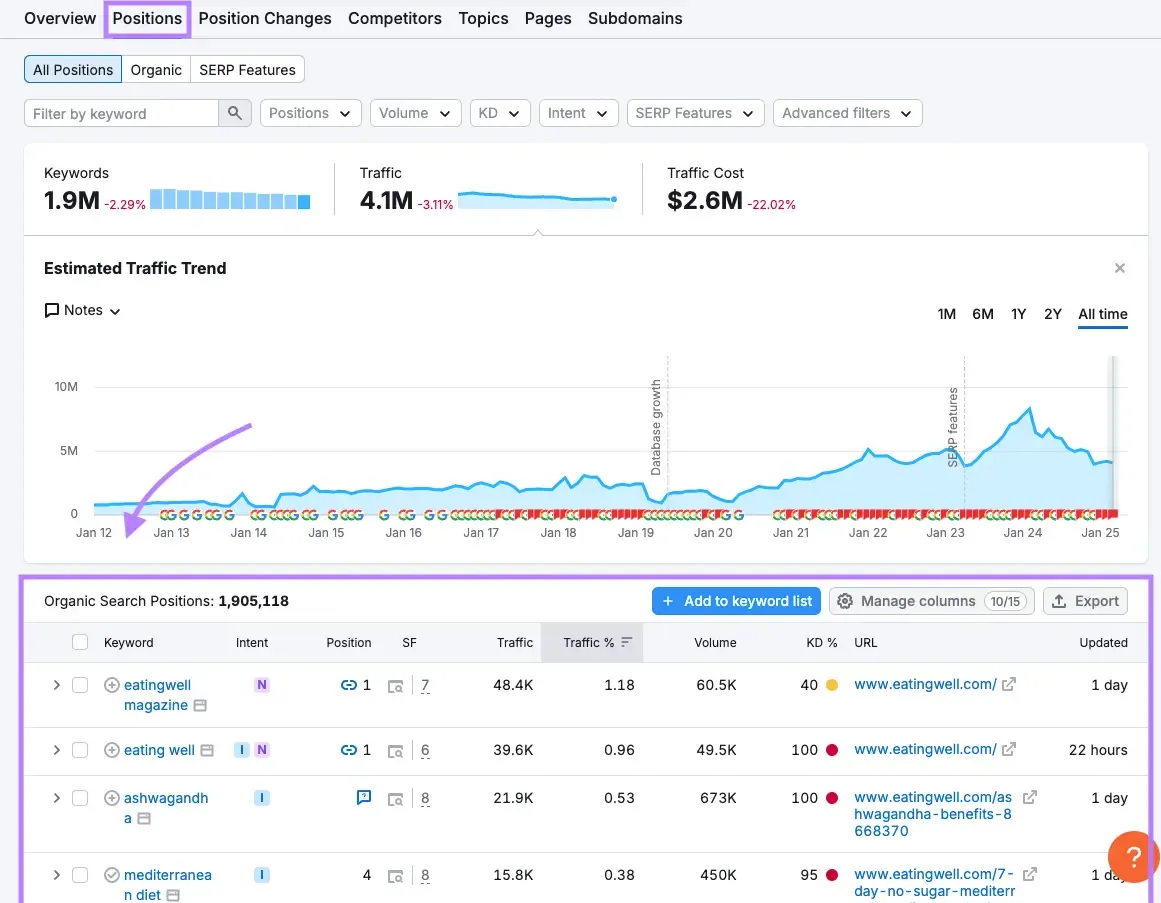
Why guess what works when your competitors have already provided the roadmap? You can use the Organic Research suite (specifically the Organic Rankings tool) to see exactly where your rivals are finding success with minimal effort.
Using the Organic Research Tool
1. Enter a competitor's domain into the main search bar and select the Organic Research tool.
2. Navigate to the Positions tab.
3. Set a filter for Volume (minimum 100). This ensures you aren't wasting time on terms no one searches for.
4. Set the KD% filter to "Easy."
This reveals the specific keywords where a competitor is gaining traffic despite the low difficulty. It’s essentially a list of successful experiments you can now replicate and improve upon.
The Keyword Gap Tool: Finding the "Missing" Gold
To take this further, use the Keyword Gap tool to find "Missing" keywords. These are terms that all your competitors rank for, but you don't.
1. Enter your domain and up to four competitors.
2. Click Compare.
3. Apply the Missing filter.
4. Sort by KD% (Easy).
This identifies the blind spots in your current strategy. If multiple competitors are ranking for an "Easy" term that you haven't even targeted, that’s your highest-priority content opportunity.
Method 3: Discovering Emerging and Community-Driven Keywords
The most profitable low-competition keywords are often those that haven't even hit the mainstream radar yet. These "emerging" terms are found where your audience actually hangs out: industry forums, Reddit, Quora, and YouTube comment sections.
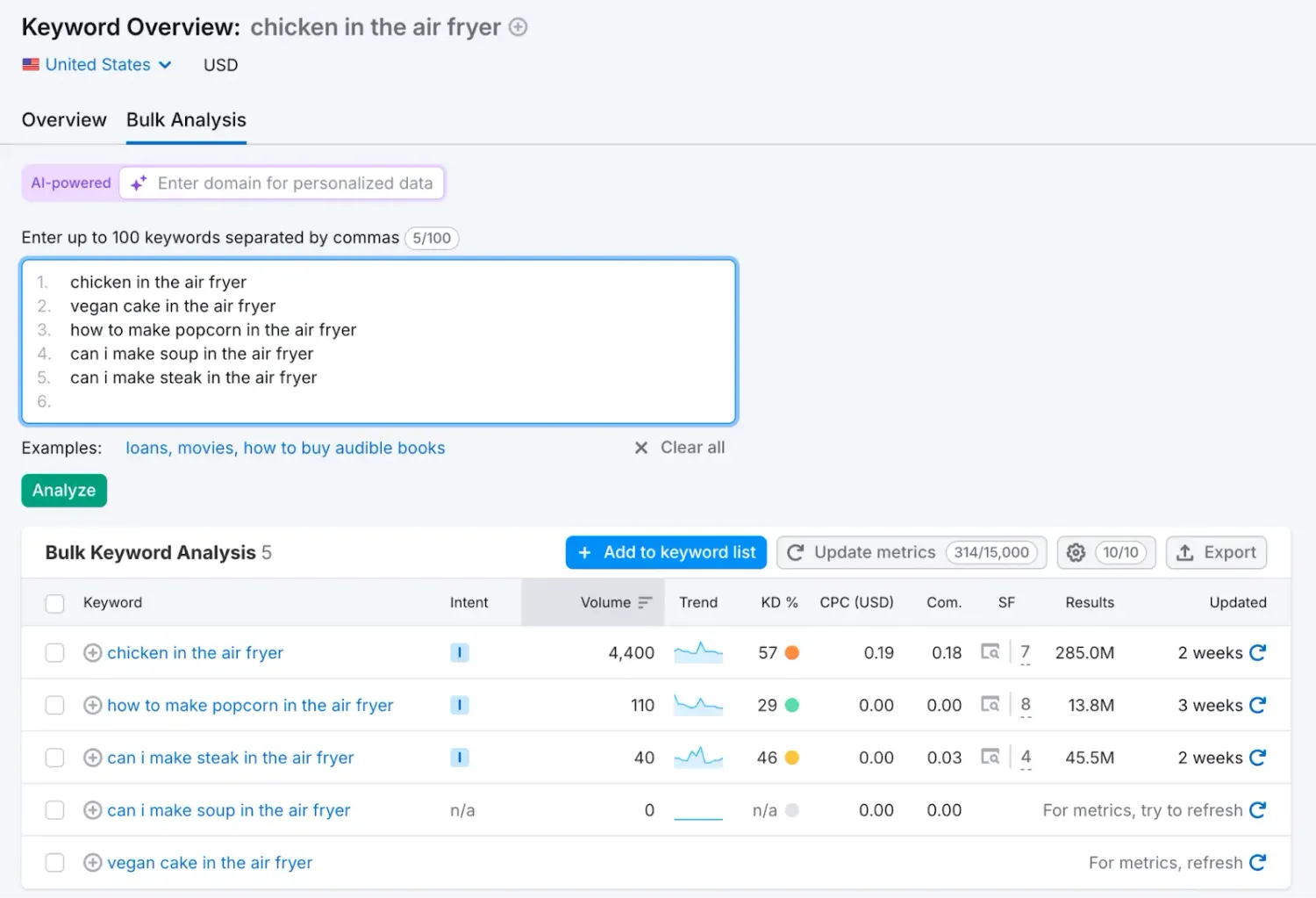
Look for recurring pain points or new terminology. Once you have a list of raw findings "from the wild," use the Keyword Overview tool's bulk analysis feature to validate them. You can upload up to 100 keywords at once to get instant data.
When analyzing the bulk report, look for:
Search Volume: Even a volume of 50-100 is excellent if the keyword is highly specific.
SERP Features: Are there featured snippets or "People Also Ask" boxes? These are opportunities to take up more real estate.
Trends: Look for an upward trajectory. If you catch a trend early, you can establish authority before the difficulty score spikes.
Personal Keyword Difficulty: For a truly cutting-edge approach, enter your URL into the Keyword Overview AI-powered search bar. This provides a "Personal KD," showing you exactly how hard a term will be specifically for your domain based on its current strength.
Method 4: Automated Clustering with Keyword Strategy Builder
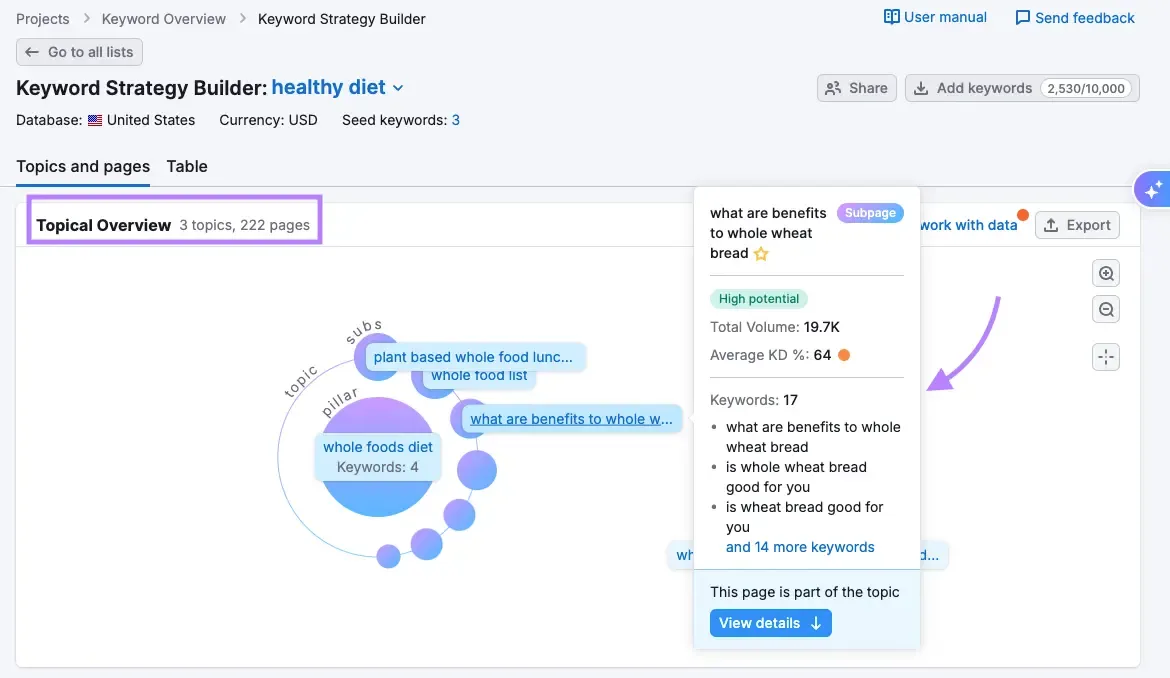
Modern SEO isn't about single pages; it's about "Topic Clusters." To rank for a low-competition term, it helps to show Google you are an authority on the broader subject. The Keyword Strategy Builder automates this complex process.
The Step-by-Step Walkthrough:
1. Enter Seed Keywords: Input up to five seed keywords that define your niche.
2. Analyze the Topical Overview: The tool will generate a visual layout. You’ll see clusters, visualized as "bubbles", of related topics. This layout helps you see the relationship between keywords at a glance.
3. Apply the "Easy Start" Filter: This is the game-changer. By toggling "Easy Start," the tool automatically rearranges your clusters to prioritize pages that can be built using low-competition keywords. It essentially builds your content calendar for you.
4. Export to Action: Hover over a cluster to see the metrics, then send these topics directly to the Content Toolkit. This moves your research from a spreadsheet into a live writing workflow.
Critical Analysis: Metrics Beyond Keyword Difficulty
A 15% KD score doesn't guarantee a win. As a strategist, I look at two other critical metrics to ensure a keyword is actually worth the investment.
Search Intent: The "Why" Behind the Query
If you ignore intent, you are wasting your time. There are four primary types of intent:
Informational: The user wants an answer (e.g., "how to audit content").
Navigational: The user wants a specific site (e.g., "myfitnesspal login").
Transactional: The user is ready to buy (e.g., "buy SEO software").
Commercial: The user is researching before a purchase (e.g., "best SEO tools 2024").
The Trap: A keyword like "myfitnesspal login" might have a low KD, but ranking for it is useless if you aren't MyFitnessPal. The user intent is navigational; they will leave your site immediately. Conversely, "easy meal prep for weight loss" is a high-value commercial term. Match the content to the intent, or you'll see high bounce rates and zero conversions.
Cost Per Click (CPC): The Value Signal
If a keyword has low volume and low difficulty, check the CPC. If advertisers are willing to pay $10.00 or more for a single click on a low-volume term, it means that the keyword is highly profitable. These are the ultimate "hidden gems", terms that don't look impressive in a volume report but drive high-ticket sales.

Frequently Asked Questions
What Are Low-Competition Keywords and Why Are They Important?
Low-competition keywords are search terms with less competition that you can feasibly rank well for without having to battle many established competitors. In the SEO world, these are often called “low-hanging fruit” because they are popular enough to drive traffic but are not yet highly targeted by other websites.
Targeting these keywords is important because:
Ranking potential: Most Google keywords are becoming increasingly competitive; finding "hidden gems" gives websites a realistic chance to appear high in search results.
Traffic growth: Creating useful content around these terms boosts organic (unpaid) traffic and visibility without the need for paid advertisements.
Strategic efficiency: It allows you to build a content plan focused on reachable goals rather than wasting resources on keywords that are currently unreachable for your site.
How Can Semrush Help You Find Low-Competition Keywords?
Semrush provides a variety of tools and specific metrics to simplify this process:
Keyword Difficulty (KD %): This metric reveals how challenging it is to rank for a term on a scale of 0 to 100. The lower the number, the easier the keyword is to rank for.
Keyword Magic Tool: This tool allows you to enter a seed keyword and then filter the results by "Questions" or set specific KD % ranges to find easy-to-rank terms.
Organic Rankings & Keyword Gap: These tools allow you to analyze the keywords your competitors already rank for and identify "missing" opportunities where they are successful, but you are not yet present.
Keyword Strategy Builder: This tool automates the process by grouping keywords into clusters and using an "Easy Start" filter to prioritize low-competition topics.
When Should You Target Low-Competition Keywords?
You should prioritize low-competition keywords in the following scenarios:
New Websites: When your site is brand new and lacks the authority to compete with established domains.
Entering New Markets: When you are expanding into a niche where you don't yet have a foothold.
Seeking Quick Wins: When you want to see a faster boost in organic traffic by targeting "low-hanging fruit".
Niche Targeting: When you want to target specific user needs, such as niche questions that may have lower volume but high relevance to your business.
Where to Look for Low-Competition Keywords in Semrush?
There are several specific locations within the Semrush platform to find these opportunities:
The "Questions" filter in Keyword Magic Tool: Questions are often lower competition than broad head terms.
The KD % Filter: Setting this filter to "Easy" (often a KD % around 15% or lower) helps filter out "unreachable" keywords.
Competitor "Positions" Report: By entering a competitor’s domain into Organic Rankings, you can see their top-ranking keywords and identify those with low KD %.
Keyword Strategy Builder's "Topical Overview": This provides a visual layout of recommended topics, where you can hover over clusters to see difficulty metrics.
Why Use Semrush for Low-Competition Keyword Research?
Semrush is highly effective for this research because it goes beyond simple volume metrics:
Comprehensive Data: The Keyword Magic Tool covers "every keyword under the sun" related to your topic.
Personalized Metrics: Users can enter their URL to get Personal Keyword Difficulty scores, which tailor the difficulty metric to their site's specific authority.
Intent Analysis: Semrush identifies search intent (Informational, Navigational, Transactional, or Commercial), ensuring you don't just find "easy" keywords, but keywords that actually match your business goals.
Commercial Value: It provides Cost Per Click (CPC) data; a high CPC on a low-competition keyword can signal a high-value "hidden gem" that advertisers are willing to pay for.
Final Summary and Strategic Takeaways
Finding low-competition keywords is the most reliable way to bypass the "authority wall" and start ranking immediately. By utilizing the Keyword Magic Tool for long-tail questions, reverse-engineering competitors via Organic Research, and leveraging the Keyword Strategy Builder, you can build a sustainable traffic engine from scratch.
Strategic Takeaways:
1. Focus on Specificity over Volume: Question-based queries and long-tail phrases represent users with higher intent and much lower competition levels than broad head terms.
2. The "Easy" Filter is Your Friend: Don't target 0% difficulty keywords that are "weird" or valueless. Target the 15-29% "Easy" range for the best balance of commercial value and rankability.
3. Verify Search Intent First: Difficulty is a technical metric; intent is a human one. Never build a page for a keyword until you are certain your content matches exactly what the user is looking for.
Don't wait for your domain authority to grow on its own. Deploy the 7-day Semrush trial today, run these reports, and start claiming the low-hanging fruit in your niche.


Ako Reviews Blog is a platform dedicated to helping online businesses reach their full potential. It offers in-depth guides on product reviews, social media marketing, and comprehensive online business strategies. Whether you're an entrepreneur or a marketer, Ako Reviews Blog provides practical tips and expert insights to help you grow and succeed in the digital marketplace.
Stay informed with valuable tips delivered straight to your inbox.
Created with systeme.io 2026 | Home | Privacy Policy | Terms and Conditions | Disclaimer | Contact