
Wobo AI Review: Is This the End of Manual Job Hunting?
The Modern Job Search "Black Hole"
Let’s be honest: the modern job search is a soul-crushing endurance test that most of us are losing. If you’ve looked for a role in the last year, you know exactly what I’m talking about. You spend your Sunday nights hunched over a glowing screen, meticulously tweaking bullet points on a resume that you’ve already edited fifty times. You craft "personalized" cover letters that feel increasingly like creative fiction, only to hit the "Submit" button and watch your effort vanish into a digital void. This is the "Application Black Hole," and it is the primary reason for the "application fatigue" currently sweeping the professional world.
Here’s the thing about the black hole: it’s not just a lack of response; it’s the systematic dehumanization of the hiring process. Most companies today use Applicant Tracking Systems (ATS) like Greenhouse or Lever to filter out 75% of candidates before a human recruiter even blinks. For the job seeker, this creates a desperate volume game. You’re told to "tailor every application," but when you’re applying to a hundred jobs to get a single interview, the math simply doesn't add up. You are a human being trying to fight a war against algorithms using a butter knife.
This is where Wobo AI enters the frame. Positioning itself as your "Personal AI Recruiter," Wobo AI is designed to flip the script entirely. Instead of you spending forty hours a week acting like a data entry clerk for various corporate HR portals, Wobo AI acts as your representative in the digital marketplace. The core value proposition is radical: it finds, vets, and applies to jobs for you while you sleep. We aren't talking about a simple scraper that sends out "Easy Apply" blasts; we are talking about a sophisticated system designed to bridge the gap between your unique professional history and the cold, hard requirements of the ATS.
In this review, we’re going to peel back the layers of Wobo AI to see if it actually delivers on the promise of reclaiming your career journey. Is this just another layer of tech-fueled noise, or is it the ultimate equalizer in the war against "ghost listings" and automated rejections? Let's dive into the mechanics of the "Digital Twin" and see if manual job hunting is finally a relic of the past.
What is Wobo AI? (The High-Level Overview)
To understand Wobo AI, you have to move past the idea of it being a "bot." Most of us have tried basic automation tools that just fill in our names and emails on forms. Wobo is fundamentally different because it operates on the concept of the "Digital Twin." Think of it this way: the software doesn’t just store your data; it builds a comprehensive AI persona that understands the nuances of your professional voice, your technical stack, and your career trajectory.
When you use a generic AI like ChatGPT to write a resume, the output often sounds like a robot trying to pass as a human, with lots of "synergy," "passionate," and "results-oriented" filler. Wobo AI’s Digital Twin is built to avoid this by mapping your actual experiences to the specific linguistic markers recruiters look for in high-tier industries like tech, marketing, and engineering. It is a "Job Search Assistant" that works on your behalf, 24/7, ensuring that every application it sends out looks like you spent hours on it, even if you were actually at the gym or playing with your kids.
The Wobo AI suite is divided into four primary pillars, each designed to tackle a specific failure point in the traditional job hunt:
AI Job Application: This is the flagship automation engine. It isn't just about finding jobs; it’s about the execution. It handles the "auto-apply" loop, generating personalized resumes and cover letters for each specific role and navigating the submission process without your manual intervention.
AI Resume Builder: This tool moves away from the "one-size-fits-all" document. It creates ATS-optimized resumes that are dynamically tailored to every job. It identifies the "Focus Keywords" required for a specific posting and ensures your experience is framed through that lens.
AI Cover Letter Generator: No one likes writing cover letters, and frankly, most recruiters don't like reading them, unless they are actually good. This generator produces job-specific, persona-driven letters in about 30 seconds. It skips the templates and focuses on the "Why You?" factor.
ATS Resume Checker: This is the diagnostic heart of the platform. It scores your resume against 24+ specific ATS criteria. This isn't just a spellcheck; it’s a technical audit that identifies why your resume might be getting filtered out by the algorithms used by the world's biggest companies.
The Four-Stop Journey: How Wobo AI Actually Works
Wobo AI has distilled the chaotic job search into a structured "Four-Stop Journey." As a tech journalist, I appreciate this because it moves away from the "black box" approach and provides a transparent narrative of how the AI actually moves a candidate from "searching" to "interviewing."
Stop One: Creating Your AI Persona
The journey begins with an onboarding process that is refreshingly brief. You aren't asked to fill out twenty pages of forms. Instead, you upload your current CV and engage in a targeted chat with Wobo AI. This is the "last form you’ll ever fill out." During this phase, the AI isn't just parsing your text; it’s analyzing your background to build your AI Persona.
Editorial Note: The reason this step is so critical is that it establishes your "writing style" and your "technical baseline." If you're a Python developer who prefers a direct, no-nonsense communication style, the AI needs to know that so it doesn't send out a cover letter that sounds like a bubbly marketing intern.
Stop Two: Scanning the Market
Once your persona is established, the "Daily Scan" begins. Wobo AI doesn't just look at LinkedIn or Indeed; it scans over 50 live sources, monitoring a database of 3M+ jobs. However, the quantity isn't the headline here, the vetting is.
We’ve all seen the "Ghost Listing" phenomenon: a job posted on a board that either doesn't exist, was filled three months ago, or is just a data-harvesting exercise. Wobo AI verifies "company signals" before any job ever hits your feed. By the time you wake up and check your dashboard, you’re looking at a curated list of live, active roles from top-tier companies like Spotify, Netflix, OpenAI, SpaceX, and Figma. It’s the difference between looking at a haystack and being handed the needle.
Stop Three: The "Swipe Right" Application
The user interface for the job matches feels more like a modern discovery app than a spreadsheet. You are presented with "Match Cards" that give you everything you need to know in a five-second glance.
Each card shows:
Wobo Score: (e.g., a "92% Strong Fit") based on how your persona matches the job description.
Salary Range: Real data points (e.g., $180k – $230k) so you don't waste time on roles below your bracket.
Company Ratings: Granular data on Comp & Benefits, Work-Life Balance, and Culture.
Tech Stack Requirements: A clear list of must-haves, like "Python, React, and Microservices."
If you like what you see, you simply tap "Apply with AI" or drag the card to the right. The system then takes over, generating the custom assets and submitting them.
Stop Four: Waking Up to Results
This is where the psychological shift happens. Instead of starting your day with the dread of "I need to find jobs to apply to," you wake up to notifications of progress. The "morning after" experience with Wobo often involves seeing that your application moved forward at Netflix, an interview was scheduled at Figma, or an acknowledgement was received from Lyft. Because the AI handled the "upload resume -> paste resume -> write cover letter" loop while you were asleep, your only job is to prepare for the conversations that follow.
Deep Dive: The AI Resume Builder & ATS Resume Checker
If you’re wondering why your manual applications are failing, the answer is likely found in the ATS Resume Checker. Let’s look at the technical reality: modern ATS software doesn't "read" resumes like humans do; it "parses" them. If your headers are formatted incorrectly, or if your keyword density is off, you are invisible.
The Technical Audit (24+ Criteria)
The Wobo ATS Resume Checker scores your document across 24+ specific criteria. From a tech journalist’s perspective, these likely include:
Parsing Compatibility: Ensuring the text is readable by standard algorithms.
Keyword Alignment: Matching the frequency of skills (like "Agile" or "SQL") to the job description.
Measurable Impact: Identifying if you have enough numbers and data points.
Formatting Hygiene: Checking for complex layouts that break ATS parsers.
The Sarah Johnson Walkthrough
To see how this works in practice, let's look at a hypothetical walkthrough based on the user "Sarah Johnson," a Product Manager. When Sarah uses the AI Resume Builder, she doesn't just type in her history. She sees an interface with a "Focus Keyword" input box. If she’s applying for a role that emphasizes "A/B Testing" and "Design Systems," she enters those as keywords.
The Wobo AI then presents an "AI Suggestions" sidebar. For her role at Acme Inc., it might suggest: "Developed wireframes and prototypes that improved client feedback cycles by 40%." This is the "secret sauce." It turns a basic task into a high-impact accomplishment. For a grad-level marketing applicant, this means the tool can take a line like "Posted on social media" and rewrite it into: "Managed social media presence for 3 brands, increasing engagement by 22% through data-driven content strategy." This is how you beat the filter.
Deep Dive: The AI Cover Letter Generator
The cover letter is often the most significant bottleneck in the job search. Most candidates either send a generic template that screams "I don't care," or they spend an hour writing something that never gets read. Wobo’s AI Cover Letter Generator attempts to solve this by focusing on speed (30 seconds) and persona-driven specificity.
The "Typical AI" vs. "Wobo Persona" Comparison
Let's look at the linguistic differences using a Spotify Product Manager role.
Typical AI Output: "I am a highly motivated professional with a proven track record of delivering results. I believe my skills and experience align perfectly with the requirements of this position. I am passionate about contributing to a dynamic, forward-thinking team..."
Recruiter’s Verdict: Trash. This is filler. It says nothing about the candidate's actual ability to do the job at Spotify.
Wobo Persona Output: "I've spent three years at Spotify managing product launches, usually with 12 to 15 people who all report to different managers. The hardest part isn't the timeline; it's getting engineering and marketing to agree on what 'ready' means. I got good at figuring that out early so we don't end up in a room two days before launch arguing about it..."
Recruiter’s Verdict: Interesting. This candidate understands the "matrix organization" pain points of a big tech company. They mentioned "distributed teams" and defined "ready", high-level competencies that suggest they've actually been in the trenches.
The Wobo version works because it adopts a "Human-to-Human" conversational tone. It uses specific numbers and addresses the "unspoken" requirements of the job posting. This is why Wobo’s Digital Twin concept is so powerful: it mimics the way a seasoned professional actually speaks in a high-stakes interview.
Feature Analysis: Auto-Apply and the "Autopilot" Plan
For many job seekers, the Autopilot plan is the core attraction. This feature automates the most repetitive part of the hunt: the data entry. When you find a job you like, Wobo doesn't just give you a link; it uses your persona to handle the entire application process on your behalf.
Think of it this way: the standard application takes about 15–20 minutes of "uploading, re-pasting what was in the upload, and typing a letter." If you're applying to 10 jobs a day, that’s over three hours of clicking buttons. The Autopilot plan reduces that work to zero.
The Nick Brown Case Study: Why Timing Matters
Let’s look at the experience of Nick Brown. Nick works the night shift at a fulfillment center, 6 pm to 6 am. In the traditional job market, Nick was at a massive disadvantage. By the time he woke up at 3 pm, the "hot" jobs posted at 9 am already had 400 applicants. Recruiters often stop looking after the first 100.
By using Wobo, Nick was able to have the AI apply during "normal" business hours while he was either at work or asleep. In five weeks, Wobo sent 195 applications for him. The results? Six callbacks and two interviews. Nick didn't have to change his life or sacrifice sleep; he simply leveraged the AI to act as his representative during the hours when recruiters are actually active. This is a game-changer for anyone working non-standard hours or managing a current full-time role while trying to exit.
Real-World Results: User Success Stories
The true measure of any career tool isn't its UI, it's the results. Wobo AI holds a 4.7/5 rating on Reviews.io, and the stories behind those numbers reveal a lot about the tool's versatility.
The Family Man (Tony)
Tony was a Product Manager who found himself trapped in a cycle of "secondary labor." He would work all day, spend time with his son, and then spend two hours every night, from 9 pm to 11 pm, applying for jobs. This led to a predictable result: extreme burnout and a strained relationship with his wife.
Wobo gave Tony back his evenings. In eight weeks, the AI applied to 275 jobs. The sheer volume, combined with the quality of the "Digital Twin" applications, resulted in 14 interviews. Tony was able to spend those two hours every night with his family, knowing that his career progression was being handled by a system that didn't get tired. This highlights the psychological impact of Wobo: it removes the guilt of "not doing enough" in your search.
The Skill-Builder (Sarah)
Sarah, a Full-Stack Developer, faced a different problem. She knew her portfolio wasn't quite where it needed to be to land a dream role at a place like Netflix or Airbnb. She faced the "impossible choice": spend her time applying to jobs or spend her time building the projects that would actually get her hired.
She chose to let Wobo handle the applications for three months. While the AI was busy scanning the market and submitting tailored resumes, Sarah was heads-down in her IDE, building complex projects. By the time the callbacks started rolling in, she was actually a better developer than when she started. Wobo allowed her to focus on "skill acquisition" while it handled "market acquisition."
The Career Pivoter (JJ and Caitlyn K.)
For those who haven't searched for a job in decades, the modern landscape is terrifying. JJ hadn't updated a resume since the early 2000s. He was terrified of sounding like "cringeworthy corporate speak" or being seen as outdated. Wobo's AI Builder walked him through the modernization process without stripping away his experience.
Similarly, Caitlyn K. had tried tools like Zety and ChatGPT but found them useless for specialized engineering roles. They gave generic advice like "be a team player." Wobo, on the other hand, understood that for an engineer, the "quantifiable impact" of their tech stack is what matters. It helped her emphasize the specific results of her projects, which is the only language technical recruiters truly speak.
Wobo AI vs. The Competition
When we talk about the job search market, we have to talk about the giants: LinkedIn, Zety, Resume.io, and Rezi. How does Wobo stack up?
The "LinkedIn Easy Apply" Trap
LinkedIn’s "Easy Apply" is the junk food of the job search. It feels good to click the button, but you’re often just adding your name to a pile of 1,000 other people who did the exact same thing. There is zero personalization. Wobo AI is the "Fine Dining" version of this. It takes the ease of one-click applying but adds a layer of deep tailoring and ATS optimization that LinkedIn simply doesn't provide.
The Template Builders (Zety, Resume.io)
Platforms like Zety and Resume.io are essentially "static" tools. They help you build a pretty PDF, but they don't help you find the job, and they certainly don't apply for you. Users like Serena have noted that Wobo’s builder is superior to even specialized tools like Rezi because it is both more intuitive and better at the actual "tailoring" aspect. While Rezi focuses heavily on the technical format, Wobo focuses on the content and the submission.
In a narrative sense, Wobo is an "active" partner, while the others are "passive" tools. Wobo doesn't just give you the hammer; it builds the house for you.
Why It Works: The War Against "Ghost Listings"
One of the most insidious trends in modern hiring is the "Ghost Listing." These are jobs that appear on boards but aren't real. Maybe the company is just "collecting resumes for the future," or maybe they’ve already hired internally but are legally required to post the role.
Wobo AI fights this by verifying "company signals." Before a job is presented to you, Wobo's algorithms look for signs of life:
Is the company actually hiring in this department?
Are there recent "hiring" signals from the company's HR team?
Does the listing appear on the company's official career page?
By vetting these 3M+ jobs and filtering them through 50+ sources, Wobo ensures that if you see a match for a company like Stripe, Airbnb, or Anthropic, it is an opportunity worth your emotional energy. This is a massive time-saver, as it prevents you from spending hours on applications that will never be seen by a human.
Frequently Asked Questions (FAQ)
Is Wobo legit?
Absolutely. Wobo AI is a legitimate "AI Recruiter" platform that has been recognized as a Product of the Day on Product Hunt and maintains a high rating (4.7/5) on Reviews.io. It is backed by a professional team in Brooklyn, NY, and is used by thousands of seekers to land roles at major tech firms.
How is this different from LinkedIn Easy Apply?
As mentioned, LinkedIn Easy Apply is a generic blast. Wobo AI creates a "Digital Twin" of you, ensuring that every application is custom-tailored, ATS-optimized, and includes a persona-driven cover letter. It’s the difference between a mass-produced flyer and a hand-delivered letter.
Can users review applications before they are sent?
Yes. While the system can run on Autopilot, you are never "out of the loop." You can review matches, see your Wobo Score, and check the assets before they go out. You retain final editorial control over your career.
Does it work outside the US?
Yes. Users like Sabrina have used Wobo to break into global opportunities. The AI is designed to understand various market standards, making it effective for those looking to relocate or work for international firms.
Pros and Cons
Pros of Wobo AI
Automated Job Search & One-Swipe Applying: Wobo scans over 3 million jobs daily across 50+ live sources. It automates the application process while you sleep or work, eliminating repetitive manual form filling.
100% Pre-Vetted Listings: Verifies company signals before any job is added to your feed, ensuring there are no ghost listings.
Personalized Wobo Persona ("Digital Twin"): Unlike standard generic AI templates, Wobo creates customized application answers and cover letters tailored to your experience and written specifically in your personal voice.
Integrated Suite of Job Search Tools: Includes an AI Resume Builder (tailors resumes and quantifies achievements), an AI Cover Letter Generator (creates job-specific letters in 30 seconds), and an ATS Resume Checker (scores resumes across 24+ ATS criteria).
Transparent Matching & Company Insights: Displays match scores, salary estimates, work-life/culture ratings, and employee benefits before you submit an application.
Free Plan & Positive User Reviews: Offers free tools and a free plan with no credit card required, holding a 4.7 out of 5 rating based on 282 reviews on Reviews.io.
Cons & Limitations
Review & Oversight Needed: Users indicate that while automation handles application delivery, you still need to review matches and monitor where applications are being sent.
Full Automation Requires an Upgrade: Although core tools and a basic plan are free, full automation features (such as the Autopilot plan) require upgrading.
Initial Setup Required: You must first upload your CV, answer background questions, and configure your persona details before the system can automate applications on your behalf.
Getting Started: Pricing and Onboarding
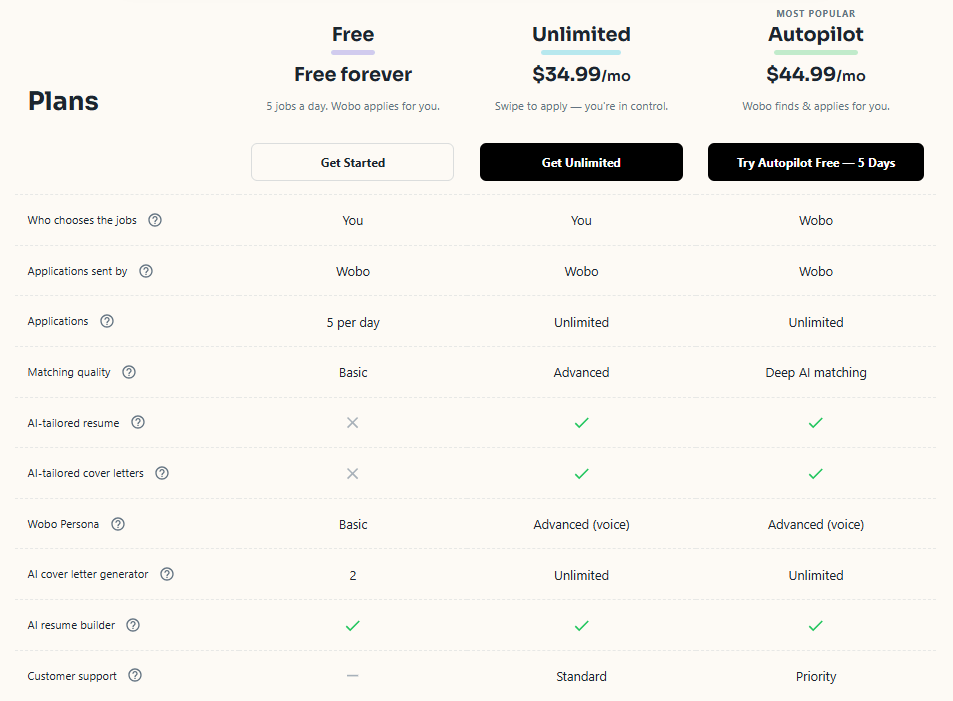
The barrier to entry for Wobo AI is intentionally low. You can start for free with no credit card required. This allows you to test the AI Resume Builder and the ATS Resume Checker to see exactly where your current job search is failing.
The onboarding is a 2-minute process:
Upload: Feed the AI your current resume.
Chat: Answer a few questions about your goals and salary expectations.
Persona: Let Wobo generate your "Digital Twin."
From there, you can choose to stay on the free tier or upgrade to the Autopilot plans to start the automated application process.
The Verdict: Is Manual Applying Dead?
Let’s be honest: the era of the manual job search is over. The "Black Hole" was created by technology, and it can only be solved by technology. We are currently in a recruitment arms race where companies are using sophisticated AI to filter you out. If you aren't using a tool like Wobo AI to fight back, you are essentially trying to outrun a supercar on foot.
The "Personal AI Recruiter" isn't just a convenience; it’s a necessity for anyone who values their time and mental health. Whether you’re a parent like Tony, a night-shift worker like Nick, or a developer like Sarah, Wobo AI offers a way to level the playing field. It takes the soul-crushing "secondary labor" out of your life and replaces it with a streamlined, automated path to the only thing that matters: the interview.
Don't spend another Sunday night staring at a blank cover letter. Stop searching, start landing, and reclaim your career journey today.


Ako Reviews Blog is a platform dedicated to helping online businesses reach their full potential. It offers in-depth guides on product reviews, social media marketing, and comprehensive online business strategies. Whether you're an entrepreneur or a marketer, Ako Reviews Blog provides practical tips and expert insights to help you grow and succeed in the digital marketplace.
Stay informed with valuable tips delivered straight to your inbox.
Created with systeme.io 2026 | Home | Privacy Policy | Terms and Conditions | Disclaimer | Contact